




Mappa Interattiva - dove le persone incontrano le attività
If Beijing tells the story of China's imperial soul, Xi'an preserves its origins.
Once the capital of thirteen dynasties and the eastern starting point of the Silk Road, Xi'an is one of the most important cities in Chinese history. Yet there is one site that has made Xi'an famous around the world more than any other.
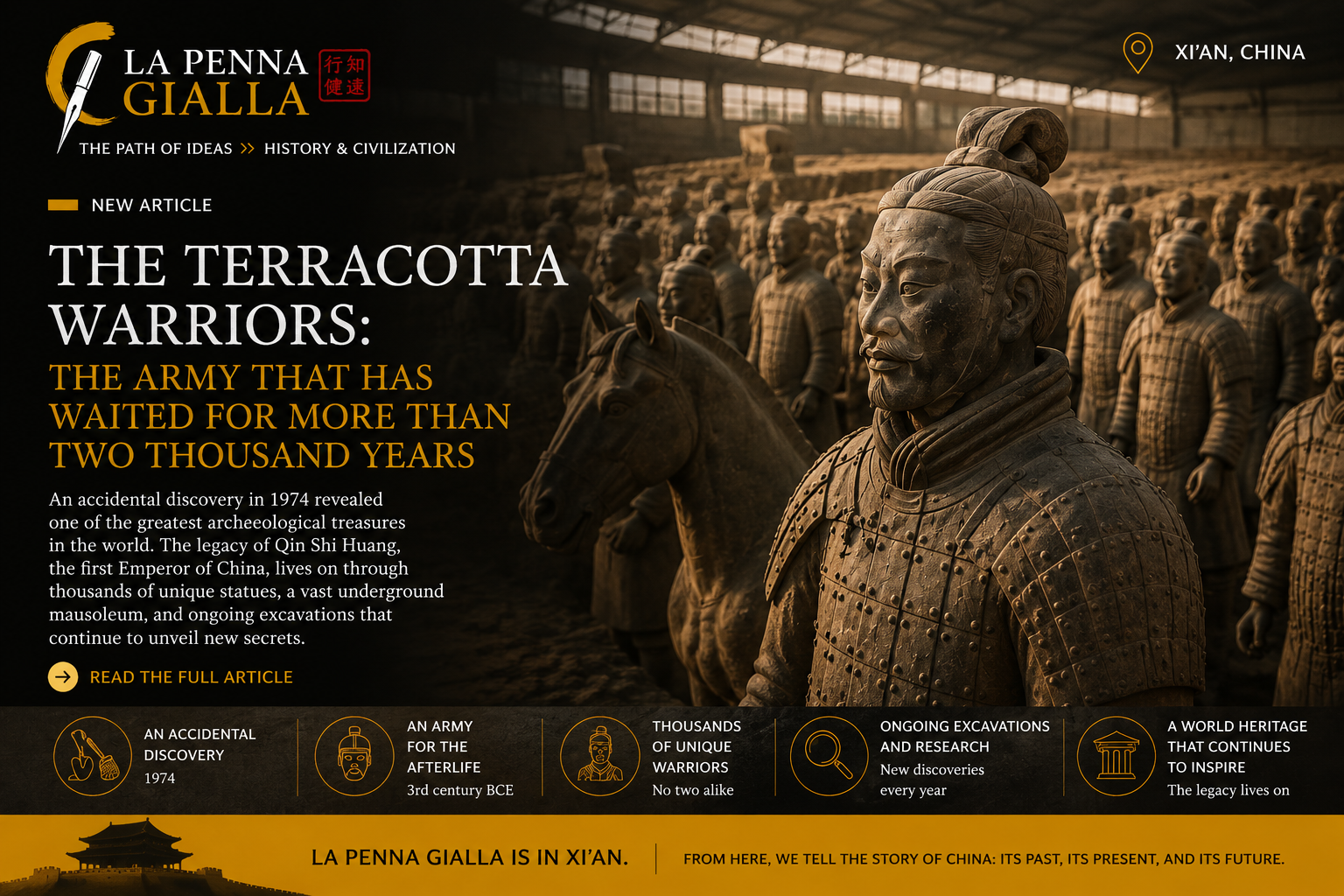
A silent army.
Thousands of soldiers standing in formation, ready for battle.
And yet, none of them ever fought.
For more than two thousand years they have waited beneath the soil of central China, guarding the eternal resting place of the emperor who unified the nation.
They are the Terracotta Warriors.
An Accidental Discovery That Changed Archaeology
Their modern story began in 1974.
A group of local farmers was digging a well in the fields of Shaanxi Province when they uncovered fragments of terracotta.
At first, no one could have imagined what lay hidden beneath the ground.
Archaeologists were called to investigate and soon found themselves facing an extraordinary discovery.
Hundreds of life-sized statues began to emerge.
Then thousands.
Soldiers, archers, officers, horses, and war chariots.
An entire army buried for more than twenty centuries.
The discovery was quickly recognized as one of the most important archaeological finds of the twentieth century.
The Emperor Who Wanted to Live Forever
To understand the significance of the Terracotta Warriors, we must travel back to the third century BCE.
At that time, China was divided among rival states that had been at war for generations.
It was Qin Shi Huang who finally brought this era to an end.
In 221 BCE, he unified the territory and became the first Emperor of China.
His influence was immense.
He standardized the writing system, currency, and units of measurement, laying the foundations of what would become the Chinese Empire.
But like many powerful rulers throughout history, he was obsessed with immortality.
To prepare for the afterlife, he ordered the construction of a vast funerary complex.
A necropolis designed to accompany him into eternity.
The Terracotta Army was part of that grand vision.
No Two Faces Are the Same
One of the most astonishing aspects of the Terracotta Warriors is the extraordinary level of detail.
Each soldier possesses unique features.
Faces, hairstyles, expressions, beards, armor, and body postures vary from one figure to another.
Many scholars believe that the craftsmen drew inspiration from real soldiers serving in the imperial army.
Walking among the warriors feels less like observing statues and more like meeting people frozen in time.
Some appear to be young recruits.
Others look like experienced veterans.
Still others resemble officers commanding their troops.
These are not simply sculptures.
They are a snapshot of the army that built a unified China.
Far More Than an Army
For many years, people assumed that the discovery was limited to the famous excavation pits open to visitors today.
In reality, the funerary complex is immense.
Archaeologists have uncovered:
- horses,
- war chariots,
- civil officials,
- musicians,
- acrobats,
- animals,
- and remarkably preserved weapons.
Everything that the emperor might need in the afterlife.
Researchers believe that a significant portion of the mausoleum remains unexplored.
Most remarkably, the central tomb of Qin Shi Huang has never been opened.
According to ancient historical records, it may contain miniature rivers and seas made of mercury, along with a representation of the entire empire.
Even today, archaeologists prefer to wait.
Current technology may not yet be capable of preserving the treasures that could lie within.
A Heritage Site That Continues to Reveal New Secrets
What makes the Terracotta Warriors so fascinating is that their story is still being written.
Every year, new technologies and research methods provide information that was once unimaginable.
Three-dimensional scanning, digital reconstruction, and advanced archaeological analysis are helping scholars better understand:
- how the warriors were produced,
- how thousands of craftsmen were organized,
- where the materials originated,
- and how the vast necropolis was designed.
Large sections of the site remain unexplored.
This means that one of the world's greatest archaeological treasures continues to reveal new discoveries even today.
The Legacy of the First Emperor
Visiting the Terracotta Warriors is about more than archaeology.
It is about standing face to face with the birth of China as we know it.
Every statue tells the story of a ruler determined to build an empire that would last forever.
And perhaps the most fascinating irony is this:
Qin Shi Huang spent his life searching for immortality and never found it.
Yet more than two thousand years after his death, his army still stands guard over his memory.
An army that never fought a war.
But one that conquered history forever.
Iscriviti e fai iscrivere al canale G-channel La Penna Gialla e non perderti le prossime novità
"Inserisci e fai inserire la tua Azienda o l'azienda di prossimità a costo zero".
"Siamo noi il tuo alleato digitale e con un semplice clic il tuo articolo puoi condividerlo su tutte le piattaforme"

I commenti degli utenti:
Non sono presenti commenti di altri utenti