




Mappa Interattiva - dove le persone incontrano le attività
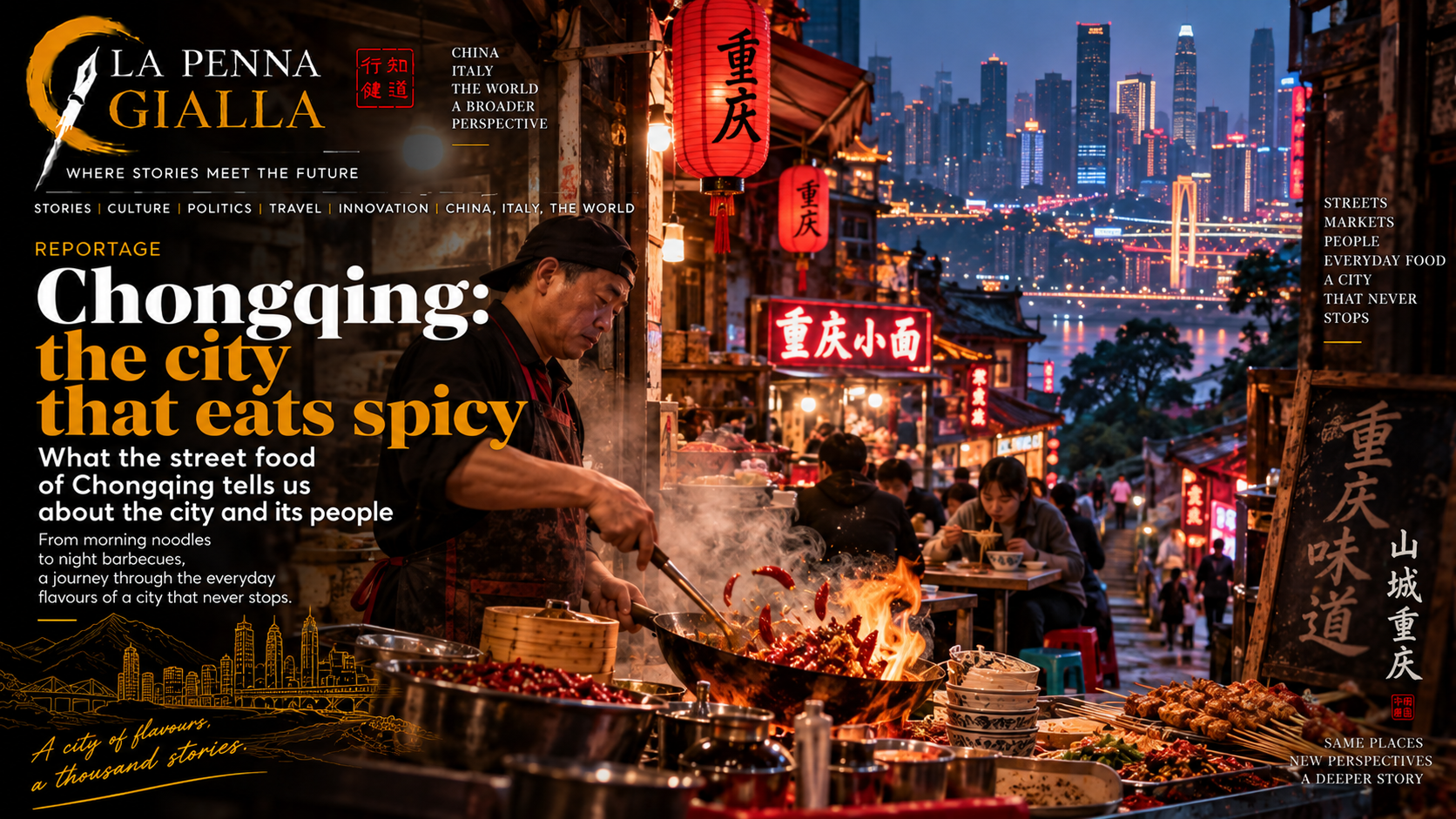
What does Chongqing’s street food tell us about the city and the people who live there every day?
In Chongqing, the day can begin with a bowl of spicy noodles, continue with a quick meal in a neighbourhood restaurant and end around a grill, with skewers arriving one after another as the city lights come on.
The point is not simply that Chongqing likes spicy food.
It is that food seems to follow the rhythm of the city.
Kitchens spill onto streets. Small restaurants become neighbourhood landmarks. Markets, food stalls and late-night grills accompany people as they work, commute, meet friends and return home. Eating is not necessarily an event separated from urban life. Often, it is part of it.
And perhaps this is where Chongqing should be discovered first.
The first bowl of the day
It is still early when the first customers begin arriving at the small noodle shops.
For many, the choice is xiaomian, Chongqing’s everyday noodles and one of the clearest expressions of the city’s food culture. They are not reserved for special occasions. Locals eat them for breakfast, lunch, dinner and even late at night. Small street-side noodle shops can fill up in the morning with workers and commuters looking for something quick, warm and intensely flavoured.
The recipe may look simple.
Wheat noodles, chilli, Sichuan pepper, spring onions, herbs and other seasonings create a bowl in which spiciness is only one part of the experience. There are versions with or without broth, and different toppings can completely change the character of the dish.
That versatility is part of its identity.
Xiaomian is not food for display. It is food for everyday life.
For office workers heading to work, for people beginning an early shift and for residents returning home after time away, the bowl can be something reassuringly familiar. Local sources even describe it as “the people’s food”.
It is perhaps the perfect counterpoint to the spectacular dishes for which Chongqing is internationally known.
Before there is tourism, there is breakfast.
A city that cooks on the street
In Chongqing, the kitchen does not always remain behind a restaurant door.
The wok can sit directly beside the pavement. A grill can be set up outside a small restaurant. The smell of spices can reach people before they have even decided where to eat.
Street cuisine is closely connected with neighbourhood life and includes dishes prepared quickly, often in front of the customer, using familiar ingredients and assertive seasoning. The city’s official culinary guide presents food as something encountered throughout its streets, alleys and waterfronts.
This is also where Jianghu cuisine enters the story.
The term describes a distinctly local culinary tradition rooted in popular food stalls and small restaurants rather than in the formal classification of China’s eight major regional cuisines. Ordinary ingredients are transformed through combinations of seasonings and cooking techniques, creating dishes with a strong local personality.
It is an informal cuisine, but not an insignificant one.
Quite the opposite.
It tells us something about how a city eats when nobody is trying to impress anyone.
Chicken hidden among the chillies
One of its most recognisable dishes is chili chicken.
The concept is almost disarmingly direct: pieces of fried chicken surrounded by red chillies. But the result is much more than heat. The dish combines contrasting textures and flavours, with the seasoning and control of the cooking temperature playing an important role in the final result.
According to Chongqing’s official culinary history, chili chicken was first served at a roadside restaurant called Linzhongle and became popular around Gele Mountain in 1990 before spreading further.
Its story is revealing.
A dish does not necessarily become representative of a city because it was created in a prestigious kitchen.
Sometimes it begins in a roadside restaurant.
It grows through word of mouth, becomes known beyond its neighbourhood and eventually becomes part of the culinary identity of the whole city.
That is very much the spirit of Jianghu cuisine: food with popular roots, strong flavours and no need for ceremony.
Spicy is a language, not a competition
To say that Chongqing food is spicy, however, is not enough.
Chilli is certainly central, but local cooking also plays with aroma, saltiness, texture, fragrance and the particular numbing sensation associated with Sichuan pepper.
The same ingredient can produce very different results depending on how much seasoning is used and how the heat is controlled.
That is why the chilli should not simply be understood as a test of endurance.
It is part of the culinary language.
In chili chicken, for example, the balance between chicken, dried chilli, Sichuan pepper, spring onions and other seasonings is what creates the dish’s character.
The heat is visible.
The flavour is underneath.
When night changes the city
Then evening arrives.
The city lights up and another part of Chongqing’s food culture begins to emerge.
Shaokao, Chinese barbecue cooked over a grill, is strongly associated with the city’s night-time eating culture. Skewers of meat and vegetables are grilled and seasoned with chilli and spices, often outside restaurants or at dedicated stalls. Local sources describe shaokao as a characteristic part of Chongqing’s night markets.
It is a different kind of meal.
There may be no reservation, no elaborate setting and no fixed sequence of courses.
Just a grill, a few skewers and a table that gradually fills.
The food arrives while conversations continue.
The street remains busy.
And dinner can become an extension of the evening rather than its destination.
Chongqing’s current urban policy also reflects the importance of this night-time economy: in summer 2026, the municipality organised more than 200 night-time consumption, tourism, cultural and sports events across the city.
Food is part of that nocturnal landscape.
Eating in a vertical city
There is another reason why food feels particularly connected to the urban experience in Chongqing.
The city is built across hills, rivers and different levels, with streets, stairways, elevated transport and buildings often occupying the same complex urban space.
Food follows that geography.
Along the stairs near Lianglukou, for example, restaurants and eateries occupy both sides of a long route of 209 steps and around 300 metres, with a vertical difference of about 60 metres. Local food found there includes xiaomian and douhua fan.
Here, eating becomes almost part of the journey itself.
You descend.
You climb.
You stop.
You smell something cooking.
You look inside.
You continue.
In Chongqing, the geography of the city can determine the geography of a meal.
The city has more than one flavour
There is also a danger in reducing Chongqing to a handful of internationally recognised dishes.
The municipality is vast, and its food traditions are correspondingly diverse.
In 2026, the “360 Bowls of Chongqing Flavors” initiative showcased dishes from across the city, presenting local specialities from its districts and counties and using food as a way to connect gastronomy with tourism and local economies.
The result is a much broader picture.
There are noodles, grilled foods, fish, chicken dishes, tofu, snacks, sweets and countless local preparations that rarely make it onto an international restaurant menu.
Even within the city, different neighbourhoods can offer different ways of eating.
The famous dishes are only the entrance.
A food street is also a portrait of the city
At Hongyadong, food is woven into one of Chongqing’s most recognisable urban landscapes.
The food street brings together hundreds of traditional specialities, from hot-and-sour sweet potato noodles and glutinous rice balls to tanghulu, chilled rice jelly with brown sugar syrup and spicy dishes.
It is an important distinction.
A place like Hongyadong can certainly be part of the visitor experience, but the broader culinary picture of Chongqing extends far beyond its best-known tourist areas.
The real story is found in the relationship between food and the people who live here.
Between the small noodle shop in the morning and the grill at midnight.
Between the neighbourhood restaurant and the food street.
Between the market, the stairs and the riverside.
Chongqing beyond the famous bowl
After looking at Chongqing through its most famous culinary symbol, it is worth moving away from the centre of the plate.
Because the city cannot be understood through one dish alone.
It can be understood through a bowl of noodles eaten before work.
Through the sound of a wok on a side street.
Through chicken hidden beneath a mountain of chillies.
Through skewers grilled after dark.
Through a small restaurant where people sit, eat and talk without making the meal an occasion.
The most interesting part of Chongqing’s food culture may be precisely this:
it is not a cuisine to observe from a distance. It is a cuisine to move through.
And as Chongqing continues to transform into one of China’s major contemporary cities, its food remains deeply connected to the places where urban life actually happens: the streets, the neighbourhoods, the markets and the everyday routines of its people.
Sometimes, the best way to understand a city is not to book its most famous restaurant.
Sometimes, you simply have to follow the smell coming from the next street.
Iscriviti e fai iscrivere al canale G-channel La Penna Gialla e non perderti le prossime novità
"Inserisci e fai inserire la tua Azienda o l'azienda di prossimità a costo zero".
"Siamo noi il tuo alleato digitale e con un semplice clic il tuo articolo puoi condividerlo su tutte le piattaforme"

I commenti degli utenti:
Non sono presenti commenti di altri utenti