




Mappa Interattiva - dove le persone incontrano le attività
Some companies make products.
Others build infrastructure.
Then there are companies that change the way the world communicates.
Huawei belongs to that last category.
Every day, billions of people make video calls, send messages or browse the internet without ever wondering how that information travels across continents. Behind this apparent simplicity lies a vast network of antennas, fiber-optic cables, servers, software and sophisticated equipment working together every second.
Over the past four decades, Huawei has become one of the companies that helped build much of this invisible digital infrastructure.
For some, it represents the success of Chinese technological innovation.
For others, it has become one of the most debated companies in the geopolitical competition between China and the United States.
Before all the controversies, however, Huawei is a story of engineering, research and long-term vision.
A story that began far from the global spotlight.
📌 Why It Matters
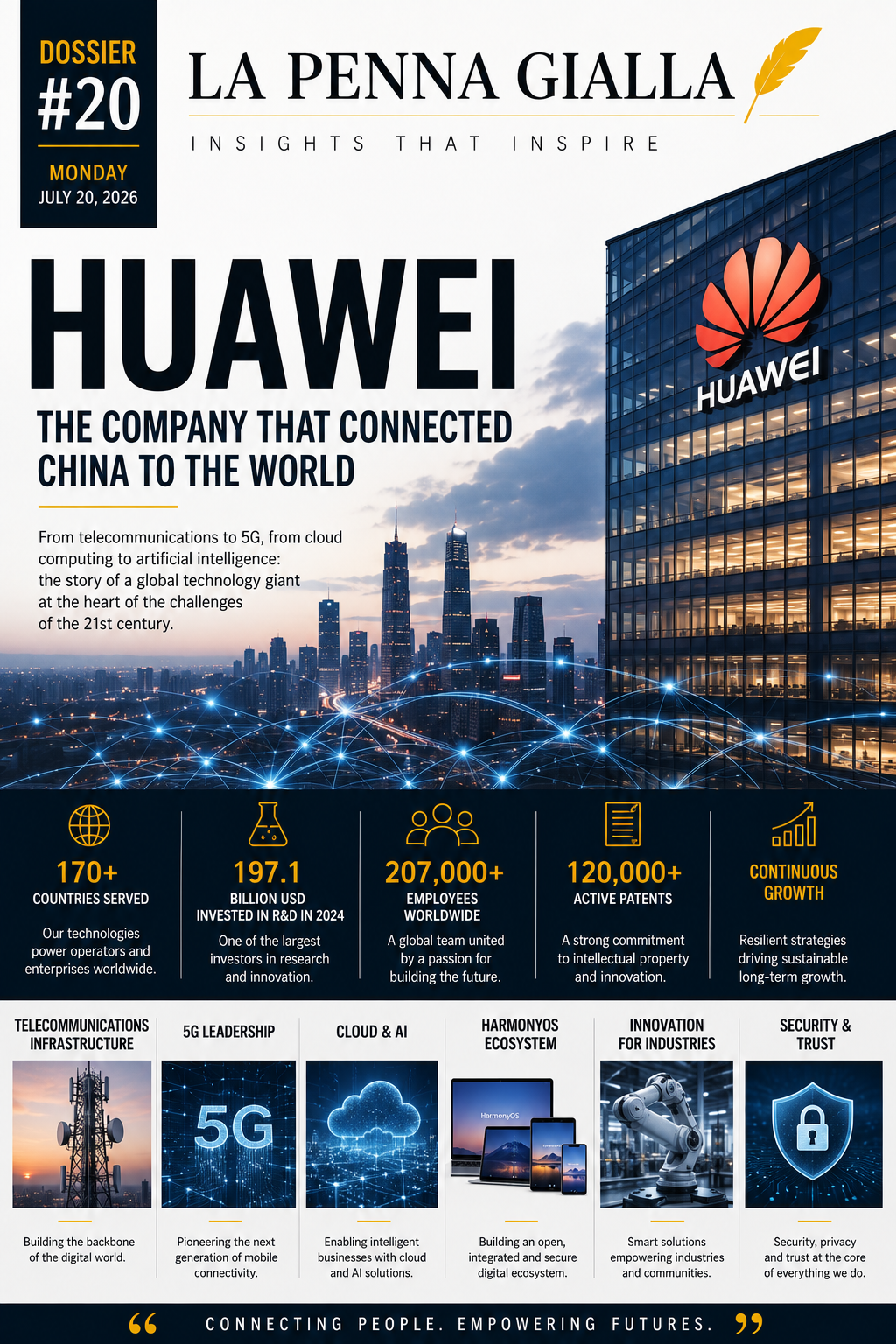
Huawei is one of the world's leading providers of telecommunications infrastructure. Beyond smartphones, it develops mobile networks, cloud computing platforms, artificial intelligence solutions, data centers, enterprise technologies and smart devices. Every year, the company invests a significant share of its revenue in research and development, making innovation the foundation of its growth.
A Small Company Born in Shenzhen
In 1987, Shenzhen was still a young Special Economic Zone.
The futuristic skyline that defines the city today did not yet exist.
That same year, Ren Zhengfei, a former engineer, founded Huawei with modest financial resources and a small team of employees.
The company did not manufacture smartphones.
It did not design consumer electronics.
Instead, it focused on telecommunications equipment—a field then dominated by large international corporations.
Huawei's ambition was simple but bold:
to develop advanced communication technologies within China instead of relying on imported solutions.
It was an enormous challenge.
It also marked the beginning of one of the most remarkable technological success stories of modern China.
Building the Invisible Infrastructure
When people hear the name Huawei, they often think of smartphones.
In reality, smartphones represent only a small part of the company's business.
Huawei's true strength lies in telecommunications infrastructure.
The antennas mounted on towers.
The equipment inside mobile network stations.
The optical transmission systems.
The technologies that allow billions of devices to communicate every second.
These systems remain largely invisible to the public.
Yet without them, modern mobile communication simply would not exist.
Huawei became one of the world's leading suppliers of these critical technologies, working with telecommunications operators across dozens of countries.
In other words, Huawei does not merely manufacture devices.
It helps build the digital highways through which information travels.
The Race Toward 5G
The arrival of 5G technology placed Huawei at the center of a new technological revolution.
Fifth-generation mobile networks are not simply about downloading videos faster.
They reduce network latency, increase capacity and enable entirely new applications, including smart factories, connected vehicles, telemedicine and intelligent cities.
Thanks to decades of research, Huawei became one of the leading contributors to global 5G development, holding thousands of patents related to wireless communication technologies.
Its work has played a significant role in shaping the next generation of global connectivity.
A Company Driven by Research
Many technology companies invest heavily in marketing.
Huawei chose a different path.
It invested in research.
The company operates research centers around the world, employs tens of thousands of engineers and collaborates with universities and scientific institutions across multiple countries.
Each year, Huawei allocates a substantial portion of its revenue to research and development, supporting innovation in artificial intelligence, cloud computing, semiconductor technologies, optical communications and digital infrastructure.
This commitment to continuous innovation has allowed Huawei to expand far beyond the smartphone market.
Years of Challenge
Beginning in 2019, Huawei entered one of the most difficult periods in its history.
Trade restrictions imposed by the United States limited the company's access to certain technologies, software and components supplied by American firms.
Many observers predicted that Huawei would struggle to remain competitive.
Instead, the company accelerated its efforts to develop proprietary technologies.
It expanded investments in cloud services, artificial intelligence, enterprise solutions and HarmonyOS, its own operating system designed to support an increasingly independent digital ecosystem.
Although the transition has not been without challenges, Huawei demonstrated an ability to adapt under extraordinary circumstances.
Beyond Smartphones
Today, Huawei is far more than a smartphone manufacturer.
Its technologies support a wide range of industries, including:
- Telecommunications infrastructure
- Cloud computing
- Artificial intelligence
- Data centers
- Smart healthcare solutions
- Intelligent energy networks
- Digital automotive technologies
In many cases, consumers may never notice Huawei's presence.
Yet millions of people rely every day on digital services supported by its technologies.
Technology Meets Geopolitics
Few companies illustrate the relationship between technology and international politics as clearly as Huawei.
Over the past several years, the company has become one of the symbols of global technological competition.
Discussions surrounding cybersecurity, digital sovereignty and strategic infrastructure have transformed Huawei from a telecommunications company into one of the most debated names in international affairs.
Understanding Huawei therefore means understanding far more than a single business.
It means understanding how technology increasingly shapes economics, diplomacy and global power.
🇮🇹 Italy–China
Like many countries, Italy is investing in digital infrastructure, cloud computing and artificial intelligence to strengthen its competitiveness. The Huawei case highlights how telecommunications technologies are no longer purely commercial products but strategic assets with economic, technological and geopolitical implications.
La Penna Gialla Tells
For many people, Huawei is simply a logo on a smartphone.
For others, it is a familiar name in international news.
In reality, it represents something much larger.
It tells the story of a country that, within just a few decades, transformed itself from a technology importer into one of the world's leading innovators.
Whether admired or criticized, Huawei has undeniably contributed to reshaping the global telecommunications landscape.
Perhaps that is its most important legacy.
The greatest technological revolutions are often invisible.
They travel silently.
Inside a fiber-optic cable.
Across a wireless signal.
Within a connection that brings people together across thousands of kilometers in only a fraction of a second.
Iscriviti e fai iscrivere al canale G-channel La Penna Gialla e non perderti le prossime novità
"Inserisci e fai inserire la tua Azienda o l'azienda di prossimità a costo zero".
"Siamo noi il tuo alleato digitale e con un semplice clic il tuo articolo puoi condividerlo su tutte le piattaforme"
I commenti degli utenti:
Non sono presenti commenti di altri utenti