




Mappa Interattiva - dove le persone incontrano le attività
What does a city reveal about its habits, desires and identity when night falls?
At six in the evening, Shanghai does not switch off.
It simply changes.
Offices begin to empty, metro trains fill up, lights come on one after another and the skyline along the Huangpu River takes on a completely different colour. The city that spends the day moving between meetings, factories, universities and business appointments gradually gives way to another Shanghai: slower in some places, louder in others, and certainly harder to understand through the usual images of China’s great metropolis.
This is a city that eats, walks, listens to music, shops, watches performances, meets friends and keeps moving.
To understand Shanghai, perhaps you have to wait until it gets dark.
When the rhythm changes
Shanghai is one of the cities that best illustrates the transformation of night into an integral part of urban life.
In 2026, the Shanghai Tonight programme brought almost 200 evening events to shopping districts, waterfront areas, parks, museums and residential neighbourhoods. The programme included food, markets, traditional culture, sport, music and entertainment, creating new forms of social life after sunset.
It is an interesting signal.
Night is no longer simply considered the period that follows the working day. It has become part of the urban economy and, above all, part of urban life.
In Shanghai, an evening can begin with a walk and end at a market. It can move from an exhibition to a performance, from a historic street to a contemporary neighbourhood, from a shopping centre to the waterfront.
The city is therefore developing a second geography, one that becomes particularly visible after dark.
A city of lights
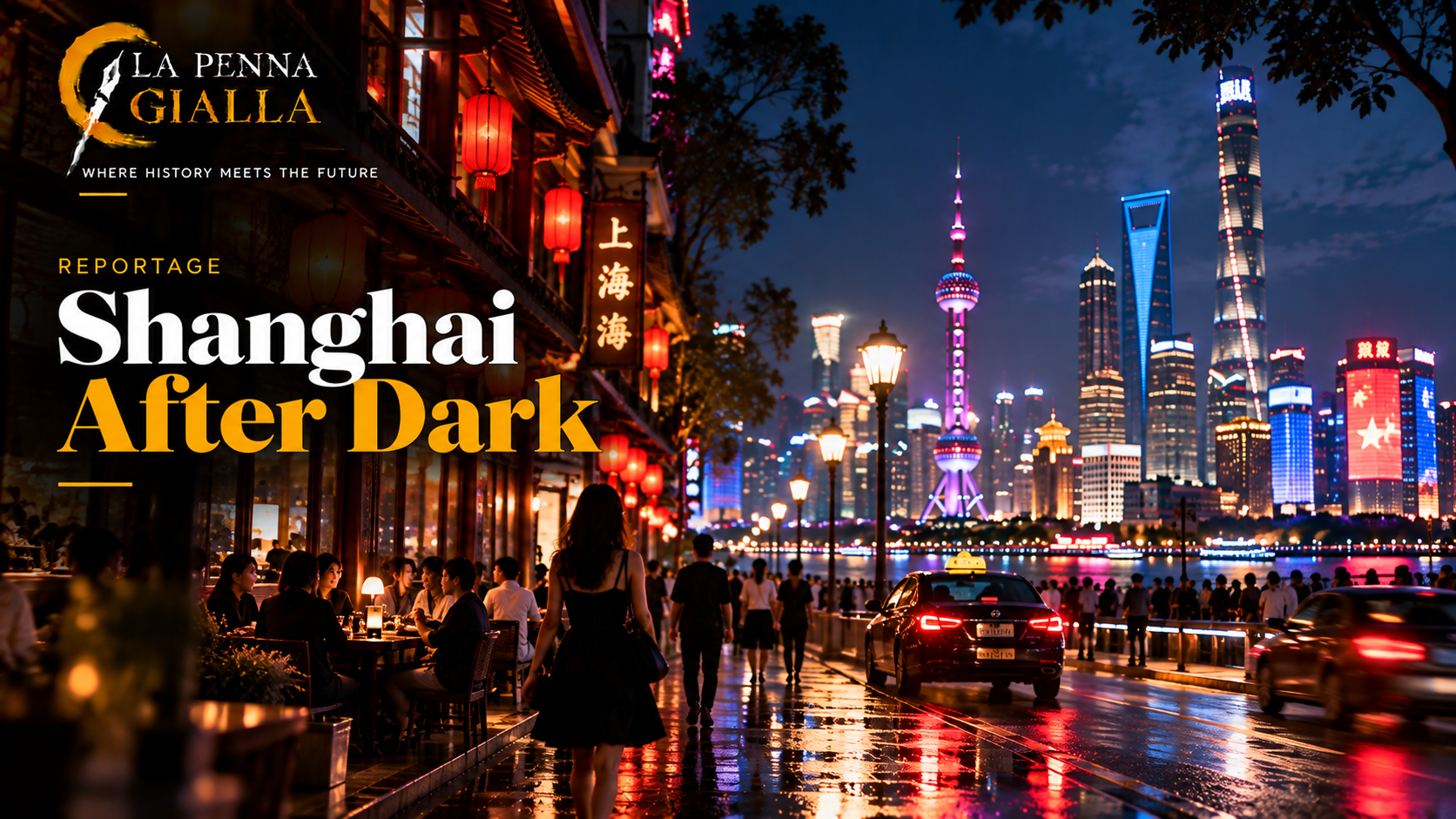
The first thing that catches the eye is, naturally, the light.
Shanghai is spectacular during the day, but after sunset it becomes almost another city. The skyscrapers of Pudong, illuminated signs, bridges and the Huangpu waterfront create a landscape in which architecture and technology seem to merge.
In September 2026, the Shanghai International Light Festival returned with 158 activities across a main venue and 16 district venues. Its “Light of Shanghai” theme brings together technology, culture, the future and everyday urban life.
This combination is what makes Shanghai at night particularly interesting.
It is not simply a search for spectacular effects. Light is being used to transform ordinary spaces, connect neighbourhoods and create new places for people to meet.
The contemporary city is not merely illuminated.
It is being designed to be experienced after sunset.
From old lanes to new squares
To understand this transformation, however, it is not enough to look at Pudong.
You have to cross back to the other side of the river, enter the neighbourhoods and observe how the night occupies very different kinds of spaces.
At Xintiandi, for example, historic shikumen buildings coexist with restaurants, entertainment venues and pedestrian areas. On Daxue Road, in Yangpu District, the evening crowd includes students, professionals and people working for companies in the area, gathering around cafés, shops, street food, music and events.
It is one of the most revealing images of contemporary Shanghai.
On one side is the architectural memory of the city.
On the other are young people working in the digital economy, studying, building businesses and looking for places where they can spend their free time.
Night becomes the meeting point between these two Shanghais.
The waterfront as a new living room
Shanghai has a particular relationship with water.
The Huangpu River is the great geographical element that both divides and connects the metropolis. In recent years, many sections of the waterfront have been transformed into places for walking, eating, attending events or simply stopping for a while.
At Longhua Hui, along the Xuhui waterfront, the 2026 summer programme combined cafés, evening markets, traditional crafts, food and cultural activities. The market dedicated to intangible cultural heritage also featured traditional crafts including weaving, velvet flowers, embroidery and sugar painting.
It is a small detail that says a great deal about Shanghai's urban strategy.
Modernity does not necessarily have to erase tradition.
It can become the setting in which tradition is presented through a contemporary language.
And so, beside the lights of the skyscrapers, an artisan or a traditional craft can suddenly appear, carrying techniques that belong to another era.
The night also belongs to the neighbourhoods
Shanghai at night is not only the city seen in photographs from the Bund.
It is also the city of neighbourhoods far beyond the classic tourist routes.
In Baoshan District, for example, 2026 programmes brought food markets, music, sport, outdoor cinema and waterfront activities into local areas. In several cases, the events were designed to accompany residents' everyday lives rather than simply attract visitors.
This is where the idea of the “night-time economy” becomes particularly interesting.
It does not simply mean keeping shops open longer.
It means creating reasons for people to remain in their neighbourhoods after work.
A square becomes a place for music. A park hosts a market. A stretch of river becomes a promenade. A commercial street turns into a space for meeting people.
The city expands through time, not only through space.
Food as a meeting point
And then there is food.
Shanghai at night has its own gastronomic vocabulary: street stalls, small restaurants, markets, late-night kitchens and, above all, a culture of eating together that turns a meal into a social occasion.
As part of the 2026 Shanghai Tonight programme, one of the main events placed renewed attention on the culture of dapaidang, the tradition of open-air dining associated with Chinese urban life: shared tables, freshly prepared food and people continuing to talk long after the official working day has ended.
It is not simply about food.
It is about extending the day through social life.
When work ends, the city does not necessarily retreat indoors.
In many places, it simply moves to the table.
A younger night
There is also a generational dimension.
Many of the places shaping Shanghai's nightlife today are designed for a younger public looking for experiences rather than simply products.
Daxue Road is a good example: cafés and everyday businesses during the day give way to music, markets, street food, sport and new experiences in the evening, including initiatives connected with artificial intelligence.
This represents an important change in the meaning of consumption.
It is not necessarily about buying something.
It is about being somewhere.
Walking. Taking photographs. Listening. Meeting friends. Eating. Watching a match. Taking part in an event.
The city becomes a platform for experiences.
And night is when this function becomes particularly visible.
When the city becomes an experience
Shanghai is therefore developing a new form of urban life.
During the day, it remains one of Asia's great economic and financial capitals. At night, it increasingly becomes something else: a city where leisure, culture, commerce and social life can occupy the same spaces.
The numerous official programmes dedicated to the night show how firmly this transformation has become part of urban policy. In 2026, events were distributed across historic districts, new waterfronts, museums and parks.
But the real transformation is not found in the number of events.
It lies in the changing relationship between the city and time.
A city is not made only of places where people work.
It is also made of the hours in which people decide what to do when work is over.
And at five in the morning?
Around midnight, Shanghai is not necessarily quiet yet.
In some neighbourhoods, the evening continues. Someone is still eating, someone is coming home from work, someone is meeting friends, someone is crossing the city on the metro.
Then, slowly, the rhythm decreases.
The lights remain on while the streets become less crowded. Sounds grow more distant. The waterfront continues to reflect the glow of the buildings.
And when dawn arrives, something curious happens.
The night does not simply end.
The city changes shift.
Those who have spent the last few hours outside head home. Early workers begin their day. Metro trains fill again. Shops start opening.
Shanghai finds its rhythm again.
A city that does not sleep — but is changing
To tell the story of Shanghai at night is therefore to tell something more than the story of its lights.
It is to observe a city trying to give new value to free time, public spaces and social life.
The metropolis that for decades was described primarily through its economic speed is revealing another side: a city that wants to be experienced even after the working day has ended.
Perhaps this is where the most contemporary Shanghai can be found.
Not in the skyscrapers that appear never to sleep, but in the people who, after a day at work, choose to stay out a little longer.
A walk beside the river.
A market.
A shared meal.
An illuminated street.
A conversation that continues.
A city can be measured through its GDP, the number of skyscrapers it has or the speed of its trains.
But there is another way to understand how alive it is.
Look at it when the day is over.
Iscriviti e fai iscrivere al canale G-channel La Penna Gialla e non perderti le prossime novità
"Inserisci e fai inserire la tua Azienda o l'azienda di prossimità a costo zero".
"Siamo noi il tuo alleato digitale e con un semplice clic il tuo articolo puoi condividerlo su tutte le piattaforme"

I commenti degli utenti:
Non sono presenti commenti di altri utenti