




Mappa Interattiva - dove le persone incontrano le attività
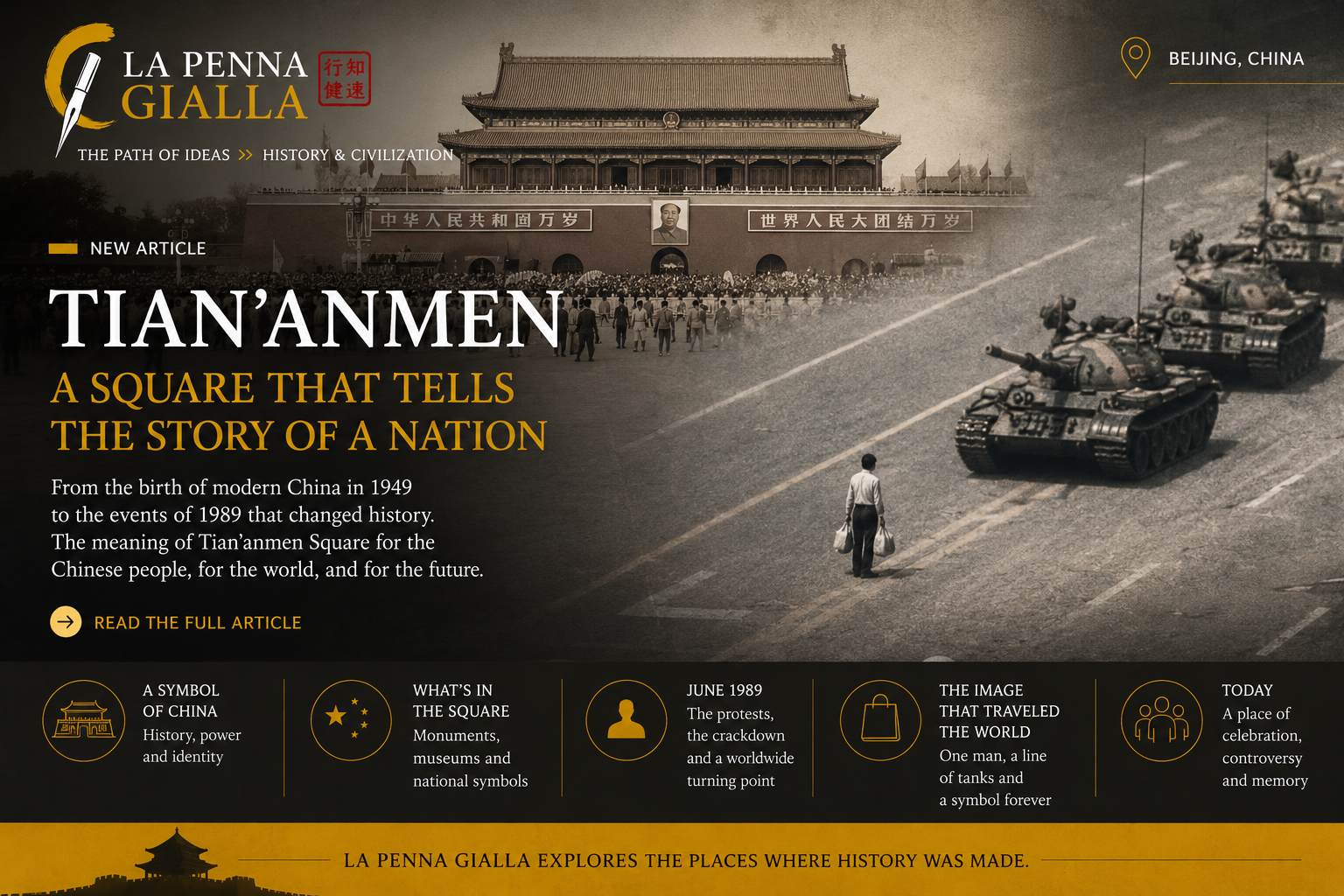
In the center of Beijing stands a place that every Chinese citizen knows.
A place that appears in school textbooks, official photographs, national celebrations, and some of the most significant moments in modern Chinese history.
It is Tiananmen Square.
Covering more than 440,000 square meters, it is one of the largest public squares in the world and the symbolic heart of the People's Republic of China.
For millions of visitors, it is an essential stop when exploring Beijing.
For the Chinese people, however, it represents much more.
It is the political and symbolic center of the nation.
But it is also one of the most debated and historically significant places in contemporary history.
The Gate of Heavenly Peace
The name Tiananmen means "Gate of Heavenly Peace."
The monumental gate overlooking the square was originally built during the Ming Dynasty and served as the southern entrance to the Imperial City.
Even today, it is impossible to separate the image of Tiananmen Square from the giant portrait of Mao Zedong displayed above the gate leading to the Forbidden City.
Emperors, revolutionaries, political leaders, and millions of citizens have passed through this place.
Few locations in China contain such a concentration of history.
The Center of Modern China
The square as we know it today is largely the result of the transformations that took place during the twentieth century.
Following the founding of the People's Republic of China in 1949, Tiananmen became the principal ceremonial and political space of the new state.
It was here, on October 1, 1949, that Mao Zedong proclaimed the establishment of the People's Republic before a massive crowd gathered in the square.
For many Chinese citizens, this moment marks the birth of modern China.
A nation emerging from decades of war, foreign invasion, and political instability.
To this day, the country's most important national celebrations are held here.
What Can Be Found in the Square Today
Tiananmen is not simply an open space.
Surrounding it are some of the most important buildings in modern China.
These include:
- The Mausoleum of Mao Zedong,
- The Great Hall of the People,
- The National Museum of China,
- The Monument to the People's Heroes,
- The Tiananmen Gate leading to the Forbidden City.
Together, these landmarks tell the story of China's transition from empire to revolution and from revolution to modern statehood.
The square serves as a symbolic meeting point between imperial history, political power, and national identity.
1989: An Event That Changed History
In the spring of 1989, Tiananmen Square became the center of a large-scale protest movement.
Thousands of students, workers, intellectuals, and citizens gathered to call for political reforms, greater transparency, and dialogue with the government.
For several weeks, the square became a space for debate, demonstrations, and public expression.
On the night of June 3–4, 1989, the Chinese government ordered military intervention to end the protests.
The events that followed resulted in numerous casualties, although the exact number remains disputed and continues to be debated by historians and researchers.
Images from Beijing quickly spread around the world and profoundly influenced international perceptions of China.
Among those images, one became especially iconic: the unidentified man carrying shopping bags who stood in front of a column of tanks.
The photograph would later become one of the most recognizable images of the twentieth century.
Two Different Memories
One of the most remarkable aspects of Tiananmen Square is that its meaning often depends on who is looking at it.
In the West, the square is frequently associated primarily with the events of 1989.
For many Chinese citizens, however, Tiananmen represents:
- the founding of the People's Republic,
- national unity,
- the political center of the country,
- and major national celebrations.
This does not mean that 1989 lacks significance.
Rather, it reflects the existence of different historical memories, shaped by culture, experience, education, and perspective.
Understanding China also means understanding these different ways of interpreting the past.
Tiananmen Today
Today, Tiananmen Square remains one of the most visited places in China.
Every day, thousands of people arrive to watch the flag-raising ceremony, visit Mao's Mausoleum, or continue toward the Forbidden City.
For visitors, the square creates a unique impression.
It feels immense.
Monumental.
Designed to represent something larger than any individual.
And perhaps this is exactly what makes it so important.
Tiananmen is not simply a public square.
It is a reflection of modern Chinese history itself.
A place where empire, revolution, memory, political power, and national identity intersect.
For some, it symbolizes a nation that regained its strength and unity.
For others, it remains a reminder of a painful chapter in modern history.
For everyone, however, Tiananmen Square continues to be one of the most significant places in the contemporary world.
Iscriviti e fai iscrivere al canale G-channel Carla Cavicchini e non perderti le prossime novità
"Inserisci e fai inserire la tua Azienda o l'azienda di prossimità a costo zero".
"Siamo noi il tuo alleato digitale e con un semplice clic il tuo articolo puoi condividerlo su tutte le piattaforme"

I commenti degli utenti:
Non sono presenti commenti di altri utenti