




Mappa Interattiva - dove le persone incontrano le attività
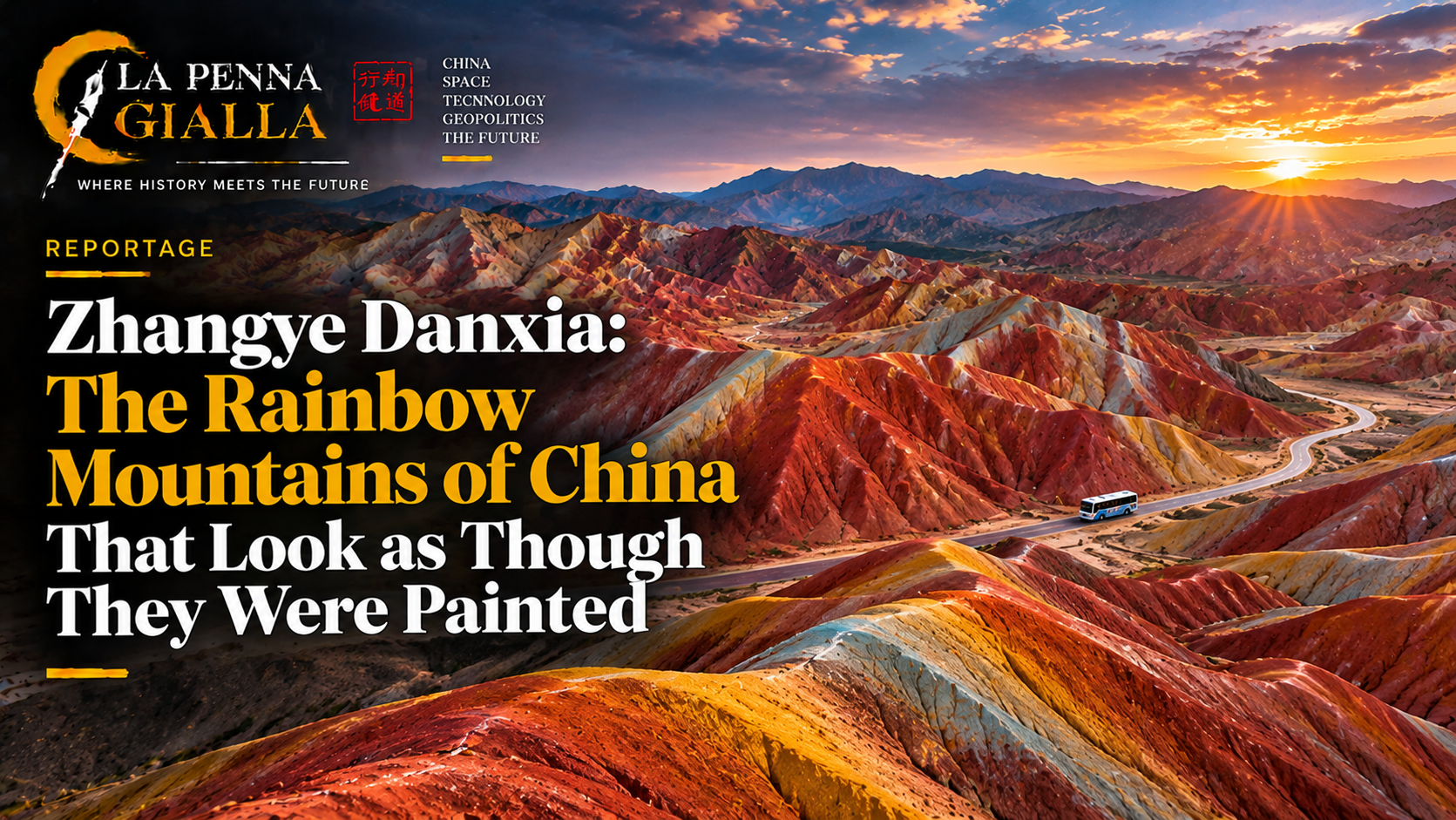
In the heart of Gansu Province, far from China's great metropolises and the images most commonly associated with the country, lies a landscape that seems to belong to another planet. Mountains unfold in waves of red, orange, yellow, grey and pale blue, their layers following the contours of the earth like brushstrokes across an immense canvas. From a distance, they look almost unreal. Yet every colour, every ridge and every fold tells a story written over millions of years.
This is Zhangye Danxia, one of China's most extraordinary natural landscapes. Often known as the Rainbow Mountains, it is a place where geology becomes spectacle and where the history of the planet can be read in the colours of the rock.
The question is irresistible: how did nature create mountains that look as though they had been painted?
A landscape hidden along the ancient Silk Road
Zhangye is located in northwestern China, in Gansu Province, along the historic Hexi Corridor. For centuries, this narrow passage between mountains and desert connected China with Central Asia and formed one of the most important routes of the Silk Road. Merchants, travellers, religious figures and explorers crossed this region, carrying goods, ideas and cultures between distant worlds.
Today, the same landscape offers a very different kind of journey. Beyond the city, the terrain opens into an extraordinary succession of coloured hills, rocky formations and deep valleys. The most famous area is the Zhangye National Geopark, where the Danxia landforms have become one of China's most recognisable natural attractions.
The word Danxia refers to a particular type of landscape characterised by steep, colourful rock formations. The term is associated with the reddish cliffs found in several parts of China, but Zhangye is especially remarkable for the variety and intensity of its colours.
Here, the mountains do not simply appear red. They seem to contain an entire palette.
Millions of years in the making
The colours of Zhangye are not the result of volcanic activity or artificial intervention. They are the visible outcome of an extremely long geological process.
The story begins during the Cretaceous period, when sediments accumulated in ancient river and lake environments. Over millions of years, layers of sand, mud and other mineral materials were deposited, compressed and gradually transformed into sedimentary rock.
Different minerals gave these layers their distinctive colours. Iron compounds, in particular, played an important role: depending on their chemical composition and oxidation state, they contributed shades ranging from deep red and rust to yellow and brown. Other minerals created lighter, greyish and bluish tones.
But the colours alone would not have produced the landscape we see today.
The movement of the Earth's crust gradually raised and folded the rock formations, exposing them to the forces of erosion. Wind, rain, temperature changes and the repeated action of freezing and thawing slowly carved the terrain into ridges, valleys, cliffs and sharply defined slopes.
The result is a landscape in which geological layers are exposed like pages in an open book. Each band represents a different moment in the planet's history, while the shapes of the mountains reveal the immense forces that have transformed this region.
What appears to be an artist's work is, in reality, the result of time, pressure and erosion.
When the light changes the colours
Although the Rainbow Mountains are spectacular throughout the day, the landscape is particularly striking when the sun is low.
In the early morning and late afternoon, sunlight reaches the slopes at an angle, emphasising the folds and contours of the rock. The colours become more pronounced, shadows deepen and the different layers appear almost three-dimensional.
After rainfall, the effect can be even more dramatic. Moisture may intensify the tones of the exposed rock, making the reds and oranges appear richer and the contrast between the layers more evident.
This changing relationship between light and landscape explains why photographs of Zhangye can look so different from one another. The mountains are not static scenery: their appearance changes with the weather, the season and the position of the sun.
For visitors, choosing the right moment is part of the experience. The same viewpoint can reveal a completely different landscape just a few hours later.
Beyond the Rainbow Mountains
The Zhangye area offers more than the colourful hills that have made it famous.
The wider geopark includes other extraordinary Danxia formations, particularly the Binggou Danxia area. Here, the landscape takes on a different character: instead of broad, flowing bands of colour, the rocks form towers, columns, walls and unusual silhouettes that resemble castles, temples or monumental sculptures.
Some formations appear almost architectural, with narrow openings, vertical faces and sharply defined edges. Others rise from the ground like isolated stone structures, shaped by erosion over geological time.
The contrast between these areas reveals the extraordinary variety of Danxia landscapes. The same geological processes can produce very different forms depending on the composition of the rocks, the local environment and the intensity of erosion.
Nearby, the Heihe River crosses the region, adding another element to a landscape largely associated with dry terrain and vast open spaces. Water has always played an important role in shaping this environment, even where its presence is not immediately visible.
A natural heritage worth protecting
Zhangye's geological importance extends beyond its visual appeal. The area is part of a wider effort to recognise and protect landscapes that preserve significant evidence of the Earth's history.
In 2020, Zhangye UNESCO Global Geopark received UNESCO Global Geopark status. This recognition highlights the geological value of the area and the importance of combining conservation, scientific research and sustainable development.
In June 2025, the Zhangye Colorful Hills were also included on China's Tentative List for UNESCO World Heritage. This is an important step in the process of possible future recognition, although it does not mean that the site has already been inscribed on the World Heritage List.
The distinction matters: the landscape is internationally recognised for its geological significance, while its potential World Heritage status remains a separate process.
As the number of visitors grows, the challenge is to preserve the fragile formations and the natural environment that make Zhangye so exceptional. The paths, viewing platforms and visitor infrastructure are designed to allow people to experience the landscape while limiting direct impact on its most delicate areas.
A painting made by the Earth
There are places that impress through their size, others through their history, and others still through the beauty of their surroundings. Zhangye Danxia manages to bring all three together.
Its mountains seem almost impossible, yet their appearance is rooted in a precise natural history. The colours are minerals, the stripes are layers of ancient sediment, and the spectacular shapes are the result of geological forces acting over millions of years.
Standing before this landscape, it is easy to understand why the Rainbow Mountains have become one of China's most photographed natural wonders. But the real fascination lies beyond the colours themselves.
Zhangye is a reminder that the Earth is constantly changing, even when those transformations unfold too slowly for us to notice. What we see today is only a moment in a much longer story: a landscape shaped by time, preserved in stone and revealed by light.
A painting, perhaps, but one for which nature has taken millions of years to complete.
Iscriviti e fai iscrivere al canale G-channel La Penna Gialla e non perderti le prossime novità
"Inserisci e fai inserire la tua Azienda o l'azienda di prossimità a costo zero".
"Siamo noi il tuo alleato digitale e con un semplice clic il tuo articolo puoi condividerlo su tutte le piattaforme"

I commenti degli utenti:
Non sono presenti commenti di altri utenti