




Mappa Interattiva - dove le persone incontrano le attività
What does it mean to grow up in a country where a single examination can change the course of a life?
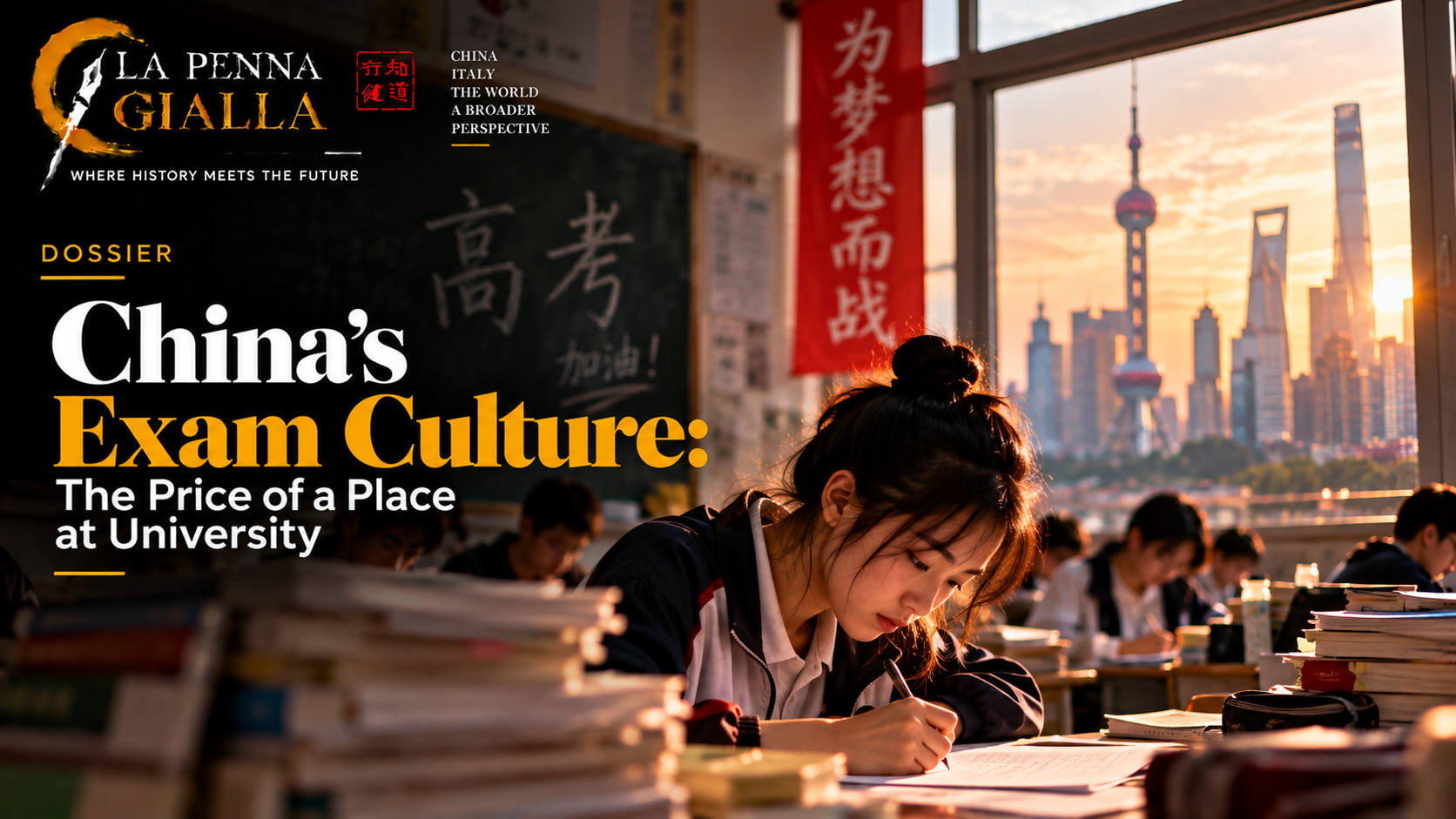
On the morning of 7 June 2026, millions of young people across China took their places in examination rooms. Some arrived accompanied by their parents; others found teachers and family members waiting outside school gates. For many, those days marked the culmination of years of study. For their families, they represented a moment when expectations, sacrifices and hopes converged on a handful of tests.
In 2026, 12.9 million candidates registered for the gaokao, China’s national university entrance examination. It remains one of the most significant events in the country's social calendar, involving schools, families and entire communities in a mobilisation that extends far beyond the education system.
To understand contemporary China, the gaokao offers a privileged vantage point. It reveals the value attached to education, the weight of family expectations, the competition for opportunities and the relationship between individual merit and the circumstances in which a person grows up.
But it also exposes a contradiction. In a country that has invested enormously in economic growth and modernisation, a university degree remains a promise of a better future, even as securing the desired place becomes an increasingly complex challenge.
In China, the examination does not simply measure what a student has learned. It is also where family expectations meet the opportunities offered by a changing country.
An examination, a national story
To understand the significance of the gaokao, we must return to 1977, when China reinstated its national university entrance examination after the Cultural Revolution.
The decision meant much more than restoring an admissions procedure. Education once again became a central instrument for developing skills, selecting talent and allowing new generations to access professional opportunities that had previously been difficult to reach.
Around 5.7 million candidates took part when the examination returned. By 2026, the figure had reached 12.9 million — a striking illustration of how dramatically the scale of Chinese higher education has changed over almost half a century.
During the same period, China transformed from a predominantly rural society into one of the world's leading industrial and technological powers. Universities became essential to this development, training engineers, researchers, doctors, managers and professionals.
A university degree consequently acquired a double meaning. It certifies knowledge and skills, but it also represents a potential route to social mobility: an opportunity to enter a skilled profession, improve a family's economic circumstances and build a life different from that of previous generations.
This is why the gaokao retains such powerful symbolic importance. It is not simply an academic test, but one of the gateways through which individual and family aspirations pass.
A calendar shaped by pressure
The examination itself is only the most visible part of a much longer journey.
Preparation begins well before the final year of secondary school. Days are organised around lessons, independent study, practice exercises and mock examinations. Students must consolidate their knowledge, learn to manage their time and develop the concentration required to perform under pressure.
Families can become deeply involved in the process, supporting educational expenses, organising household routines and helping their children navigate an especially demanding period.
In an environment where results can influence access to particular universities, preparation risks becoming the centre of everyday life. Leisure, sport and personal relationships may be pushed into the background.
Not every student experiences the process in the same way, and schools do not all follow identical routines. Nevertheless, academic pressure has become a recognised issue for Chinese authorities.
In March 2026, the Ministry of Education announced measures intended to reduce excessive academic workloads, limit the frequency of assessments and protect time for rest and physical activity. The measures also seek to discourage practices that judge teachers primarily on examination results.
The need for such measures illustrates how difficult it can be to balance two objectives: maintaining high academic standards while protecting students' broader development.
The question is therefore not simply how much students study, but how much room remains for growing beyond their studies.
Merit and the place where you are born
In principle, a national examination provides a common framework: candidates face selection according to their performance. But a formally common test does not automatically eliminate differences in educational opportunity.
The availability of schools, teachers, learning resources and family support varies according to location and economic circumstances. Major cities often have a broader educational offering, while students in rural areas and less-developed regions may have more limited access to certain resources.
China has introduced specific admissions programmes to expand opportunities for students from rural and economically disadvantaged backgrounds. These initiatives reflect an acknowledgement that educational access cannot be assessed solely through examination scores.
The issue is delicate because it brings two important principles into tension: selecting students according to their abilities and ensuring that they have reasonably fair opportunities to develop those abilities.
A student who achieves an excellent result after attending a school with limited resources has followed a different path from a peer who has benefited from a more favourable educational environment. The final score cannot necessarily capture that difference.
This does not mean that merit is irrelevant. It means that merit is also shaped by the opportunities available.
The central question is not only who passes the examination, but who has had the best conditions in which to prepare for it.
The family as an investment in the future
In China, as in many other East Asian societies, education carries profound family significance.
Academic success can be perceived as the result of a shared commitment: the student's effort, of course, but also the parents' contribution, as they support the educational journey and often organise their financial decisions around their children's future.
For some families, admission to a prestigious university represents a form of social advancement. For others, it is a way to consolidate an already established position and preserve professional opportunities for the next generation.
This investment is not purely financial. It includes time, attention and expectations.
Pressure can emerge precisely here: when a young person's result is perceived not only as a personal achievement, but also as the reward for sacrifices made by the entire family.
In such circumstances, an examination is never entirely individual. Parental hopes can provide powerful motivation, but they can also become a difficult burden.
The line between encouragement and expectation is a fine one. The desire to give children a better future can unintentionally turn into the belief that there is only one acceptable route to achieving it.
The paradox of the university degree
For decades, higher education has been associated with access to skilled professions and greater economic security.
That promise has not disappeared, but the context has changed.
China has dramatically expanded its economy, developing advanced manufacturing, services, digital commerce and new technologies. The labour market demands increasingly sophisticated skills, while young people face significant competition for certain professional positions.
As a result, a university degree remains important, but it no longer guarantees the job a graduate wants.
Differences between universities, fields of study, practical skills and employers' needs can all influence career prospects. The reputation of an institution and the professional path chosen can also make a difference.
This creates a paradox: families continue to invest in education because they see it as one of the main ways to improve their future, yet the actual value of that investment increasingly depends on what happens after graduation.
Success in the gaokao can open a door. It cannot, on its own, determine everything that lies beyond it.
That makes it even more important to consider what preparing young people for adult life should mean: not merely passing a selection process, but developing adaptability, critical thinking and skills that can be used in different circumstances.
When artificial intelligence enters the classroom
Technological change is transforming even the way students prepare for the examination.
In 2026, artificial intelligence tools became part of the study experience for some candidates. They can help students analyse mistakes, explain concepts, generate practice questions and personalise revision.
A Xinhua report on gaokao preparation described students using AI tools while highlighting the need for caution: excessive dependence on technology and exaggerated claims by services promising to predict examination questions can undermine effective preparation.
The phenomenon is part of a broader national strategy. In April 2026, five Chinese government bodies, including the Ministry of Education, published an action plan for integrating artificial intelligence into education. It envisages wider AI literacy in schools and universities, alongside tools to support learning and personalise educational pathways.
Technology can help a student identify a weakness and work on it. It can offer additional explanations and make certain learning resources more accessible.
But it also raises new questions.
If students can obtain immediate explanations from an intelligent system, which abilities will they need to demonstrate independently? How can genuine understanding be distinguished from the ability to use a tool effectively? And how can unequal access to technology be prevented from creating new educational inequalities?
Artificial intelligence can make studying more efficient. It does not eliminate the need to learn how to reason, verify information and tackle problems without a ready-made answer.
The future of Chinese education will depend partly on finding this balance: using technology to expand students' abilities without turning it into a shortcut that replaces learning.
The school China wants to build
The debate over education concerns more than students and their families. It is also connected to the development model China intends to pursue.
A country investing in artificial intelligence, robotics, electric vehicles and scientific research needs new skills. Universities must train professionals capable of supporting this transformation, while schools must prepare students for a world in which technical knowledge, creativity and problem-solving are becoming increasingly important.
China's strategy for digital education aims to integrate new technologies, teaching tools and learning pathways while expanding access to educational resources.
The challenge is to move beyond a system in which examination results dominate, towards one that can also recognise other dimensions of learning.
This is not a simple transformation. Selection remains necessary when universities must allocate a limited number of places, and a national examination provides common criteria for assessing millions of candidates. But preparing a generation cannot be reduced to preparing it for a test.
The ability to collaborate, communicate, deal with uncertainty and continue learning is becoming essential in an economy that is changing rapidly.
The issue is not choosing between rigour and freedom, or between examinations and creativity. It is finding a balance in which the pursuit of excellence does not narrow the very meaning of education.
The day after the gaokao
When the examinations end, the tension accumulated over months gives way to a different kind of waiting: the results and the subsequent admissions process.
For some students, the doors of their preferred universities will open. Others will have to reconsider their options, evaluate different institutions or imagine alternative routes.
This is when an aspect often obscured by the scale of the examination becomes clear: candidates' lives do not all follow the same trajectory.
A result can have important consequences, but it does not exhaust a person's possibilities. A professional future will also depend on later choices, acquired skills, opportunities encountered and the ability to adapt to a changing world.
The difficulty lies in reconciling this awareness with a system in which competition is real and decisions made during adolescence can influence future opportunities.
For an eighteen-year-old, however, it can be difficult to distinguish between what matters in the long term and what feels decisive in the present. If the entire community considers the examination a turning point, it is natural for students to attach enormous weight to it.
The question therefore also concerns how society communicates the meaning of success to its young people.
The price of a place at university
The gaokao remains one of the most powerful symbols of contemporary China because it concentrates several of the country's fundamental contradictions into a few days.
It is a selection mechanism that can open opportunities. It is the product of an educational system that has contributed to the country's growth. It is also the centre of a competition involving millions of families and exposing differences in starting conditions.
Today, as China invests in artificial intelligence and develops the skills needed for future industries, it must confront a question that concerns not only schools but society as a whole: how can it educate a generation to compete without reducing its value to a result?
Education will continue to be one of the main routes through which young people build their futures. But its meaning may need to evolve, moving beyond the search for the best university place towards the ability to navigate a more complex reality, in which no qualification can guarantee every answer.
Perhaps the true success of an education system cannot be measured solely by the number of students who reach the most prestigious universities.
It must also be measured by what those students are able to do afterwards, the opportunities available to them and the freedom to imagine different paths.
Because examination day can mark a turning point. But a life should not be defined by a single test.
The question that remains is this: can China transform the pressure to pass an examination into an education system that genuinely prepares young people for the world awaiting them?
Iscriviti e fai iscrivere al canale G-channel La Penna Gialla e non perderti le prossime novità
"Inserisci e fai inserire la tua Azienda o l'azienda di prossimità a costo zero".
"Siamo noi il tuo alleato digitale e con un semplice clic il tuo articolo puoi condividerlo su tutte le piattaforme"

I commenti degli utenti:
Non sono presenti commenti di altri utenti