




Mappa Interattiva - dove le persone incontrano le attività
For many Europeans, China is still associated with images of the past: ancient temples, calligraphy, traditional markets, and imperial history.
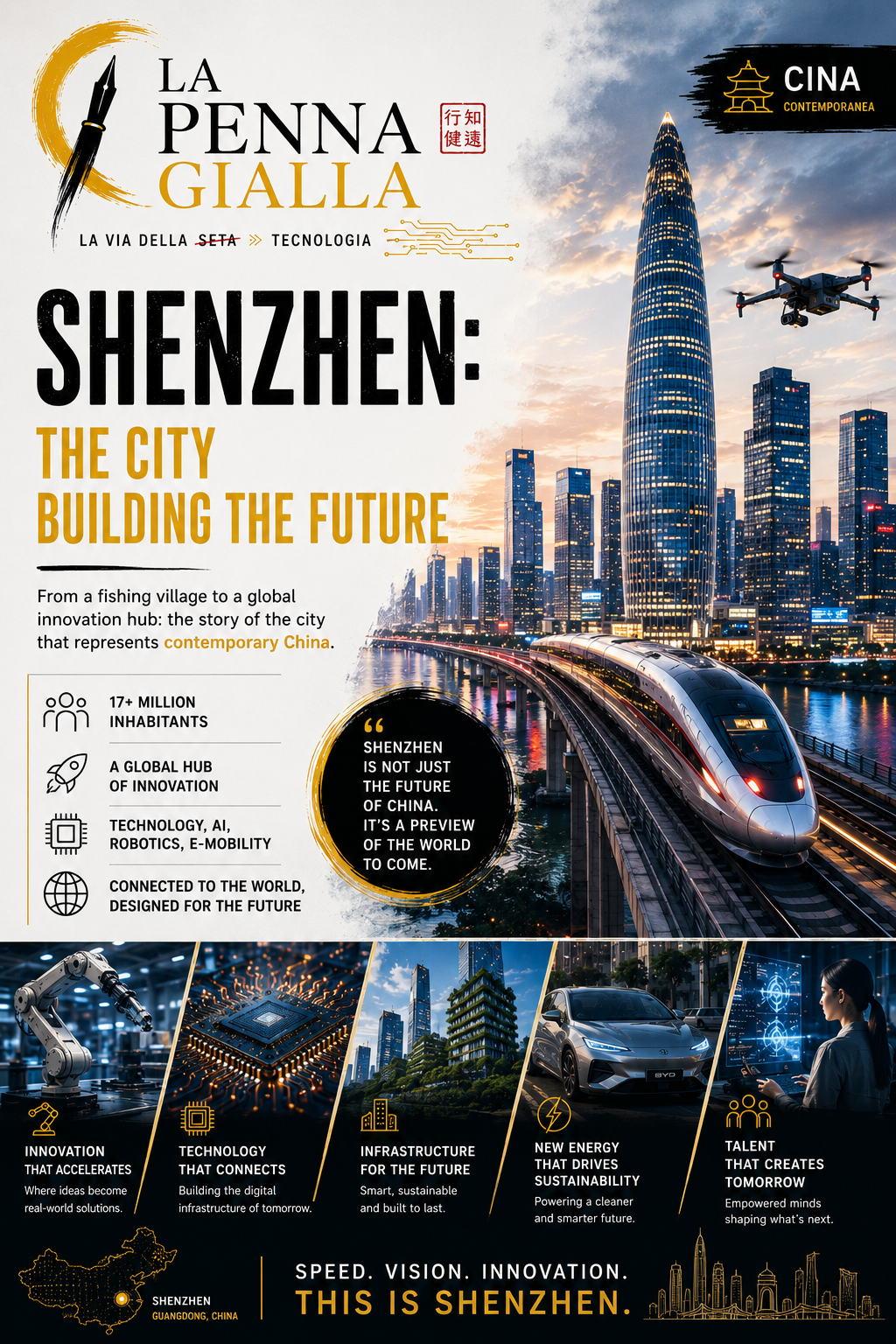
But there is one city that, more than any other, represents contemporary China.
A city that, just forty years ago, was little more than a fishing village.
Today, it is one of the most technologically advanced urban centers on the planet.
That city is Shenzhen.
From Fishing Village to Global Metropolis
Until the late 1970s, Shenzhen was a small town located near the border with Hong Kong.
Then came the transformation.
In 1980, the Chinese government selected it as the country’s first Special Economic Zone — a massive experimental hub designed to attract foreign investment, industrial development, and economic openness.
It marked the beginning of something the world had never seen before.
Within just a few decades:
- millions of people moved to the city,
- industries and research centers emerged,
- entire districts were built from scratch,
- and Shenzhen became a futuristic megacity.
Today, it has more than 17 million inhabitants and is widely considered China’s Silicon Valley.
The New Factory of the World
For years, the West viewed Chinese manufacturing through a simplistic lens:
mass production, cheap labor, and copies of Western products.
But Shenzhen completely changed that narrative.
Today, the city is a global hub for:
- drones,
- robotics,
- artificial intelligence,
- electric vehicles,
- smartphones,
- batteries,
- digital infrastructure,
- and telecommunications technology.
China is no longer simply assembling products.
It is designing, developing, investing, and innovating.
Many of the technologies used every day around the world are conceived or produced here.
A City Built at the Speed of the Future
What makes Shenzhen remarkable is not only its technology.
It is the speed.
Entire neighborhoods emerge within a few years.
Its infrastructure feels designed for tomorrow rather than today.
Automated metro systems, digital payments everywhere, robotic deliveries, electric taxis, and widespread 5G networks: things that still seem experimental in many European cities are already part of daily life here.
And yet, behind this extreme modernity lies significant social pressure:
- intense work culture,
- fierce competition,
- constant urban transformation,
- and a difficult balance between innovation and quality of life.
Because the future often comes with a human cost.
A China That No Longer Produces Only for Others
For decades, China’s growth was tied to exports toward Europe and the United States.
Today, however, the country aims for something different:
to lead global innovation.
And Shenzhen perfectly represents that ambition.
Chinese technology companies no longer want to be seen merely as low-cost alternatives to Western brands.
They want to become global leaders.
Electric vehicles, renewable energy, batteries, telecommunications, and artificial intelligence are sectors in which China is investing massively.
The rest of the world is watching closely.
Sometimes with admiration.
Sometimes with concern.
Beyond the Stereotypes
Perhaps the greatest challenge for the West in understanding contemporary China is the speed at which the country has changed.
Within a single generation, China moved:
- from textile production to advanced technology,
- from bicycles to electric vehicles,
- from rural landscapes to megacities,
- from imitation to innovation.
Shenzhen has become the symbol of this transformation.
A city that does not simply represent China’s present, but perhaps a glimpse of the global future itself.
And while Europe continues to debate what the world may look like in the coming decades, in some Chinese cities that future already seems to have arrived.
Iscriviti e fai iscrivere al canale G-channel La Penna Gialla e non perderti le prossime novità
"Inserisci e fai inserire la tua Azienda o l'azienda di prossimità a costo zero".
"Siamo noi il tuo alleato digitale e con un semplice clic il tuo articolo puoi condividerlo su tutte le piattaforme"
I commenti degli utenti:
Non sono presenti commenti di altri utenti