




Mappa Interattiva - dove le persone incontrano le attività
What allows an ancient craft to survive and thrive in a changing world?
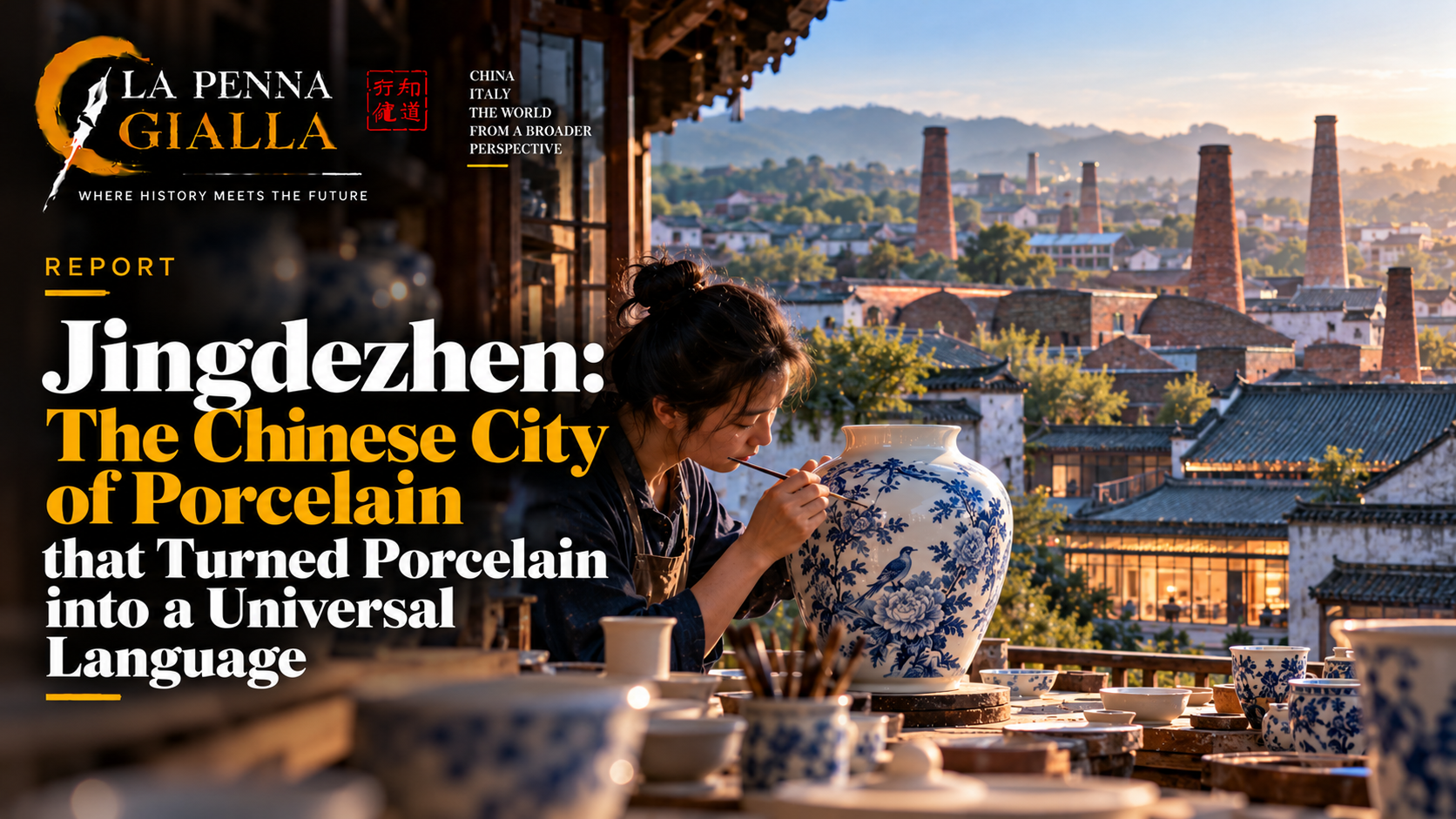
The first thing that strikes you about Jingdezhen is the relationship between earth and fire. Before it becomes a bowl, a vase or an object destined for a collection, porcelain is a material to be understood, shaped and tested. It requires skilled hands, high temperatures and a particular willingness to accept uncertainty: during firing, something that seemed perfect can change colour, warp or crack.
In this city in southeastern China's Jiangxi province, ceramics are more than an ancient craft. They are the thread connecting imperial history, international trade, industrial production and a new generation of artists and designers. For centuries, objects made here have crossed borders and cultures, finding their way into homes, palaces and collections across distant countries.
Today, Jingdezhen faces a new challenge: preserving the knowledge that made it famous without turning it into an immovable tradition. To do so, it must navigate a global market very different from that of the past, changing aesthetic sensibilities and the ambitions of young creatives seeking to develop a language of their own.
The result is a city where history can be found not only in museums, but also in workshops, studios, everyday objects and the choices of those who continue to work with porcelain, exploring new forms without abandoning their understanding of the material.
A City Built Around Porcelain
Jingdezhen has been producing ceramics for more than a millennium. Its location, the natural resources available in the region and the possibility of transporting materials and finished objects along waterways contributed to the growth of a manufacturing centre whose influence would eventually extend far beyond China's borders.
The surrounding area provided essential raw materials, including kaolin and porcelain stone. The combination of these materials, refined over centuries, allowed craftspeople to produce bodies capable of withstanding the high temperatures of kilns, making it possible to create objects with particularly desirable qualities.
Yet the quality of the raw materials alone cannot explain Jingdezhen's success. The city developed an elaborate production system in which different stages of the work were entrusted to specialised craftspeople. Preparing the clay, shaping a vessel, applying decoration, controlling the firing process and selecting finished pieces were distinct operations, connected through a complex organisation of labour.
This division of skills made it possible to manufacture large quantities without abandoning quality. Innovation, therefore, was not limited to ceramic techniques: it also involved the organisation of workshops, relationships between producers and merchants, and the management of raw materials.
During the Ming and Qing dynasties, Jingdezhen's production became particularly important to the imperial court. Alongside kilns serving the court's requirements, numerous private kilns operated within an increasingly extensive commercial network.
Porcelain thus became the product of a balance between craftsmanship, production organisation and the ability to respond to demand from different social groups and markets.
The Blue and White That Conquered the World
Among the most recognisable images of Chinese porcelain is that of blue motifs painted against a white background. Landscapes, flowers, animals and geometric compositions transform the surfaces of objects into narrative spaces, where decoration interacts with form.
Jingdezhen's blue-and-white porcelain became one of the most celebrated expressions of this tradition. The designs, created with cobalt-based pigments applied beneath a transparent glaze, required precision and a deep understanding of how materials behaved during firing.
The result was an object that combined durability, visual lightness and decorative refinement. Its beauty also depended on a fundamental characteristic: the design was not simply applied to a neutral surface, but had to be conceived in relation to the shape of the vessel and the transformations caused by heat.
This combination of technique and aesthetic expression helped make Jingdezhen porcelain a highly sought-after commodity in international markets. Objects travelled along overland and maritime routes, reaching Asia, the Middle East and Europe.
Trade involved more than the circulation of finished goods. It carried patterns, tastes and cultural influences. Chinese decorative motifs were studied, reinterpreted and sometimes imitated by foreign craftspeople; at the same time, the demands of international buyers influenced the shapes and decorations produced in Jingdezhen.
Porcelain became a means of communication between different worlds, long before globalisation acquired its contemporary meaning.
In Europe, interest in these objects also encouraged the development of new technical research. For centuries, Chinese porcelain was an object of desire and study, and attempts to reproduce its qualities stimulated experimentation in European ceramic centres.
Jingdezhen's history demonstrates that knowledge does not travel only through treaties, embassies or official encounters. It can also travel through a vase that arrives in a distant city, is observed, copied and reinterpreted.
The Invisible Work Behind a Perfect Object
A finished piece of porcelain tends to conceal the complexity of the process that produced it. A smooth surface, precise decoration and balanced shape can create the impression of a natural, almost inevitable result.
In reality, every object is the outcome of a succession of decisions. The choice of clay affects how it can be shaped; the thickness of the walls influences its behaviour during firing; the decoration must suit the surface; and the kiln imposes temperatures and timings that cannot be managed carelessly.
The material retains an element of unpredictability. An error in preparation, a variation during firing or tension within the clay can compromise the result. Experience also means learning to recognise these risks before they become visible.
This is where the transmission of knowledge becomes particularly important. A master craftsperson's expertise cannot always be reduced to a set of easily codified instructions. It includes gestures, observations, sensitivity and the ability to recognise subtle differences.
Learning means repeating, making mistakes and gradually refining one's perception. An apprentice may know the sequence of operations without yet being able to judge when the clay has reached the right consistency or when a decoration needs to be adjusted.
This heritage is not incompatible with modern technology. More precise tools can help control certain stages, while new design systems make it possible to experiment with shapes and solutions. Yet technology does not automatically eliminate the value of experience. In many cases, it makes that value even more apparent.
Jingdezhen's challenge is also to keep this body of knowledge alive, ensuring that production does not depend solely on reproducing familiar models.
When the Traditional System Faces a Crisis
Porcelain's long history did not protect Jingdezhen from the economic transformations of the twentieth century.
For decades, state-owned factories were an important part of the local economy. Production had been organised on an industrial scale, with facilities capable of manufacturing large quantities of goods for domestic markets and export.
Economic reforms and changing market conditions gradually undermined this model. The closure of major state-owned factories during the 1990s disrupted the city's ceramic sector, eliminating jobs and challenging an organisation of labour that had sustained the city for decades.
This was not simply an industrial crisis. When a factory closes, jobs disappear, but relationships between suppliers, craftspeople, merchants and apprentices can also weaken. A production system consists of more than machinery and buildings: it includes people's skills and the connections that allow those skills to become an economic activity.
For Jingdezhen, the problem was particularly significant. How could the city continue to make a living from porcelain in a market where international competition was increasing and traditional production models no longer guaranteed the same results?
The answer could not simply be to produce more. The relationship between production, quality, markets and creativity had to be reconsidered.
A New Generation Enters the Workshops
In recent years, Jingdezhen has attracted artists, designers, independent craftspeople and creatives from China and abroad. Some come to learn traditional techniques; others seek spaces in which to experiment with contemporary forms, work on small production runs or create unique pieces.
This movement is changing the city's professional landscape. Alongside activities linked to traditional production, independent studios, shared workshops and initiatives connecting ceramics with design, sculpture and artistic research are emerging.
The difference is not merely aesthetic. It also changes how work itself is conceived.
In traditional production systems, a single craftsperson might be responsible for a very specific stage of the process, developing deep expertise in that operation. Many contemporary artists, by contrast, prefer to oversee the entire journey: from the initial idea to shaping, from decoration to the choice of firing technique.
These two approaches do not necessarily exclude one another. Specialisation makes exceptional precision possible, while control over the entire process allows for a more direct relationship between the original concept and the final result.
The presence of new creatives also raises different questions. What can a porcelain object become when it no longer has to conform to inherited shapes and functions? How can an ancient technique engage with contemporary aesthetic sensibilities? And how far can innovation go without losing the connection to the skills that make a tradition distinctive?
There is no single answer. Some artists experiment with form, others with surface, and still others with the relationship between an object and the space around it. What they share is the opportunity to use an established technical heritage as the foundation for personal exploration.
Jingdezhen is therefore not simply a place where traditional porcelain is preserved. It is also a place where porcelain is being reimagined.
Tradition as a Resource, Not a Formula
When an ancient production activity returns to the spotlight, there is a risk of turning it into a brand. History becomes a marker of recognition, craftsmanship becomes a sign of authenticity, and tradition becomes a commercial promise.
For a city such as Jingdezhen, this can represent an economic opportunity, but also a limitation. If every object must confirm an already familiar image of Chinese porcelain, the space for experimentation risks shrinking.
Heritage, however, can be understood as a body of knowledge from which something new can emerge. Knowing a technique does not mean being obliged to reproduce the same result indefinitely. It means understanding the possibilities and limitations of the material, knowing which rules can be followed and which can be challenged.
This distinction also applies to the relationship between craftsmanship and industry. Large-scale production can provide accessibility and economic continuity; independent work can open new aesthetic paths and reach different audiences. The challenge is to find a balance between these dimensions without assuming that one is always superior to the other.
Porcelain does not necessarily have to choose between a functional object and a work of art, or between industrial production and individual creation. Its history shows that these categories can overlap, influence one another and change over time.
Jingdezhen's vitality also depends on its ability to accommodate this diversity without reducing its heritage to an unchanging image.
A Heritage That Belongs to the World
In 2014, Jingdezhen joined UNESCO's Creative Cities Network in the field of Crafts and Folk Art. In 2026, sites associated with its traditional porcelain industry were inscribed on the World Heritage List.
These recognitions underline a fundamental dimension of the city's history: Jingdezhen porcelain has influenced not only Chinese culture but also decorative arts and production practices in many parts of the world.
The heritage encompasses much more than objects preserved in collections. It includes raw-material extraction sites, kilns, workshops, transport infrastructure and the spaces in which labour was organised. The production system as a whole tells the story of how the city achieved international prominence.
This perspective also allows porcelain to be understood as a history of economic and cultural relationships. Objects travelled, but so did techniques, models and ideas. External influences did not necessarily erase local traditions; they could become part of their evolution.
Jingdezhen's international dimension is therefore not a recent phenomenon. It is a characteristic that has accompanied its identity for centuries.
What has changed is how this legacy is being reinterpreted. The commercial relationships of the past have given way to a more complex network of exchanges, in which artists, designers, institutions and businesses can collaborate on different projects. The city can thus continue to be a place of production, but also one of learning and experimentation.
The Future Takes Shape in the Material
In an economy increasingly dominated by speed, standardisation and digital production, porcelain seems to belong to a different kind of time. It requires patience, attention and a deep understanding of materials. Not every stage can be accelerated without consequences, and not every result can be predicted with absolute certainty.
This is precisely why Jingdezhen offers an interesting perspective on modern China. Alongside major technological transformations, there remains an economy in which value still depends on the quality of a gesture, the transmission of skills and the ability to turn a natural material into a cultural object.
That does not mean craftsmanship is immune to present-day difficulties. Workshops must find customers, cover costs, compete with industrial products and offer a viable professional future to those who choose this trade. Creativity, too, requires economic conditions that allow it to continue.
Tradition survives when it can be practised, taught and transformed, not merely celebrated. The future of porcelain therefore depends on more than preserving old kilns or protecting historic buildings. It also depends on whether new generations can find concrete reasons to dedicate themselves to this work.
In Jingdezhen, a bowl can still tell the story of a technique's journey, a craftsperson's knowledge and a city's history. But it can also become the starting point for an unexpected shape, a contemporary project or a new understanding of an everyday object.
Its strength lies precisely in this dual possibility: preserving memory without abandoning transformation.
Perhaps that is the secret of a tradition that has endured for centuries. It does not remain identical to itself; instead, it retains enough knowledge to change without losing its identity.
Iscriviti e fai iscrivere al canale G-channel La Penna Gialla e non perderti le prossime novità
"Inserisci e fai inserire la tua Azienda o l'azienda di prossimità a costo zero".
"Siamo noi il tuo alleato digitale e con un semplice clic il tuo articolo puoi condividerlo su tutte le piattaforme"

I commenti degli utenti:
Non sono presenti commenti di altri utenti