




Mappa Interattiva - dove le persone incontrano le attività
There are places you visit.
And then there are places that seem to have been painted by nature itself.
Guilin belongs to the second category.
Located in China's Guangxi region, this city is surrounded by some of the most recognizable landscapes on Earth. Towering limestone peaks rise dramatically from the ground, creating a scenery that has inspired poets, painters, and travelers for more than a thousand years.
Yet the true protagonist of this story is not the city itself.
It is the Li River.
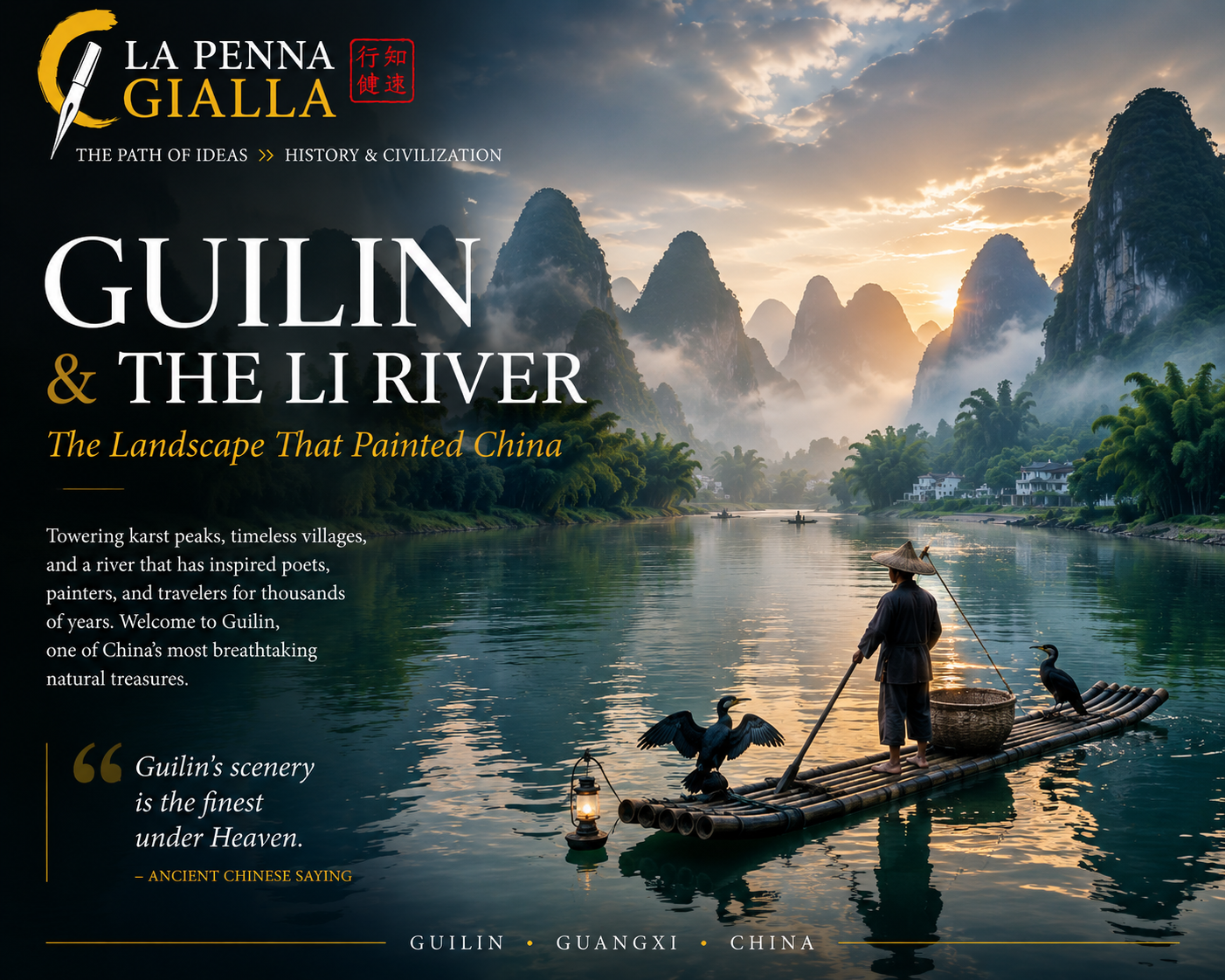
Flowing quietly through mountains, bamboo forests, rice fields, and ancient villages, the Li River has become one of the most iconic images of China.
Its scenery is so famous that it appears on the Chinese 20-yuan banknote.
When the Sea Became Mountains
To understand Guilin, we must travel back hundreds of millions of years.
The entire region was once covered by a shallow sea.
Over time, geological movements pushed vast layers of limestone upward. Rain, rivers, and erosion slowly sculpted the rock into the spectacular karst landscape visible today.
Unlike traditional mountain ranges, Guilin's peaks rise individually from the earth like giant stone towers.
Some resemble elephants.
Others look like dragons, camels, or ancient pagodas.
For centuries, local legends have given these formations names and stories that continue to fascinate visitors.
The River That Shaped a Region
If the mountains are Guilin's face, the Li River is its soul.
Stretching for approximately 160 kilometers, the river has long served as a lifeline for the communities living along its banks.
Long before tourism arrived, merchants transported goods through these waters.
Fishermen earned their living from the river.
Farmers cultivated the fertile land surrounding it.
The Li River was not merely a landscape.
It was a way of life.
Even today, watching a small wooden raft drift silently through the mist feels like stepping back into another era.
The Journey from Guilin to Yangshuo
The most celebrated section of the river runs between Guilin and Yangshuo.
This route is widely considered one of the most beautiful river journeys in the world.
As boats move slowly downstream, passengers encounter:
- dramatic karst peaks,
- bamboo groves,
- rice terraces,
- traditional villages,
- and fishermen navigating the water using techniques passed down through generations.
Every bend reveals a new panorama.
Every hour brings different light, different colors, and different moods.
For many travelers, this journey becomes the highlight of their entire visit to China.
The Tradition of Cormorant Fishing
One of the most iconic images associated with Guilin is that of fishermen working alongside cormorants.
For centuries, local fishermen trained these birds to catch fish in the river.
The practice has largely disappeared as a commercial activity, but it survives today as an important cultural tradition and symbol of the region's heritage.
At sunset, when lanterns illuminate the rafts and the mountains fade into silhouette, the scene appears almost timeless.
It is one of the most photographed moments in all of China.
From Hidden Treasure to Global Destination
For much of its history, Guilin was known mainly within China.
Today, it has become one of the country's most celebrated tourist destinations.
Millions of visitors arrive every year to:
- cruise along the Li River,
- explore Yangshuo,
- cycle through the countryside,
- hike among the karst formations,
- and experience one of Asia's most extraordinary natural landscapes.
Modern tourism has transformed the region, yet much of its original charm remains intact.
Luxury resorts coexist with farming villages.
Modern infrastructure stands beside traditions that have survived for centuries.
The Landscape That Defined China
An ancient Chinese saying declares:
"Guilin's scenery is the finest under Heaven."
At first, it may sound like poetic exaggeration.
Then the sun rises over the Li River.
Mist slowly lifts from the water.
Mountain peaks emerge one by one.
Silence settles over the landscape.
And suddenly the saying makes perfect sense.
Guilin is more than a destination.
It is one of the places that helped shape the world's image of China itself.
A landscape where nature, history, and culture continue to flow together.
Just like the calm waters of the Li River.
Iscriviti e fai iscrivere al canale G-channel La Penna Gialla e non perderti le prossime novità
"Inserisci e fai inserire la tua Azienda o l'azienda di prossimità a costo zero".
"Siamo noi il tuo alleato digitale e con un semplice clic il tuo articolo puoi condividerlo su tutte le piattaforme"

I commenti degli utenti:
Non sono presenti commenti di altri utenti