




Mappa Interattiva - dove le persone incontrano le attività
There are cities you visit.
And then there are cities you try to understand.
Chongqing belongs to the second category.
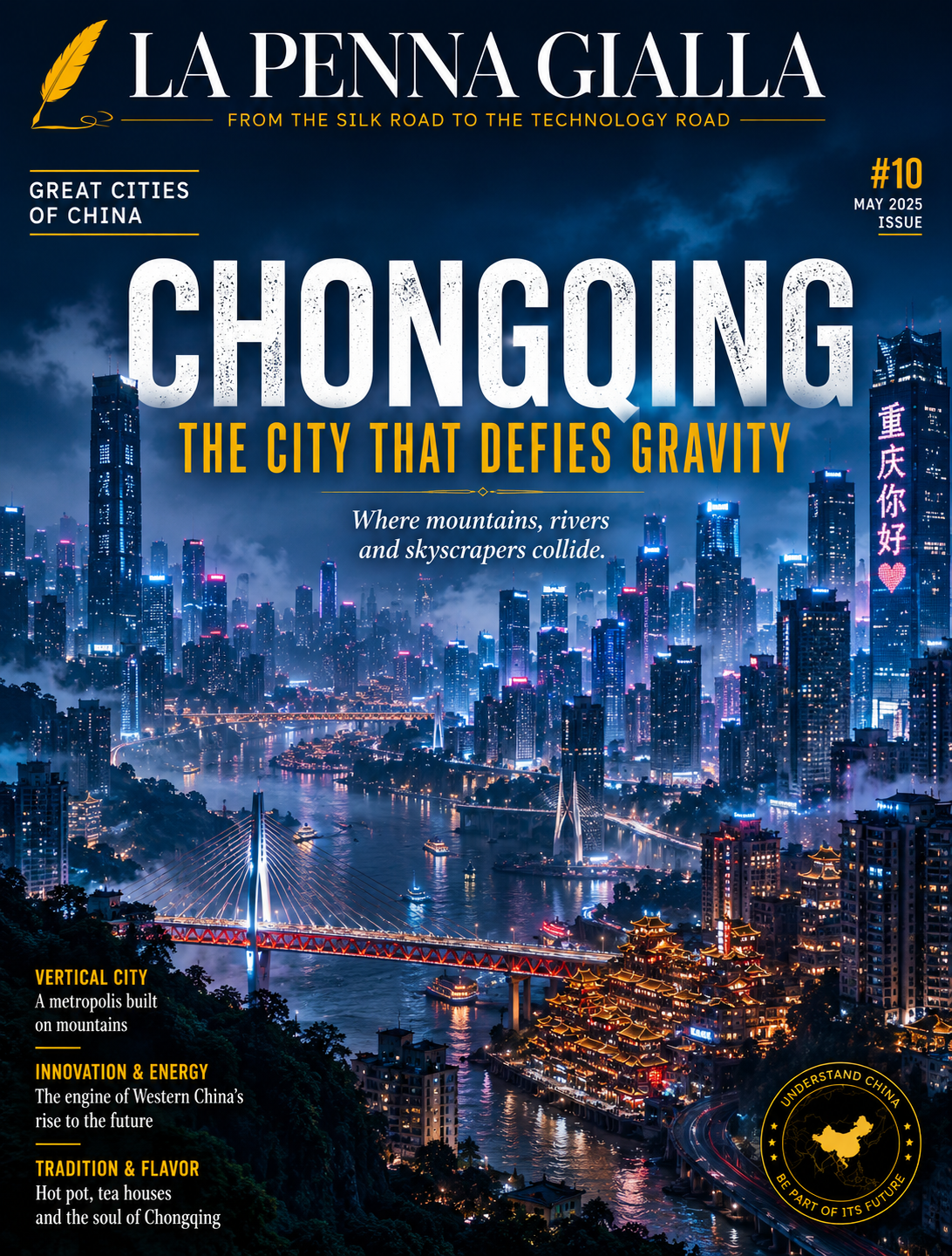
At first glance, it looks like something straight out of a science fiction movie. Skyscrapers emerge from the mist, highways weave through mountains, bridges stretch across vast rivers, and a metro line runs directly through a residential building.
Many people call it China's version of Blade Runner.
But Chongqing is not a movie set.
It is one of the largest and most extraordinary cities on Earth.
And perhaps one of the least understood outside China.
Where Rivers Meet Mountains
Located in southwestern China, Chongqing sits at the confluence of the Jialing and Yangtze Rivers.
For centuries, its strategic location made it a vital commercial hub connecting China's interior with the rest of the country.
Yet geography is the true architect of Chongqing.
Unlike many modern cities built across vast plains, Chongqing rises among steep hills, mountains, and valleys.
Nothing here is truly flat.
And that has shaped the city into something unique.
A Vertical Metropolis
Walking through Chongqing can feel disorienting.
A street that appears to be at ground level may actually be several stories above another road.
Pedestrian bridges connect neighborhoods suspended above busy avenues.
Elevators often replace stairways as the quickest way to navigate the city.
For this reason, Chongqing is frequently described as a vertical city.
Its growth is not limited to width or height.
It expands in every possible direction.
For visitors, getting lost is almost part of the experience.
The Metro That Runs Through a Building
Among the city's most famous landmarks is Liziba Station.
Here, trains on Metro Line 2 pass directly through a nineteen-story residential building.
Not underneath.
Not beside it.
Through it.
What initially looks like a digital manipulation is actually an ingenious urban planning solution.
Instead of demolishing the building or redesigning the rail line, engineers integrated the station into the structure itself.
The result has become one of the most recognizable images of modern China.
Practical.
Creative.
And unapologetically unconventional.
Hongyadong: A City of Lights
If one place captures Chongqing's visual identity, it is Hongyadong.
Built along a cliff overlooking the Jialing River, this multi-level complex combines traditional Chinese architectural styles with the dramatic topography of the city.
By day, it is impressive.
By night, it becomes magical.
Thousands of golden lights illuminate wooden facades, terraces, and rooftops, creating the illusion of an ancient city floating above the water.
It is no surprise that Hongyadong has become one of the most photographed locations in China.
When Night Falls
As darkness arrives, Chongqing transforms.
Mist drifts between skyscrapers.
Bridges glow above the rivers.
Digital billboards illuminate entire buildings.
Elevated roads weave through the skyline like streams of light.
It is at this moment that comparisons with science fiction become unavoidable.
Yet unlike the worlds imagined by filmmakers, Chongqing is entirely real.
And perhaps even more impressive because of it.
A City of More Than Thirty Million People
Many international visitors are surprised to discover the scale of Chongqing.
Its administrative region is home to more than thirty million people, making it one of the largest municipalities in the world.
In recent decades, it has emerged as a major center for manufacturing, logistics, research, higher education, and technology.
It also plays a strategic role in China's Belt and Road Initiative, serving as a gateway between western China and international markets.
While cities such as Shanghai and Shenzhen often dominate global headlines, Chongqing represents another side of China's development story.
Beyond the Skyline
Despite its futuristic appearance, Chongqing remains deeply connected to its traditions.
Local markets still thrive.
Tea houses remain gathering places for residents.
And the city's famous hot pot continues to bring families and friends together around tables filled with spice, heat, and conversation.
The old and the new do not compete here.
They coexist.
The China You Don't Expect
For many travelers, Chongqing is a revelation.
It lacks the imperial grandeur of Beijing.
It does not possess Shanghai's international reputation.
Nor is it known as China's technology capital.
Yet it tells one of the most important stories of modern China.
A story of growth beyond the coast.
A story of adaptation.
A story of a nation constantly reinventing itself.
La Penna Gialla Tells
Looking at Chongqing from above, it feels as though someone decided to build a city where no city should exist. Mountains, rivers, bridges, and skyscrapers combine to create an urban landscape unlike any other on Earth. Perhaps that is why Chongqing leaves such a lasting impression. Not because it looks like the future, but because it seems to have already arrived there.
Iscriviti e fai iscrivere al canale G-channel La Penna Gialla e non perderti le prossime novità
"Inserisci e fai inserire la tua Azienda o l'azienda di prossimità a costo zero".
"Siamo noi il tuo alleato digitale e con un semplice clic il tuo articolo puoi condividerlo su tutte le piattaforme"

I commenti degli utenti:
Non sono presenti commenti di altri utenti