




Mappa Interattiva - dove le persone incontrano le attività
How can a country as vast as China have transformed its geography, climate, history and culture into eight major culinary identities?
The first thing to forget when talking about Chinese food is precisely the idea of “Chinese cuisine” in the singular.
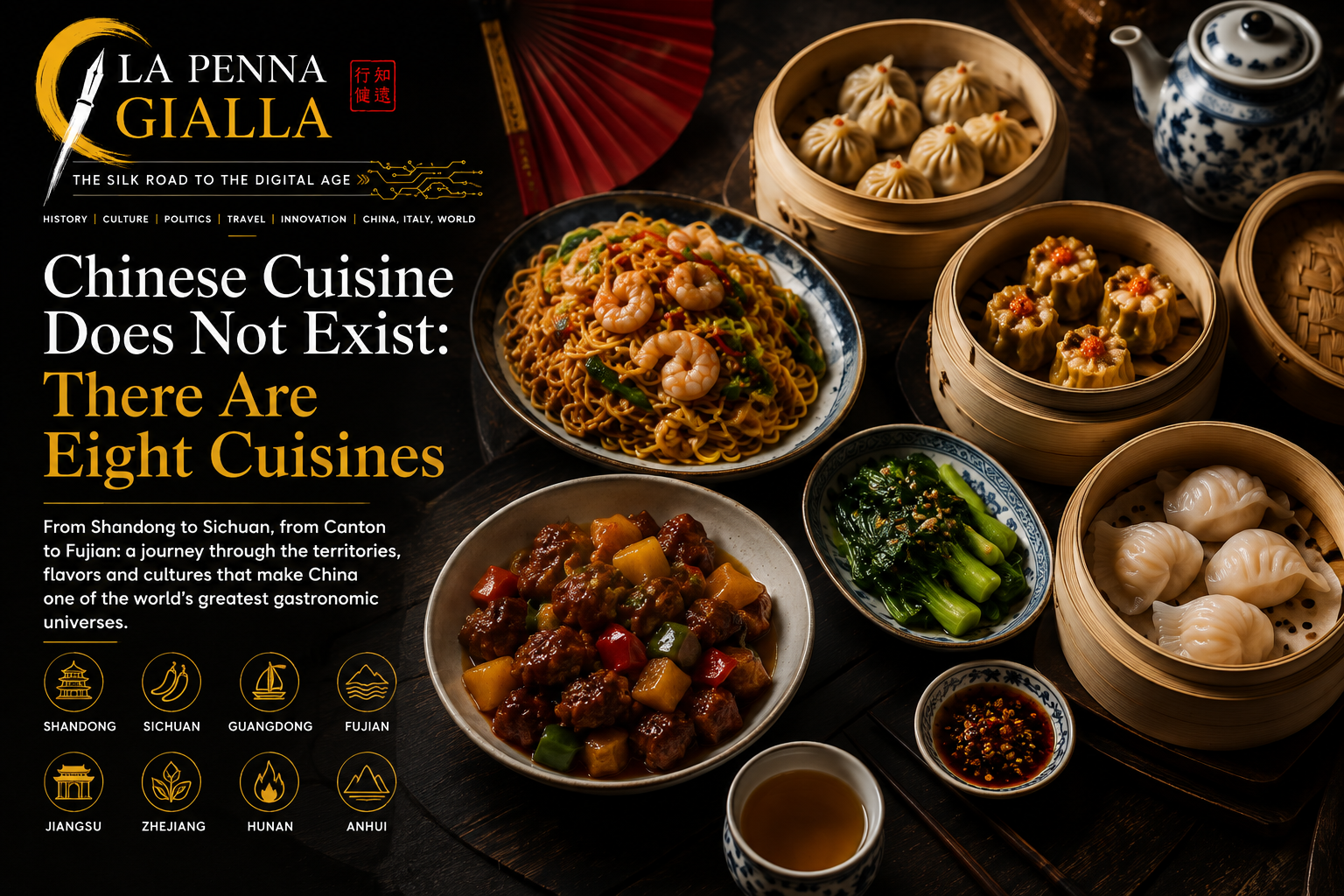
What we call Chinese cuisine in the West is actually a vast gastronomic universe made up of territories, ingredients, techniques and traditions that can be profoundly different from one another. The best-known classification brings together eight major regional traditions: Shandong, Sichuan, Guangdong, Fujian, Jiangsu, Zhejiang, Hunan and Anhui.
This is far more than an abstract distinction. In China, moving from one province to another can mean encountering a completely different way of eating: the relationship with spice, the use of fish and seafood, the importance of rice or wheat, cooking techniques and even the idea of balance between flavours can all change.
Cuisine, in other words, becomes a map of China that can be tasted.
When Geography Enters the Plate
To understand this variety, we have to begin with geography.
China encompasses profoundly different environments: vast agricultural plains, mountains, plateaus, coastlines, rivers and lakes. Shandong, for example, facing the Yellow Sea and the Bohai Sea and crossed by the lower reaches of the Yellow River, developed a cuisine deeply connected to marine resources as well as to a remarkable variety of land-based ingredients.
In the south, meanwhile, the relationship with the sea, the climate and the availability of fresh produce encouraged different culinary traditions. Zhejiang cuisine, for instance, places great importance on seasonality and on choosing ingredients at the moment when they are at their best, with fish, seafood, vegetables and fruit playing an important role.
In Fujian, geography creates an especially distinctive combination: a coastal province marked at the same time by mountains and hills. Its culinary tradition reflects this landscape, bringing together seafood and ingredients from mountainous areas.
The differences between China's regional cuisines are therefore not accidental.
Before cuisine becomes a question of recipes, it is a question of territory.
Eight Cuisines, Eight Characters
Chinese culinary tradition has transformed this geographical variety into distinct regional identities.
Shandong cuisine, or Lu cuisine, is regarded as one of the oldest and most technically sophisticated traditions. Its history reaches deep into northern China, while its relationship with the sea has made fish and seafood particularly important. It also played a significant role in the development of imperial cuisine.
Then there is Sichuan cuisine, perhaps one of the most recognisable Chinese culinary traditions around the world. Its defining characteristic is not simply heat, but the encounter between chilli and málà — the distinctive sensation created by combining chilli with Sichuan pepper.
It should not be confused with Hunan cuisine, another tradition famous for its use of chilli. But reducing Hunan food to spiciness would be far too simplistic. Its cuisine also embraces sour, aromatic and fresh flavours, alongside its own combinations and cooking techniques.
Further south, we find Cantonese cuisine, or Guangdong cuisine, which has perhaps become the most internationally familiar Chinese culinary tradition. Its long history developed through the interaction between local culture and influences arriving from other parts of China.
Jiangsu cuisine, meanwhile, is often associated with refined preparation and great attention to the cutting and presentation of ingredients. One of its most celebrated expressions is Huaiyang cuisine, developed around Huai'an, Yangzhou and Zhenjiang, where fish and other aquatic products play an important role.
Zhejiang cuisine shares certain characteristics with the culinary traditions of the Jiangnan region, but has its own identity: freshness, seasonality and attention to the quality of ingredients are central elements. Cooking techniques are selected according to the nature of the product.
Fujian cuisine reflects the particular landscape of the province: sea and mountains, fresh ingredients and preparations in which broths and soups have an important role. Its history has also been influenced by contacts with the outside world, including the long migratory tradition of its people.
Finally, there is Anhui cuisine, closely connected to a mountainous landscape and characterised by robust preparations, local ingredients and an important tradition of soups and slow cooking.
Eight names, therefore, but above all eight different ways of interpreting the relationship between people, territory and food.
It Is Not Just About Flavour
This is where Chinese cuisine becomes particularly interesting for anyone who wants to understand China.
Regional differences do not simply tell us whether a population prefers sweet, salty or spicy flavours. They tell us how people have lived and how their societies have changed.
The land determines what can be grown, raised or caught. Climate influences the availability of ingredients. Preservation techniques develop partly from the need to make resources last throughout the year. Trade routes bring new products and techniques. Migration brings different traditions into contact.
Cuisine thus becomes a form of memory.
This is also why certain dishes remain closely associated with a particular city or province. A dish is not simply something to eat: it can become a way of recognising oneself in a place.
And this becomes even more visible in China's contemporary cities.
Contemporary China Brings Everything to the Table
The growth of China's major cities has brought together cuisines that once belonged to distant regions.
In Beijing, Shanghai, Shenzhen, Guangzhou or Chengdu, people no longer eat exclusively according to local traditions. Restaurants, workers, students and migrants have carried their own culinary habits with them.
Regional cuisine travels with people.
This is particularly fascinating because it shows that tradition is not something static.
A recipe can travel hundreds or thousands of kilometres, encounter new ingredients, adapt to local tastes and become something slightly different without losing its connection to its origins.
The same process has taken place with Chinese cuisine outside China.
The Chinese Cuisine We Think We Know
When we enter a Chinese restaurant in Italy, therefore, we are not necessarily encountering “Chinese cuisine.”
We are encountering a selection of dishes and traditions that have travelled, adapted and, in some cases, become quite different from their original versions.
This is a normal process in the history of food. When a cuisine crosses a border, it changes: ingredients change, customers' habits change, portion sizes change and sometimes even the way dishes are presented changes.
That is why looking for a single, immutable model of authenticity would be misleading.
Chinese cuisine is, by its very nature, plural.
A Map You Can Eat
Perhaps that is the most fascinating part.
The eight major culinary traditions are not simply eight categories in a cookbook. They are the result of centuries of history, geography, trade, migration and adaptation.
From the seas of Shandong to the mountains of Anhui, from the intense flavours of Sichuan to Zhejiang's pursuit of freshness, from Cantonese traditions to the cuisine born between the sea and mountains of Fujian, each region has transformed what was available to it into its own idea of food.
So the next time we talk about “Chinese cuisine”, perhaps it is worth stopping for a moment.
Because behind that apparently simple definition there is not one tradition.
There are eight major ones — and many more besides.
And it is precisely at the table that China begins to tell its story.
Iscriviti e fai iscrivere al canale G-channel La Penna Gialla e non perderti le prossime novità
"Inserisci e fai inserire la tua Azienda o l'azienda di prossimità a costo zero".
"Siamo noi il tuo alleato digitale e con un semplice clic il tuo articolo puoi condividerlo su tutte le piattaforme"

I commenti degli utenti:
Non sono presenti commenti di altri utenti