




Mappa Interattiva - dove le persone incontrano le attività
For decades, the Moon was the symbol of a superpower rivalry. In 1969, with the Apollo 11 landing, the United States achieved a historic milestone that would remain forever etched in human history. Today, more than half a century later, that race has begun again. But the world has changed, the main players are different, and the objectives go far beyond reaching a largely unexplored surface.
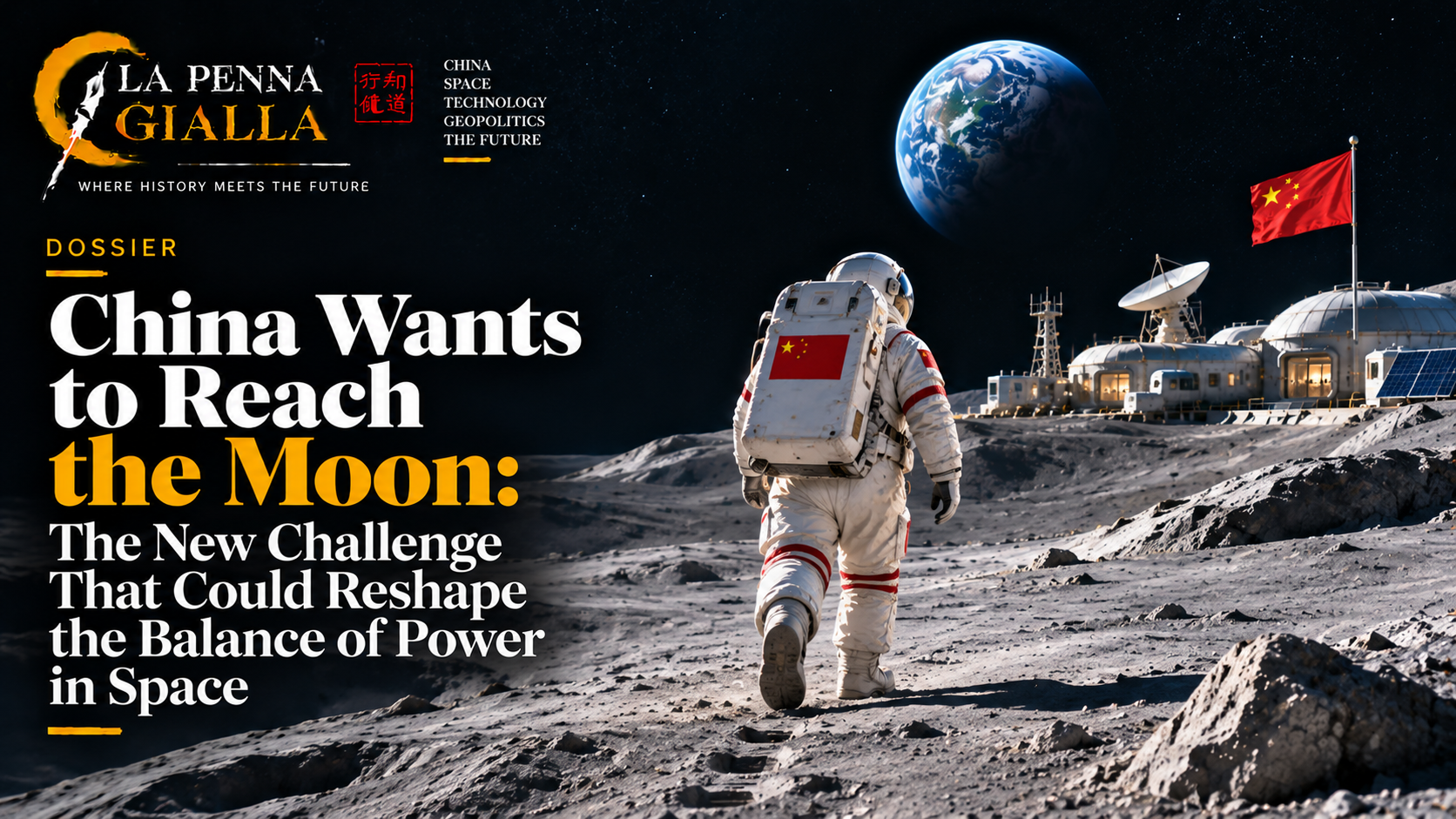
China wants to send its astronauts to the Moon by 2030. Its ambition is not simply to repeat an achievement already accomplished by the Americans. Beijing aims to become one of the world's leading space powers, establish a lasting presence beyond Earth and help shape the rules that will govern future lunar activities.
The question, therefore, is not simply when a Chinese astronaut will set foot on the Moon. It is something much bigger: who will have the power to decide how the Moon is used in the decades ahead?
The Moon Is Back at the Centre of Geopolitics
To understand the new space race, we need to start with a fundamental change. The Moon is no longer simply a scientific destination or the stage for a technological competition. It has become a potential strategic asset for the future of space exploration.
Its surface could host scientific facilities, communication systems, instruments for observing the universe and, in the longer term, installations capable of exploiting some of the resources available there. The possibility of building bases and developing technologies directly on the lunar surface opens up scenarios that, until recently, belonged largely to science fiction.
For China, investing in this sector means strengthening its technological independence, developing advanced industrial capabilities and gaining international influence in an area that is likely to become increasingly important.
The competition is therefore not just about who arrives first, but who will be able to remain, build and cooperate with other countries.
From Earth to the Moon: China's Lunar Programme
Beijing's strategy did not begin today. China's lunar programme, known as Chang'e, has progressively laid the scientific and technological foundations needed to undertake increasingly complex missions.
The name refers to Chang'e, the Moon goddess in Chinese mythology. It is a symbolic choice that accompanies a very practical programme, developed in several stages: reaching lunar orbit, exploring the surface, collecting samples and developing the technologies required for a future human presence.
One of the most important milestones came in June 2024, when the Chang'e-6 mission brought back samples from the far side of the Moon. It was the first time in history that humanity had successfully retrieved material from this region of the satellite. A major scientific achievement, it also demonstrated China's ability to carry out extremely complex space operations.
The programme continued with Chang'e-7, designed to explore the lunar South Pole, one of the areas considered most promising for future scientific and technological activities. The mission is intended to search for water ice inside permanently shadowed craters and analyse the environmental conditions of the region.
The launch, initially planned for 2026, has been postponed. Chinese space authorities indicated that the mission had not yet reached the conditions required for launch within the planned window. The technical details behind the decision have not been made public.
The postponement does not diminish the importance of the project, but it highlights just how difficult it is to turn an ambitious programme into an operational mission. Every stage must be carefully verified: a failure during a lunar mission can jeopardise years of work and enormous investment.
2030: The Year a Chinese Astronaut Could Walk on the Moon
Beijing's stated goal is to land a Chinese astronaut on the lunar surface by 2030. To achieve it, China is developing three essential systems: the Long March 10 rocket, the Mengzhou spacecraft and the Lanyue lunar lander.
The Long March 10 will be the launch vehicle responsible for carrying the spacecraft required for the mission into space. Mengzhou, whose name can be translated as “Dream Vessel”, will transport the astronauts. Lanyue, meaning “embracing the Moon”, will enable the crew to travel from lunar orbit to the surface and then return.
The plan involves two separate launches: one to carry the crewed spacecraft into orbit and another to deliver the lunar lander. The two systems will then have to meet and dock in lunar orbit. At that point, some of the astronauts will transfer to the lander to descend to the surface, while the main spacecraft remains in orbit.
After completing their activities on the Moon, the astronauts will take off in the lander, reconnect with the spacecraft and begin their journey back to Earth.
It is an operation requiring extraordinary precision. Docking two vehicles in orbit, making a controlled descent, taking off from the lunar surface and carrying out a second rendezvous must all work flawlessly. Nearly 400,000 kilometres from Earth, the possibilities for rapid intervention in an emergency are extremely limited.
Throughout 2026, testing of the main systems has continued. China has already carried out safety tests on the Mengzhou spacecraft, launch-system checks and tests of the Lanyue lander's descent and take-off capabilities. A new spacesuit, called Wangyu, is also under development. It is designed to protect astronauts from the environmental conditions on the lunar surface and allow them to work outside their spacecraft.
The 2030 target is therefore part of a much broader industrial and scientific programme. China must demonstrate that it can manage the entire sequence of operations required for a crewed lunar mission, from launch on Earth to the safe return of its astronauts.
Why the Lunar South Pole?
One of the most important aspects of the new lunar exploration race is the choice of where to go. International interest is increasingly focused on the South Pole, a region that may contain reserves of water ice inside permanently shadowed craters.
In space, water is much more than something to drink. If it can be extracted and processed directly on the Moon, it could support astronauts and, through technological processes that still need to be developed on an operational scale, contribute to the production of oxygen and rocket propellant.
This could fundamentally change the prospects for future missions. Transporting every litre of water, every component and every quantity of fuel from Earth involves enormous costs. Being able to use resources available on the Moon could reduce, at least partially, dependence on supplies from our planet.
The South Pole is also interesting because of its environmental conditions. Some areas receive sunlight for relatively long periods, while others remain permanently in darkness. This unusual geography could provide favourable locations for energy systems while allowing scientists to study ice deposits preserved at extremely low temperatures.
For this reason, the competition is not simply about reaching the Moon. It is also about exploring and operating in the regions considered most promising.
An International Lunar Base: China's Ambitions Extend Beyond 2030
A crewed landing is only an intermediate objective. China's vision extends to establishing a lasting scientific presence on the Moon.
Together with Russia, Beijing is promoting the International Lunar Research Station, known as ILRS. The project envisages the construction of a facility dedicated to scientific research and technological experimentation, with infrastructure on the lunar surface and, in the longer term, in lunar orbit.
The idea is to develop a system capable of supporting robotic missions and, eventually, human activities. The station is expected to include energy systems, communications, scientific instruments and vehicles for travelling across the lunar surface.
China's roadmap envisages an initial development phase by 2035, followed by further expansion towards a more advanced facility by 2045. These are long-term objectives that will depend on the results of preliminary missions and the ability to maintain the necessary investment.
International cooperation is an integral part of the project. China has stated that it wants to involve other countries, scientific organisations and technological partners. The programme is therefore presented not simply as a national initiative, but as a potential framework for international cooperation in lunar exploration.
However, the actual participation of different countries will depend on economic, technological and diplomatic considerations. Building a base on the Moon requires resources that few governments can provide independently.
United States and China: Two Visions for the Future of the Moon
The new lunar race has inevitably brought the United States back into the spotlight. The American Artemis programme, led by NASA with the involvement of international partners and private companies, aims to return astronauts to the lunar surface and develop the infrastructure required for a longer-term presence.
The two strategies share some objectives, but they are being pursued through different networks of international cooperation.
The United States has promoted the Artemis Accords, a set of principles designed to encourage international cooperation in the exploration and peaceful use of space. They address issues such as transparency, the sharing of scientific information, the interoperability of systems and the coordination of operations.
China, together with Russia, is building its own network of cooperation through the International Lunar Research Station project.
This does not mean that the Moon is about to be formally divided into two opposing territories. International space law, beginning with the 1967 Outer Space Treaty, establishes that the Moon cannot be subject to national appropriation. No country can claim sovereignty over it in the same way it might claim territory on Earth.
The challenge is that future activities could concentrate in the same areas of greatest scientific and economic interest. If several countries seek to install instruments, energy systems or infrastructure in the same region, coordination will become essential to avoid interference and potential conflict.
This issue is particularly sensitive at the South Pole, where areas receiving sunlight and potentially accessible ice deposits are limited.
In this scenario, the ability to build alliances and establish shared standards could become just as important as the technology needed to reach the lunar surface.
The Technology Needed to Live on the Moon
Establishing a permanent human presence on the Moon requires solutions very different from those used during the short missions of the Apollo programme.
The Moon has no breathable atmosphere, experiences extreme temperature variations and offers no significant protection against radiation from space. Its surface is also covered with regolith, a fine, abrasive dust that can damage instruments, spacesuits and equipment.
Future facilities will therefore have to address a range of complex challenges: providing energy, maintaining temperatures compatible with human life, recycling water and air, protecting astronauts and ensuring continuous communication with Earth.
Construction itself is another major challenge. Transporting building materials from Earth would be extremely expensive. For this reason, research is focusing on the possibility of using lunar regolith to manufacture components, protective structures and building materials through technologies such as 3D printing.
Robotics will also play a crucial role. Before astronauts can live on the Moon, robotic systems and automated vehicles will need to prepare the ground, assess environmental conditions, transport instruments and carry out dangerous operations.
Cooperation between humans and machines will therefore be one of the defining features of future missions. Astronauts will not necessarily have to perform every task themselves. They will be able to coordinate robots, analyse data and intervene directly only when necessary.
This is a very different model of exploration from that of the 1960s, when the main objective was to prove that a human being could reach the Moon and return safely to Earth.
The Moon as the First Step Towards Mars
There is one final reason why this programme is particularly significant: the Moon could become a laboratory for preparing future missions to Mars.
A journey to the Red Planet will require technologies far more advanced than those needed to reach our natural satellite. Astronauts will have to spend extended periods away from Earth, manage autonomous life-support systems and operate in extremely hostile environments.
The Moon offers an opportunity to test some of these solutions at a relatively short distance from Earth. Energy systems, construction techniques, robotic equipment and procedures for maintaining a human presence in an extraterrestrial environment can all be tested there.
For China, developing a lunar presence therefore means building expertise that could also prove strategically valuable for future missions.
The same logic applies to the United States and other countries involved in space exploration. The Moon is not necessarily the final destination, but it could become an essential stepping stone towards understanding how humanity can travel farther into space.
Who Will Write the Rules of the New Space Age?
The new race to the Moon says a great deal about the historical moment we are living through. Technological competition between China and the United States is no longer limited to semiconductors, artificial intelligence, telecommunications or electric vehicles. It is extending into space, where scientific and industrial capabilities can translate into international influence.
China wants to demonstrate that it can reach the Moon with its own astronauts, build infrastructure and lead an international project. The United States intends to maintain a central role through Artemis and an increasingly broad network of partners. Other countries, from Europe to India, Japan and South Korea, are also seeking to establish their position in this new phase of exploration.
The real challenge, however, may not simply be getting there first. It will be deciding how to use an environment that no country can claim as its exclusive property, and how to prevent technological competition from turning into a new geopolitical confrontation.
When a Chinese astronaut walks on the Moon, if the 2030 target is achieved, we will not simply be witnessing another chapter in the history of space exploration. We will be seeing the outcome of a strategy built over decades through investment, research and industrial development.
And perhaps the most important question will not be who leaves the first footprints on the lunar surface, but who has the capabilities, alliances and technologies to build what comes next.
Iscriviti e fai iscrivere al canale G-channel La Penna Gialla e non perderti le prossime novità
"Inserisci e fai inserire la tua Azienda o l'azienda di prossimità a costo zero".
"Siamo noi il tuo alleato digitale e con un semplice clic il tuo articolo puoi condividerlo su tutte le piattaforme"

I commenti degli utenti:
Non sono presenti commenti di altri utenti