




Mappa Interattiva - dove le persone incontrano le attività
For generations, the inhabitants of Xiyaogou lived surrounded by mountains, cut off from easy access to the outside world. Reaching nearby communities meant following steep, narrow paths, while transporting goods and travelling beyond the valley required considerable effort.
Then the villagers decided to change their future. Without modern machinery or the resources of a major construction company, they began carving a road directly into the mountainside.
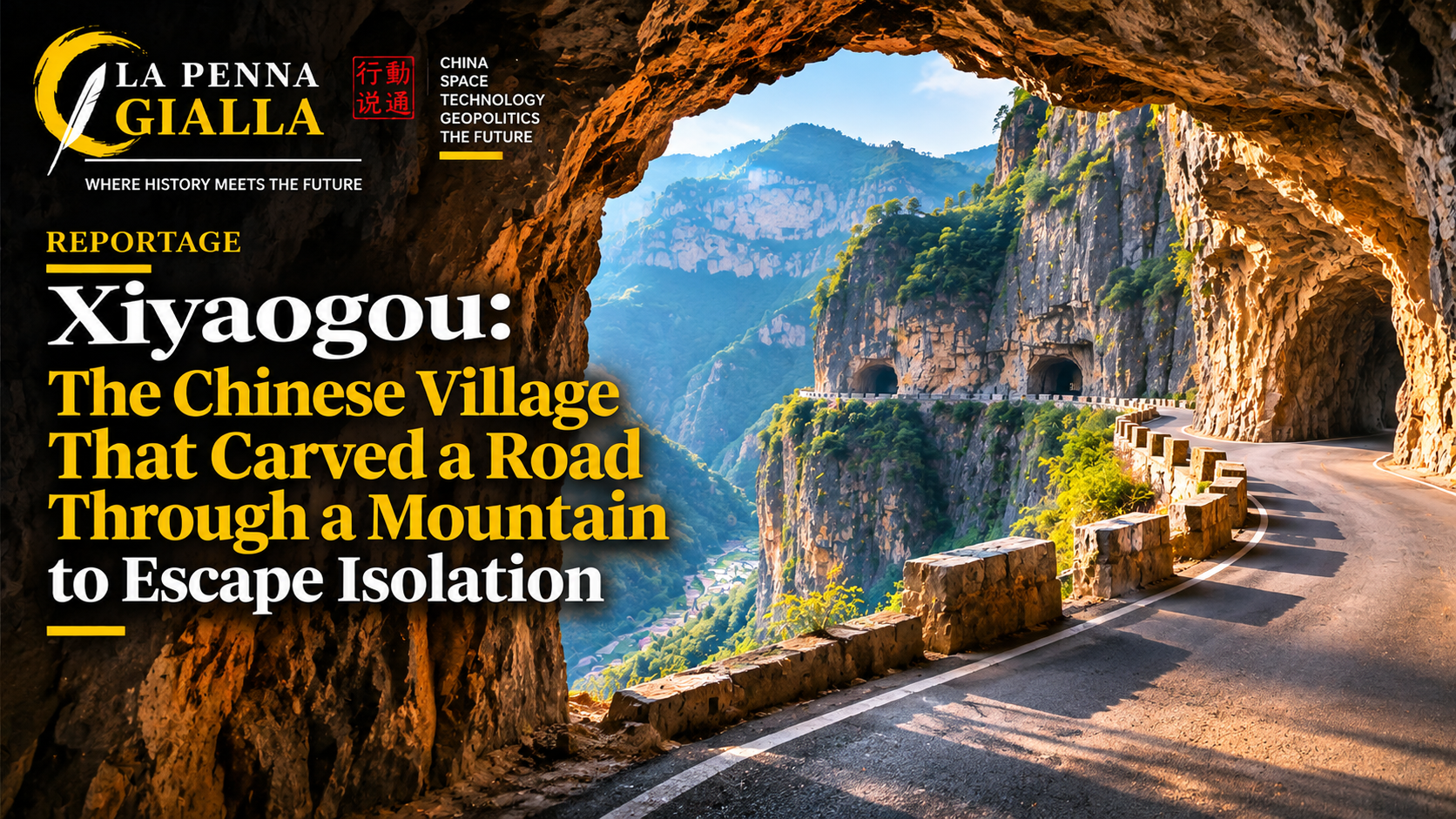
The undertaking would take decades and involve several generations. The result is a spectacular route of approximately 7.5 kilometres, winding along the cliffs of the Taihang Mountains, through tunnels carved into solid rock and passages overlooking deep valleys.
Today, the road attracts visitors from across China. But its original purpose was far more important than tourism: it was built to connect an isolated community with the rest of the world.
A village hidden among the Taihang Mountains
Xiyaogou is located in Lingchuan County, Shanxi Province, in northern China, near the border with Henan.
The village lies in a valley surrounded by steep rocky slopes and deep gorges. Its landscape is striking, but for its inhabitants, the mountains were once a major obstacle to everyday life.
Before the road existed, people relied on narrow mountain paths to reach neighbouring settlements. Goods had to be carried by hand or transported with animals, while access to schools, healthcare and commercial opportunities remained difficult.
The geography offered few alternatives. If the village wanted to become better connected, someone would have to find a way through the rock.
An extraordinary construction project
The first efforts to improve access began in 1962. With limited resources, villagers managed to open a basic route, but it was not suitable for cars.
The decisive phase began in November 1982, when the community resumed the project with a more ambitious objective: to carve a proper road into the mountain itself.
One of the people involved was Song Zhilong, a former soldier with experience in military engineering techniques. His knowledge helped organise an undertaking that required careful planning and considerable determination.
There were no modern construction machines. Villagers worked with hammers, chisels and basic tools, removing rock metre by metre. In the most difficult sections, workers were suspended from ropes against the cliff face to reach the areas where the road had to be carved.
The project became a collective effort. While some residents worked on the mountain, others continued to look after farming and the daily needs of the community.
It was not simply a construction site: it was a shared ambition that involved several generations.
Thirty years to open a way out
The road was finally completed on 10 June 1991, allowing vehicles to reach the village.
Stretching for approximately 7.5 kilometres, it follows the contours of the mountain, alternating between exposed sections along the cliff and tunnels carved through the rock.
Openings in the tunnels allow natural light to enter and reveal dramatic views of the valleys below. Even today, looking at the road, it is difficult to imagine how such an ambitious structure could have been created with such basic equipment.
For the inhabitants, however, its greatest value was practical. Transporting goods became easier, journeys took less time and access to education, services and employment opportunities improved.
The village had finally gained a connection with the outside world.
From isolation to tourism
As access improved, Xiyaogou gradually attracted attention beyond the region.
Visitors came to see the remarkable road, but they also discovered the surrounding landscape: the steep cliffs, mountain gorges, streams and traditional stone houses of the Taihang Mountains.
Tourism began to offer new economic opportunities. Local families could earn additional income through restaurants, local products and services for visitors. The proximity of attractions such as Wangmangling helped increase interest in the area.
The mountain, once an obstacle to development, had become an asset.
A new road was built in 2006 to provide more convenient access to the village. The original cliffside route gradually took on a different role, becoming a tourist attraction and a reminder of the community's extraordinary achievement.
Today, visitors can admire its tunnels, dramatic openings and winding passages, while learning about the people who created it.
A road that changed a village's future
Xiyaogou tells a different story from the one usually associated with China's transformation. There are no skyscrapers, high-speed trains or cutting-edge technologies here. There is simply a mountain, a small village and a community that refused to accept isolation as its destiny.
The road changed how people travelled, traded and worked. It opened new economic possibilities and helped turn a remote settlement into a destination.
For visitors, the route is a spectacular feat of human determination. For the inhabitants, it represents something much more personal: the achievement of generations who believed that their village deserved a way forward.
At Xiyaogou, the mountain was neither demolished nor bypassed. The villagers carved their own passage through it.
And that road still tells a powerful story: sometimes, the way to a different future begins with the decision to build it yourself.
Iscriviti e fai iscrivere al canale G-channel La Penna Gialla e non perderti le prossime novità
"Inserisci e fai inserire la tua Azienda o l'azienda di prossimità a costo zero".
"Siamo noi il tuo alleato digitale e con un semplice clic il tuo articolo puoi condividerlo su tutte le piattaforme"

I commenti degli utenti:
Non sono presenti commenti di altri utenti