




Mappa Interattiva - dove le persone incontrano le attività
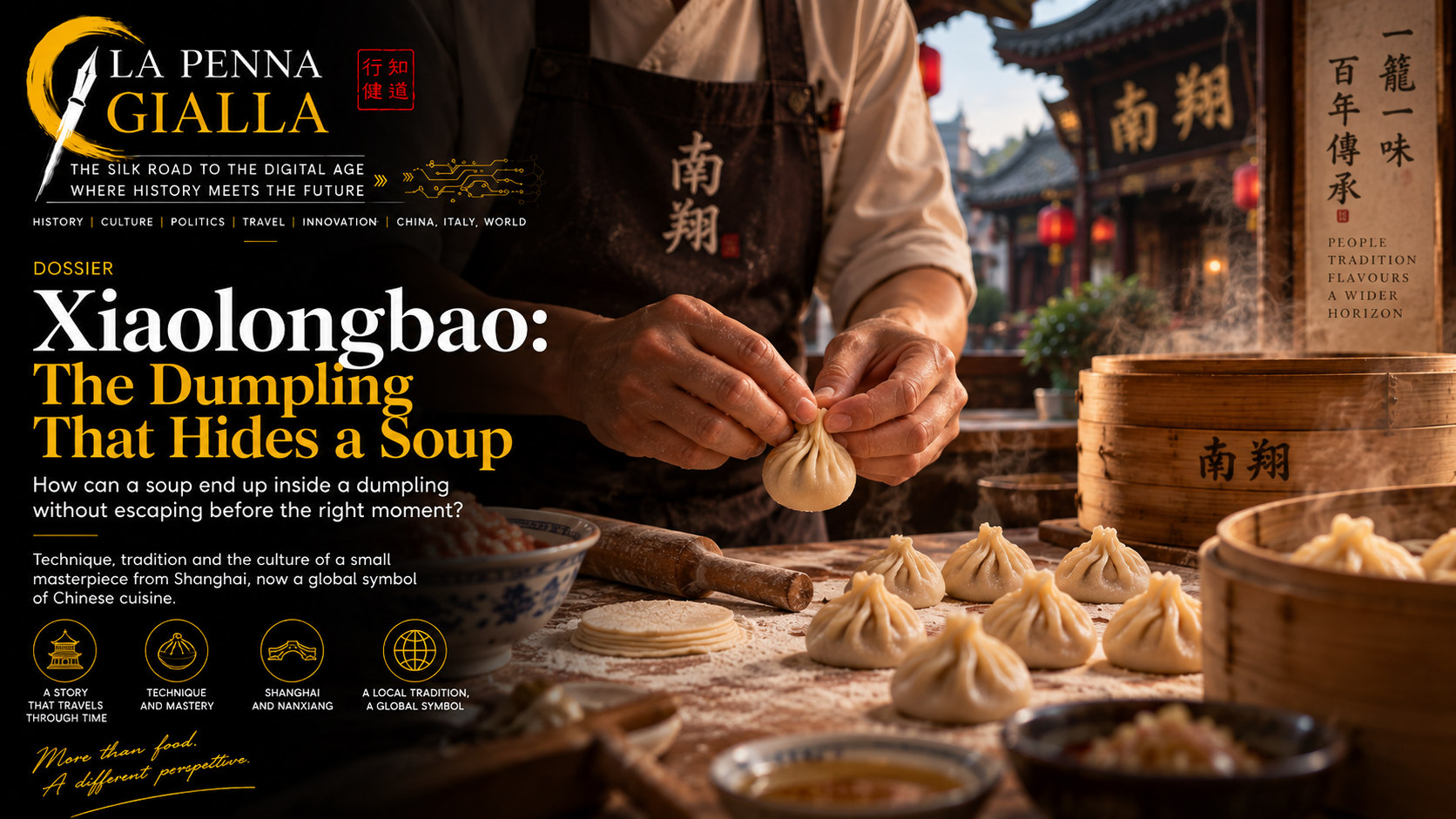
How can a soup end up inside a dumpling without escaping before the right moment?
There is a moment, when a basket of xiaolongbao arrives at the table, when hunger has to wait for a few seconds.
The small dumpling sits inside a bamboo steamer, its delicate skin almost translucent, its folds gathered tightly at the top. It looks harmless. It is not.
Inside that tiny parcel is something that, at first glance, should not be there at all: a surprising amount of hot broth.
The natural instinct is to pick it up with chopsticks and eat it in one bite. It is also the quickest way to regret being in a hurry.
Because xiaolongbao is not simply a stuffed dumpling. It is a small exercise in balance: between dough and filling, heat and patience, tradition and technique. Above all, it is one of the most recognisable expressions of Shanghai’s culinary culture, where an apparently simple gesture — wrapping meat inside a thin layer of dough — has become an art.
The real question, then, is not simply how to eat it.
It is: how did the soup get in there in the first place?
It begins long before Shanghai
The story of xiaolongbao does not begin simply with the idea of making a smaller dumpling.
Its roots lie in the long Chinese tradition of filled dough products and steamed breads. Official Shanghai sources connect its development to the traditions of mantou dating back to the Song period, as well as to the movement of people and culinary techniques from northern China towards Jiangnan, the region around the lower reaches of the Yangtze River.
Over the centuries, these traditions encountered local ingredients, tastes and cooking techniques.
It was in the nineteenth century, however, that the form we recognise today began to emerge.
In Nanxiang, now part of Shanghai’s Jiading District, tradition dates the development of modern xiaolongbao to 1871, when Huang Mingxian, owner of the Ri Hua Xuan pastry shop, is said to have refined the traditional filled bun.
The idea was deceptively simple: make the familiar stuffed bun smaller, more delicate and more refined.
But one particular addition changed everything.
Meat aspic was incorporated into the filling.
When the dumpling was steamed, the aspic melted.
And became broth.
That is the small culinary trick that still makes the seemingly impossible possible.
The soup is not poured into the dumpling
This is probably the first thing worth understanding.
The broth inside a xiaolongbao is not simply poured into the dumpling as a liquid before the dough is sealed. That would make it extremely difficult to handle and cook without losing it.
Instead, the broth is concentrated and transformed into a gelatinous form. This is combined with the filling, traditionally based on pork. At room temperature, the mixture is firm enough to be enclosed inside the dough.
Then comes the steam.
As the dumpling cooks, the heat melts the gelatin. The filling cooks, while the liquid remains enclosed within the thin wrapper.
What reaches the table is therefore the result of a transformation: a broth that changes state so it can be enclosed inside a dumpling, then becomes broth again during cooking.
The magic is really nothing more than cooking technique applied with extraordinary precision.
But that precision is exactly what makes the difference.
The hardest part is the part you can barely see
A well-made xiaolongbao has to bring together three elements that seem almost incompatible.
The dough must be thin enough to feel delicate when you bite into it, but strong enough to hold the broth. The filling must have the right texture and balance between meat and fat. And the top must be sealed firmly enough to survive steaming without breaking.
In Shanghai, and particularly in the Nanxiang tradition, this precision has become part of the identity of the dish.
Traditional versions are distinguished by their thin wrapper, generous filling and numerous folds gathered at the top. Official Shanghai sources associate Nanxiang xiaolongbao with at least 18 folds.
Those folds may look decorative.
They are not.
They are the visible signature of a technique in which appearance and function become one.
The dumpling has to be beautiful because it has to be precise.
The real ritual begins when the basket reaches the table
The bamboo steamer opens, and the aroma arrives before the first bite.
This is when you have to slow down.
A freshly steamed xiaolongbao contains extremely hot broth. The traditional way of eating it is to lift the dumpling carefully, place it on a spoon and make a small opening in the wrapper to release some of the steam.
Only then is it time to taste the broth and finally eat the dumpling itself.
In Shanghai, the process is sometimes reduced to a simple sequence: lift gently, move slowly, open first, then drink.
It is a small gesture, but it says something important about the culinary culture that created the dish.
Xiaolongbao is not designed to be rushed.
It demands attention.
First you have to understand where to hold it. Then how to open it. Then you have to wait for the heat to become manageable.
Only after that comes the bite.
Nanxiang, where the dumpling became an identity
To understand how closely xiaolongbao is tied to Shanghai, it helps to look beyond the centre of the metropolis and towards Nanxiang.
The ancient town is far older than its famous dumpling. Its history stretches back more than 1,500 years, and its name is associated with Baihe Nanxiang Temple, built in 505.
Here, food is not an addition to the history of the place.
It has become part of it.
Today, Nanxiang is associated with xiaolongbao almost as strongly as Shanghai itself. Historic streets, gardens and places of memory coexist with restaurants and workshops where the technique continues to be passed from one generation to the next.
It is an interesting example of how a culinary speciality can become cultural heritage, not simply because it is old, but because a community continues to recognise itself in the way it is made.
There is no single xiaolongbao
As with so much of Chinese cuisine, speaking of a single, fixed model can be misleading.
Xiaolongbao has developed different regional interpretations, with variations in the flavour of the broth, sweetness, dough and filling. Shanghai, Changzhou and Wuxi, for example, have developed distinct traditions while sharing the fundamental idea of a small steamed dough parcel filled with meat and broth.
That distinction matters.
Because xiaolongbao, like the great regional traditions of Chinese cuisine, tells the story of a country in which recipes travel, change and adapt.
A dish does not necessarily lose its identity when it changes.
Sometimes, those variations are precisely what make its history more interesting.
From Shanghai to the world
Today, xiaolongbao is known far beyond China.
It has found its way onto international menus, into gastronomic guides and into contemporary cuisine. It has been reinterpreted with different ingredients and, in some cases, transformed into a fine-dining creation.
Its evolution has not stopped at restaurants.
In Shanghai, new products and techniques have also appeared to make traditional xiaolongbao easier to prepare outside restaurants, including modern cooking systems aimed at younger consumers and contemporary retail.
This is the fate of many dishes that become symbols.
First they are protected.
Then they travel.
Eventually, they are reinvented.
The challenge is to modernise without reducing the dish to a generic imitation of itself.
The small dumpling that tells the story of Shanghai
Perhaps this is why xiaolongbao deserves more attention than that normally given to a street-food speciality.
Inside a wrapper only a few centimetres wide are at least three layers of history.
There is the ancient Chinese tradition of dough and steam cooking. There is the culinary evolution of Jiangnan and Shanghai. And there is the ability of contemporary Chinese cuisine to transform a traditional technique into something that remains recognisable even after crossing borders and generations.
But there is also something much simpler.
Xiaolongbao reminds us that food is not only what we eat, but the way a culture chooses to transform ingredients, time and technique into an everyday gesture.
That is why its real secret is not actually the soup.
The soup is simply the visible result.
The true secret lies in everything that has to happen first: the concentrated broth, the gelatin, the filling, the thin wrapper, the folds, the steam, the patience of the person making it and the patience of the person eating it.
And when the little parcel finally opens and the broth slips into the spoon, history suddenly becomes tangible.
You are no longer looking at a tradition.
You are tasting it.
Iscriviti e fai iscrivere al canale G-channel La Penna Gialla e non perderti le prossime novità
"Inserisci e fai inserire la tua Azienda o l'azienda di prossimità a costo zero".
"Siamo noi il tuo alleato digitale e con un semplice clic il tuo articolo puoi condividerlo su tutte le piattaforme"
I commenti degli utenti:
Non sono presenti commenti di altri utenti