




Mappa Interattiva - dove le persone incontrano le attività
Some habits are more surprising than skyscrapers.
More surprising than high-speed trains.
Even more surprising than self-driving cars.
One of them is the way people pay.
You arrive in China.
You walk into a small neighborhood shop to buy a bottle of water.
You reach for your wallet.
The shopkeeper smiles.
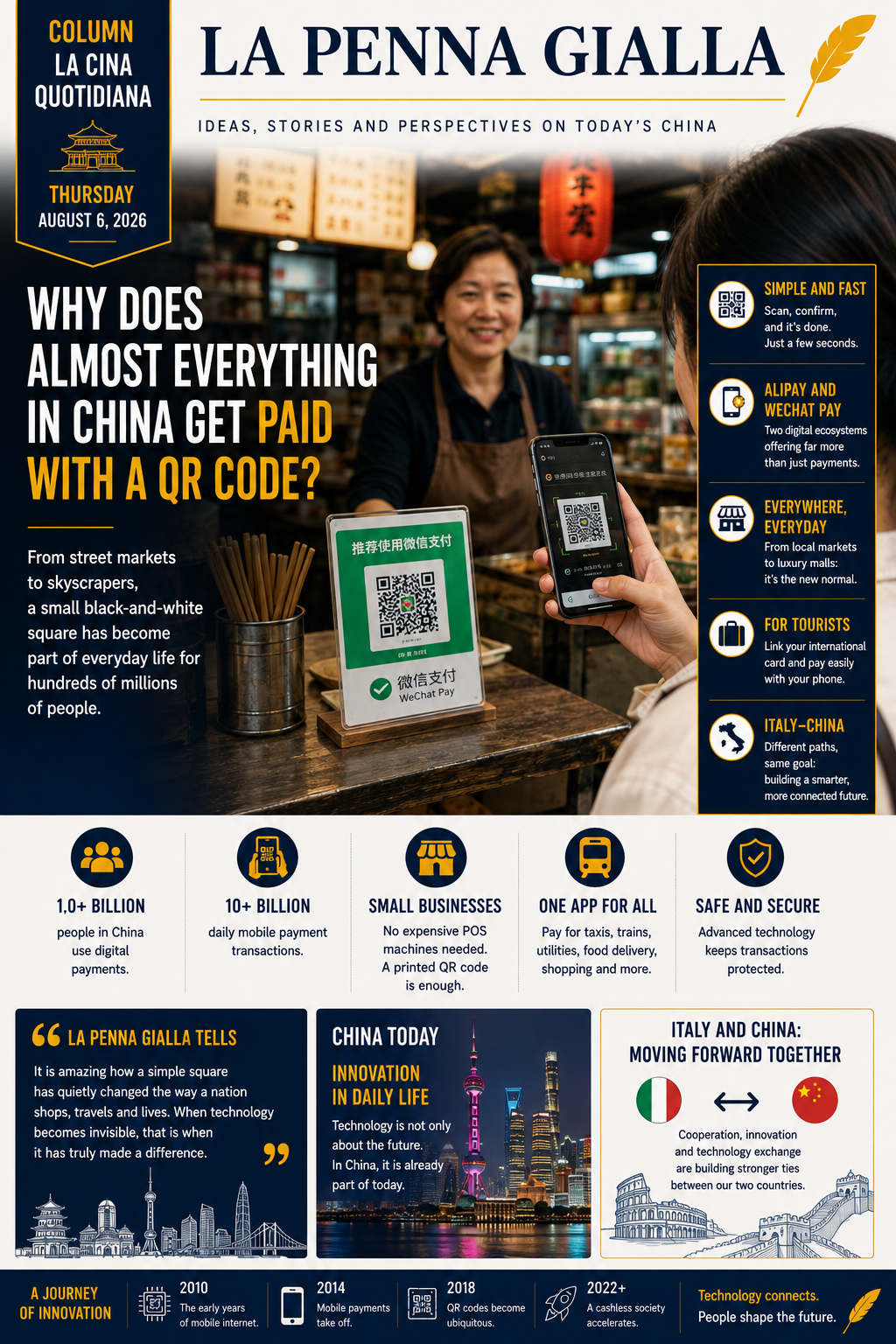
Instead of pointing to a card terminal, they point to a simple printed QR code sitting on the counter.
No cash register.
No credit card machine.
No change.
You simply open an app on your smartphone, scan the code and confirm the payment.
A few seconds later, the transaction is complete.
In China, this is not a glimpse of the future.
It is everyday life.
📌 Why It Matters
China is one of the world's most advanced societies when it comes to digital payments. Every day, hundreds of millions of people use their smartphones to buy food, pay for transportation, book services, shop online and even make donations at temples. The QR code has become one of the clearest symbols of how digital technology has reshaped daily life across the country.
A Revolution Powered by Smartphones
In many countries, digital payments evolved through credit and debit cards.
China followed a different path.
The smartphone became the center of the entire payment experience.
As mobile internet expanded rapidly, millions of people adopted applications that combined communication, shopping, banking and payments into a single digital ecosystem.
The result was remarkable.
Many consumers skipped an entire stage of financial evolution.
They moved almost directly from cash to mobile payments.
A Small Black-and-White Square
At first glance, a QR code looks like nothing more than a geometric pattern.
In reality, it contains all the information needed to identify a merchant or receive a payment.
For businesses, it is inexpensive.
There is no need for complex equipment.
A printed card is often enough.
For customers, the process is even simpler.
Open the payment app.
Scan the code.
Confirm.
The transaction is completed within seconds.
Its simplicity is precisely what made the system so successful.
More Than a Digital Wallet
Whenever digital payments in China are discussed, two names almost always appear.
Alipay and WeChat Pay.
Neither is simply a payment application.
Both are complete digital ecosystems.
With the same app, users can order food, book train tickets, call a taxi, pay utility bills, transfer money to friends, schedule medical appointments and shop online.
Paying is only one feature among many.
For millions of people, these platforms have become an essential part of everyday life.
From Street Markets to Skyscrapers
One of the most impressive aspects of China's payment system is its universality.
The same QR code can be found inside luxury shopping malls in Shanghai.
It is equally common at local fruit stands.
Family restaurants.
Taxi drivers.
Convenience stores.
Street food vendors.
Even street performers sometimes display a QR code for voluntary donations.
Few technologies have spread so naturally across every level of society.
What About International Visitors?
Traveling in China has become much easier in recent years.
Major payment platforms now allow many international visitors to link foreign bank cards to their accounts, making mobile payments accessible during their stay.
Carrying some cash can still be useful in certain situations.
However, for many travelers, the smartphone has effectively replaced the traditional wallet.
🇮🇹 Italy–China
Digital payments continue to grow in Italy through contactless cards and mobile wallets. China has taken a different approach by placing QR codes at the center of everyday transactions, creating a payment ecosystem that connects shopping, transportation, public services and communication. Both countries are embracing digital innovation, but each has followed its own path toward a more connected economy.
La Penna Gialla Tells
When people think about China's technological transformation, they often imagine futuristic skylines.
Electric vehicles.
Artificial intelligence.
High-speed railways.
Yet one of the country's most influential innovations is remarkably simple.
A small black-and-white square.
It makes no noise.
It does not move.
It does not attract attention.
And yet, every single day, it allows hundreds of millions of people to shop, travel and live more conveniently.
Perhaps that is the true power of technology.
Not when it amazes us.
But when it becomes so natural that we almost stop noticing it.
That is when we realize it has quietly changed the way we live.
Iscriviti e fai iscrivere al canale G-channel La Penna Gialla e non perderti le prossime novità
"Inserisci e fai inserire la tua Azienda o l'azienda di prossimità a costo zero".
"Siamo noi il tuo alleato digitale e con un semplice clic il tuo articolo puoi condividerlo su tutte le piattaforme"
I commenti degli utenti:
Non sono presenti commenti di altri utenti