



Mappa Interattiva - dove le persone incontrano le attività
What does the way people share food tell us about the way relationships are lived?
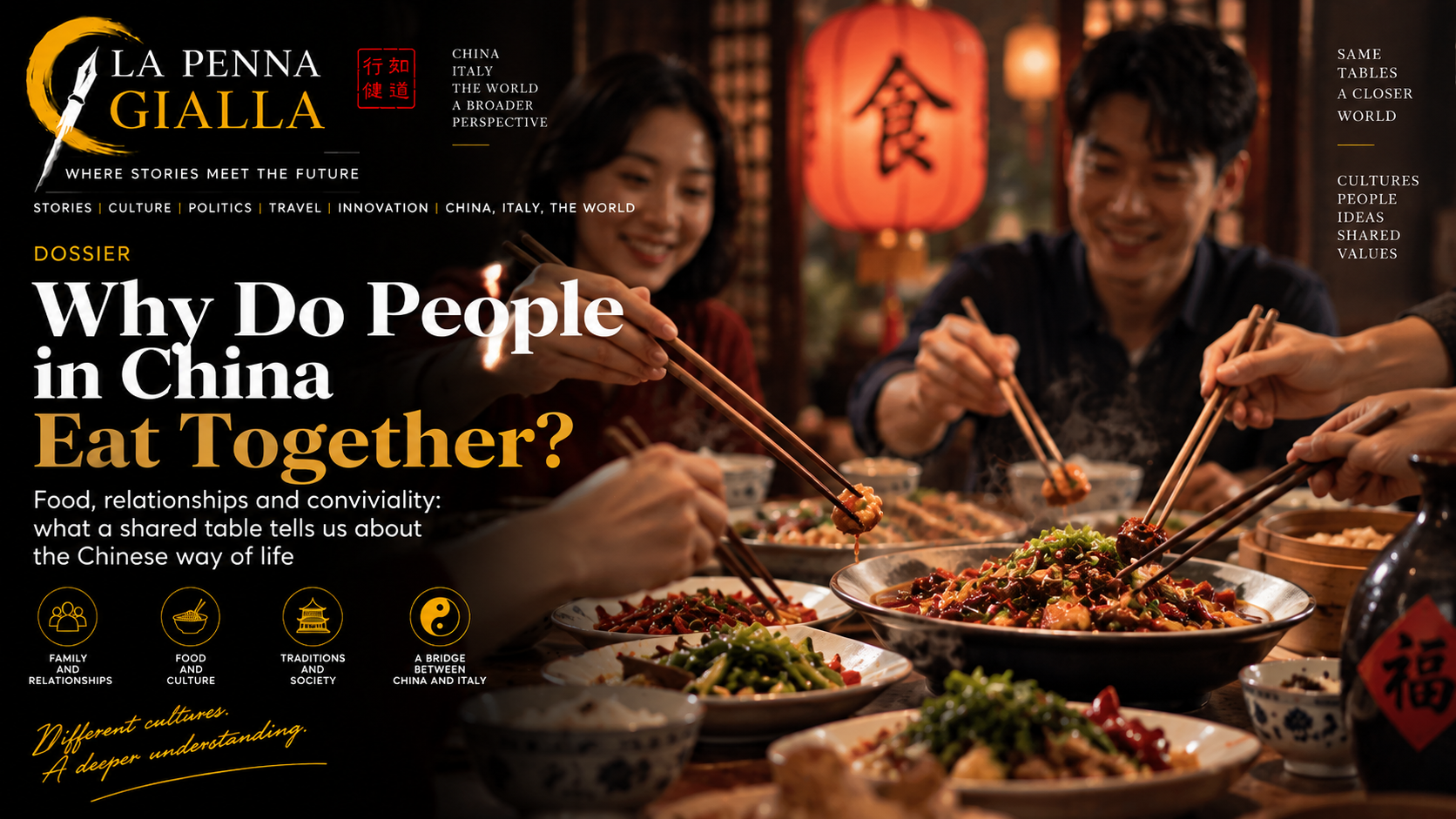
Imagine a Chinese dinner table during a family meal. In the centre there is not a single dish destined for one person, but a selection of dishes: vegetables, meat, fish, tofu, rice, perhaps a soup. Everyone has their own bowl and chopsticks, but the main dishes belong to the table.
Food is taken, tasted and passed around. A dish is moved towards another person, someone offers a portion to a guest, another person may wait for an older family member to choose first.
At first sight, it simply looks like a different way of eating. In reality, behind that shared table lies a precise idea of conviviality: a meal is not only about what each person eats, but about what people do together.
The difference becomes particularly clear when the traditional Chinese table is compared with the Western one. In many Western settings, especially in restaurants, the structure is individual: each person chooses their own dish, which arrives in front of them, and that portion defines what they will eat.
In the Chinese tradition, by contrast, the centre of the table becomes a shared space.
This does not mean that people in China always eat together or that individual meals do not exist. Contemporary Chinese society is far more diverse than this stereotype suggests. But sharing dishes remains one of the most recognisable features of Chinese food culture.
The centre of the table belongs to everyone
The shape of the table itself helps explain how this works.
When the group is large, a round table is particularly well suited to sharing: nobody occupies an end, and dishes can be reached by everyone. In restaurants, a large rotating tray in the centre — often called a lazy Susan — is also common, allowing diners to bring different dishes closer to themselves in turn.
It is not simply a practical solution.
The arrangement encourages people, in a sense, to take the others into consideration. Before reaching for a dish, you notice who else is reaching for it; after using it, you can turn it towards the others.
The table therefore becomes a small representation of social relationships: you do not eat while ignoring the people beside you, but while taking their presence into account.
Modern dining etiquette also reflects this logic through the use of gōngkuài, communal serving chopsticks, when they are provided. They are used to take food from shared dishes rather than using one's own chopsticks.
A meal designed to be shared
There is another important consequence: when food is ordered for the whole table, the way people choose what to eat also changes.
The question is not necessarily What will I eat? but What will we eat?
Several dishes are ordered, often different from one another, so that everyone can taste a variety of preparations. One dish may be spicy, another more delicate; one may contain meat, another vegetables or tofu.
The result is a meal built around tasting.
This also makes it possible to accommodate people with different preferences. Everyone does not have to eat the same thing: what creates the collective dimension is the fact that everyone can participate in the same selection of dishes.
This is one reason food can become such a powerful instrument of social connection.
Eating is also a way of caring
In Chinese dining culture, consideration for others can be expressed through small gestures.
A guest may be encouraged to try a particular dish. An older person may be served first. The person hosting the meal may make sure that everyone has enough to eat.
Food thus becomes a form of hospitality.
Attention to the position of diners is particularly evident during formal banquets, where seating arrangements can carry social meaning and places of honour are assigned according to established conventions. These rules vary according to the situation, but in formal settings seating can still be significant.
For this reason, sitting down at a Chinese table can mean entering, at least for a few hours, a network of relationships.
Family begins at the table
The meaning of sharing becomes even clearer during family occasions.
Birthdays, traditional festivals, anniversaries and family gatherings are often accompanied by meals in which dishes are placed in the centre and shared.
The table allows different generations to occupy the same space and participate in the same daily or festive ritual.
Food therefore becomes memory.
A family recipe can connect one generation to another; a regional dish can evoke a place of origin; a preparation associated with a particular festival can be repeated year after year.
There is no need to give a speech to pass on a tradition.
Sometimes, it is enough simply to sit at the same table.
And the restaurant becomes an extension of the home
This culture of sharing does not remain confined to the domestic environment.
It is particularly visible in Chinese restaurants, where the table can become a meeting place for relatives, friends, colleagues and guests.
Eating out does not necessarily mean choosing an individual dish and eating it alone. The meal can be built around the table itself: several dishes are ordered, brought to the centre and shared.
For this reason, a business lunch can also be a moment of relationship-building, just as a dinner with friends can become an opportunity to strengthen a bond.
Food is not simply the content of the meeting.
It is part of the meeting itself.
The table also expresses respect
Sharing, however, does not mean that there are no rules.
On the contrary, the traditional Chinese table has its own grammar.
Waiting for the right moment before beginning, respecting seating arrangements, not taking an excessive amount from a shared dish, allowing others to serve themselves and using communal chopsticks when they are provided are all behaviours that express consideration for the group.
Even an apparently simple gesture, such as taking a piece of food, can have a social dimension.
The logic is straightforward: the table is shared, so behaviour must take the others into account as well.
And this is precisely where the meal becomes more than nourishment.
From tradition to contemporary China
Naturally, China today does not eat exactly as China did a generation ago.
Cities have changed, lifestyles have become faster, eating outside the home has increased and dining options have diversified. Hygiene practices have also evolved, and the use of communal serving chopsticks is promoted in many settings as a safer way to share food.
Yet the fundamental structure remains recognisable.
One table, several dishes in the centre, many people around it.
It is a simple formula that has survived modernisation.
Because it does not depend only on the way food is served. It depends on a deeper idea: food can create and maintain relationships.
It is not only about China
Looking at this habit from a Western perspective raises an interesting question: why are we so accustomed to thinking of a meal as something individual?
Of course, Italy too has a deeply convivial food culture. Families and friends share starters, pizzas, platters, large pasta dishes and festive meals.
The difference, therefore, is not between a culture that “shares” and one that does not.
It is mainly about the way sharing is incorporated into the structure of the meal itself.
In China, the shared dish is often the starting point. In Italy, sharing may emerge through particular dishes and occasions within a broader tradition of conviviality.
Two different ways of arriving at the same gesture: putting something in the centre and inviting others to take part.
One table, many relationships
In the end, the answer to the initial question is less about food than it might seem.
In China, dishes are shared because the table has historically also been a space for relationships, hospitality, respect and belonging.
Eating together means seeing the others, waiting for them, serving them, making room for them and tasting what they have chosen.
It also means transforming a universal need — eating — into a collective experience.
Perhaps that is the most interesting detail of all.
At a Chinese table, food does not belong entirely to the person who orders it. For the duration of the meal, at least, it belongs to the table.
And that table may bring together a family, a group of friends, colleagues or people meeting for the first time.
For a few hours, however, they share something.
Not only food.
They share space, time and a relationship.
Iscriviti e fai iscrivere al canale G-channel La Penna Gialla e non perderti le prossime novità
"Inserisci e fai inserire la tua Azienda o l'azienda di prossimità a costo zero".
"Siamo noi il tuo alleato digitale e con un semplice clic il tuo articolo puoi condividerlo su tutte le piattaforme"
I commenti degli utenti:
Non sono presenti commenti di altri utenti