




Mappa Interattiva - dove le persone incontrano le attività
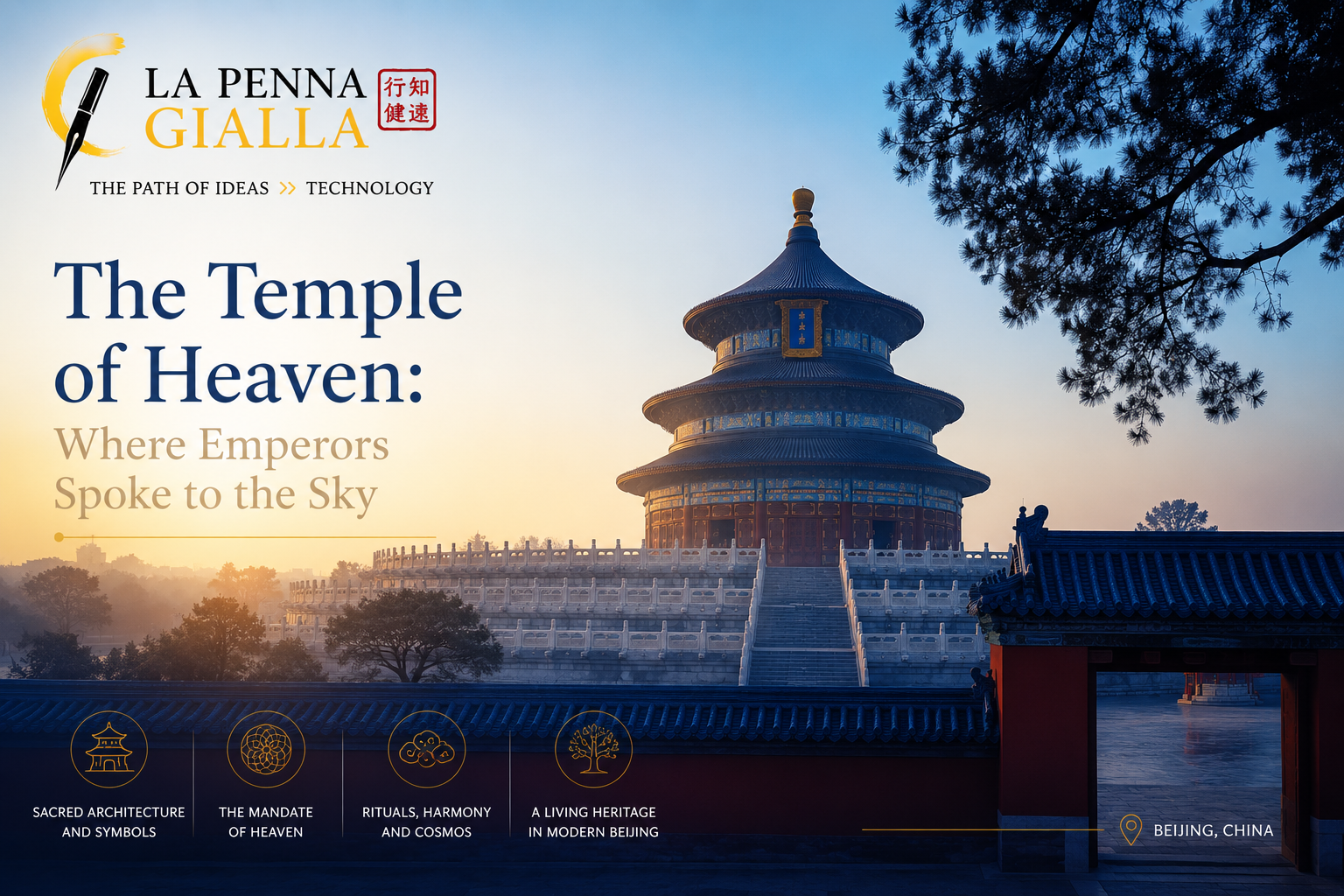
In the heart of Beijing, far from the skyscrapers and the relentless pace of modern China, stands a place that tells a story unlike any other.
Not a palace.
Not a fortress.
Not a monument built to celebrate military power.
The Temple of Heaven was built for something far more ambitious.
It was built to connect Earth and Heaven.
For centuries, Chinese emperors came here not as rulers, but as intermediaries between the human world and the cosmos.
Today, millions of visitors walk through its gates every year. Yet few realize that this extraordinary complex represents one of the deepest expressions of traditional Chinese philosophy.
A Sacred Space for an Empire
Construction of the Temple of Heaven began in the early fifteenth century during the Ming Dynasty.
Unlike the Forbidden City, which symbolized imperial authority, the Temple of Heaven represented something greater than political power.
According to traditional Chinese belief, the emperor ruled under the Mandate of Heaven.
His legitimacy depended not only on governing well, but also on maintaining harmony between nature, society, and the universe.
Every year, the emperor would travel from the Forbidden City to the Temple of Heaven to perform elaborate ceremonies and prayers for a successful harvest.
The fate of the empire depended on these rituals.
A poor harvest could be interpreted as a sign that Heaven had withdrawn its support.
In a civilization built around agriculture, this was no small matter.
The Language of Symbols
Nothing inside the Temple of Heaven was built by chance.
Chinese architecture has always been deeply symbolic, and nowhere is this more evident than here.
The most famous structure, the Hall of Prayer for Good Harvests, is perfectly circular.
In ancient Chinese cosmology, Heaven was represented by a circle, while Earth was represented by a square.
Throughout the complex, visitors encounter recurring patterns based on the number nine, considered the most powerful imperial number.
Colors, shapes, dimensions, and even the arrangement of stones all reflect a vision of cosmic balance.
The Temple of Heaven is not simply architecture.
It is philosophy expressed through stone and wood.
A Place of Harmony
One of the most fascinating aspects of the Temple of Heaven is how it reflects a central idea in Chinese culture: harmony.
Harmony between:
- humanity and nature,
- rulers and citizens,
- Earth and Heaven,
- past and future.
Unlike many Western religious monuments that emphasize divine power, the Temple of Heaven focuses on balance.
Its vast open spaces, ancient cypress trees, and symmetrical design create an atmosphere of calm that feels surprisingly modern.
Even today, visitors often describe a sense of peace while walking through the park surrounding the complex.
Perhaps because the questions it raises remain timeless.
How do we live in harmony with the world around us?
How do we balance progress and tradition?
How do we find our place within something larger than ourselves?
The Temple of Heaven Today
Modern Beijing is a city of innovation, artificial intelligence, and futuristic skylines.
Yet every morning, the Temple of Heaven Park fills with residents practicing tai chi, playing traditional instruments, dancing, exercising, and gathering with friends.
It is one of the clearest examples of how China's past continues to live within its present.
The Temple of Heaven is no longer the ceremonial center of an empire.
But it remains a place where history, culture, and everyday life meet.
Looking Up
For centuries, emperors came here seeking answers from Heaven.
Today, visitors arrive with cameras instead of ceremonial robes.
The rituals have changed.
The questions have not.
The Temple of Heaven reminds us that China is more than economic growth, technology, and megacities.
It is also a civilization that has spent thousands of years reflecting on humanity's relationship with nature, order, and the universe.
And perhaps that is why, even in the age of artificial intelligence and high-speed trains, this ancient sanctuary continues to speak to the modern world.
Iscriviti e fai iscrivere al canale G-channel La Penna Gialla e non perderti le prossime novità
"Inserisci e fai inserire la tua Azienda o l'azienda di prossimità a costo zero".
"Siamo noi il tuo alleato digitale e con un semplice clic il tuo articolo puoi condividerlo su tutte le piattaforme"
I commenti degli utenti:
Non sono presenti commenti di altri utenti