




Mappa Interattiva - dove le persone incontrano le attività
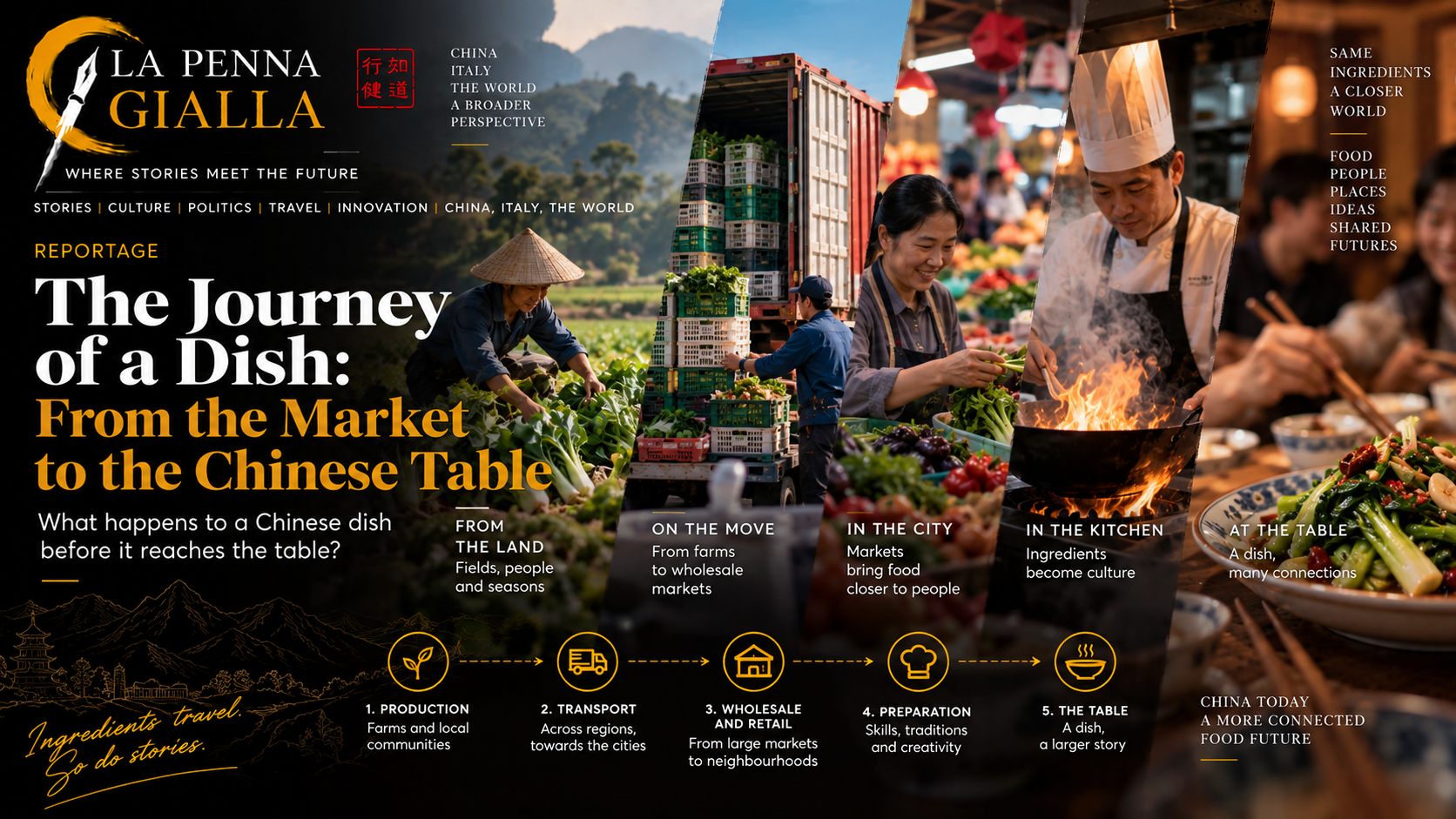
What happens to a Chinese dish before it reaches the table?
Before becoming a dish, food is a journey.
It begins long before someone turns on the stove and long before a waiter places a bowl on the table. It may start in a field, on a farm, along a coastline or in an orchard. It passes through a collection centre, a truck, perhaps a large wholesale market and then a neighbourhood market. Eventually, it enters a kitchen.
Only at the end does it reach the table.
In China, this journey can cover enormous distances, connecting rural areas, cities, markets and increasingly sophisticated logistics networks. The country's agricultural market system includes production areas, wholesale markets, distribution centres and retail markets, creating a structure that connects production, distribution and consumption.
To understand it, we can follow an imaginary dish: a simple plate of vegetables stir-fried in a wok.
We do not yet know what it will taste like.
We only know where its journey begins.
Before the market, there is the land
At dawn, when the streets of China's major cities are only beginning to fill, the working day may already have started hours earlier in the countryside.
Vegetables are harvested, selected and placed into crates. Some will be consumed locally. Others will travel much farther.
The distance between where food is produced and where it is consumed is one of the reasons China has developed an increasingly complex network of collection, transportation, storage and distribution.
There is therefore no single model.
A product may move from a collection centre to a wholesale market and then to a city market. Another may follow a more direct route. Food destined for restaurant chains may be handled through organised and traceable supply systems.
China is also investing in the modernisation of agricultural infrastructure and cold-chain logistics, with the aim of better connecting production areas with places of consumption. The country's new agricultural five-year plan, published in 2026, also includes strengthening cold-chain infrastructure.
The journey of food, therefore, is not only geographical.
It is technological too.
The first major stage: the wholesale market
At some point, the crates enter the market system.
Here, the scale changes completely.
A wholesale market is not where a consumer goes to buy two tomatoes or a bunch of vegetables. It is a commercial infrastructure through which large quantities of products are bought, sold, sorted and sent towards other destinations.
Wholesale markets connect production and consumption, acting as points of collection, transit, information and price formation.
This is where a vegetable's journey becomes part of something much larger.
A crate no longer represents simply the harvest of one farmer.
It becomes part of a flow.
Chengdu: a city that can be read through its market
One particularly revealing example comes from Chengdu.
The Chengdu Agricultural Products Wholesale Market, in Shuangliu District, handles a wide range of products: vegetables, meat, seafood, fruit, frozen products, dried goods and seasonings.
According to the China Agricultural Wholesale Market Association, the market covers around 402 mu, with more than 138,000 square metres of commercial space and over 3,000 operators. The market says it contributes to supplying around 80% of the fresh agricultural products consumed in Chengdu's main urban area.
It is difficult to imagine what a figure like that actually means.
Behind a seemingly simple dinner there may be a network of producers, traders, transport companies, wholesalers and retailers.
The consumer sees the dish.
The market sees the network that makes it possible.
From the large market to the neighbourhood
The journey continues.
Once products have been purchased by traders or distributors, they can reach neighbourhood markets, shops, supermarkets, restaurants and other businesses.
This is the moment when a large supply chain becomes local again.
In a city market, the scale changes once more. There are no longer tonnes of goods destined for dozens of operators. There are people choosing what they need for lunch or dinner.
This is where a vast food infrastructure meets everyday life.
A vegetable that has travelled hundreds of kilometres can end up, only a few hours later, in a family's shopping basket.
Or through the back door of a restaurant.
The kitchen: when ingredients become culture
And this is where a decisive transformation takes place.
Until this point, we have been following agricultural products.
Now the cook's work begins.
Washing, cutting, marinating, mixing, frying, steaming or cooking in a wok: different techniques can completely change the nature of an ingredient.
This is the moment when raw material becomes cuisine.
Chinese cuisine shows particularly clearly how closely this transformation is connected to place.
The same vegetable can be prepared differently in Sichuan, Guangdong, Jiangsu or Zhejiang. The accompanying ingredients, seasonings, cooking techniques and, of course, the resulting flavour all change.
This is why the journey of a dish does not end when food enters the kitchen.
That is precisely where it acquires its identity.
Safety is part of the journey too
There is another element that consumers normally do not see.
Food safety.
Before a product reaches the table, there are controls, documents, certifications and monitoring systems.
In 2025, Chinese authorities introduced new measures to strengthen supervision throughout the food supply chain, explicitly covering the process from production to consumption. The framework includes inspections and quarantine for certain products, verification systems and greater integration of digital supervision.
Technology can also make it possible to reconstruct the journey of a product.
In 2026, for example, Xinhua reported on rice produced in Heilongjiang using systems that allow consumers, through codes, to verify its journey from seed selection through cultivation, processing, storage and delivery.
Technology is therefore entering a sector that for centuries was shaped primarily by land, seasons, markets and personal relationships.
A contemporary dish can have an ancient story behind it and, at the same time, an increasingly digital supply chain.
When the food reaches the table
Finally, the simplest moment arrives.
The dish is brought to the table.
Almost everything that happened before disappears from view.
We no longer see the field.
We do not see the truck.
We do not see the wholesaler.
We do not see the market.
We do not see the warehouse.
We see only the final result.
And it is precisely this invisibility that makes the journey of food so interesting.
A bowl of vegetables can look like an ordinary, almost insignificant object.
But behind it lies a sequence of decisions, movements and people.
The new geography of Chinese food
This journey also tells the story of how much China has changed.
In the past, the relationship between producer and consumer was necessarily closer to the local scale. Today, a major metropolis can be supplied by products coming from regions hundreds or even thousands of kilometres away.
The growth of logistics infrastructure has made it possible to move fresh and perishable products rapidly.
Cold-chain logistics is a crucial part of this process. China's 2021–2025 plan aimed to develop a network connecting production and consumption areas, cities and rural communities and, increasingly, international markets.
And the process is continuing.
In 2025, China adopted a plan to accelerate the development of digital and intelligent supply chains, explicitly including agriculture, wholesale and retail distribution. The technologies mentioned include artificial intelligence, the Internet of Things and blockchain.
The food market is therefore becoming increasingly technological — often without the consumer even noticing.
From the field to the table, without losing the market
Yet as technology advances, traditional markets have not disappeared.
Large wholesale markets and small neighbourhood markets continue to coexist with modern supermarkets, specialist shops, restaurants and digital platforms.
They are different channels operating side by side.
And this may be one of the most interesting characteristics of China's contemporary food system: it has not simply replaced the old with the new. It has built a network in which different forms of distribution can operate simultaneously.
A farmer may sell through an intermediary.
A market may supply a restaurant.
A consumer may shop at the neighbourhood market and through an app on the same day.
An agricultural product may be bought locally or travel through a complex national logistics network.
The final table does not necessarily reveal which route the food has taken.
But all of them belong to the same story.
The real journey begins before the first bite
When we finally taste the dish, the journey is over.
Or perhaps it is not.
Because food reaches the table through much more than a recipe.
It arrives through a geography of production, a commercial network, logistics infrastructure, markets, transport companies, traders and cooks.
And in a China that is rapidly transforming its agricultural and distribution systems, the journey from field to table is becoming increasingly traceable, faster and more technological. At the same time, the oldest dimension — the market as a place where people choose, negotiate and build relationships — continues to survive.
In the end, there is a very simple scene.
A dish in the centre of the table.
Someone picks up their chopsticks.
Someone else serves a portion.
And at that moment, nobody is thinking about how far the food has travelled.
But that journey is already inside the dish.
Iscriviti e fai iscrivere al canale G-channel La Penna Gialla e non perderti le prossime novità
"Inserisci e fai inserire la tua Azienda o l'azienda di prossimità a costo zero".
"Siamo noi il tuo alleato digitale e con un semplice clic il tuo articolo puoi condividerlo su tutte le piattaforme"
I commenti degli utenti:
Non sono presenti commenti di altri utenti