




Mappa Interattiva - dove le persone incontrano le attività
How has China transformed a live online broadcast into a new business model capable of engaging millions of consumers?
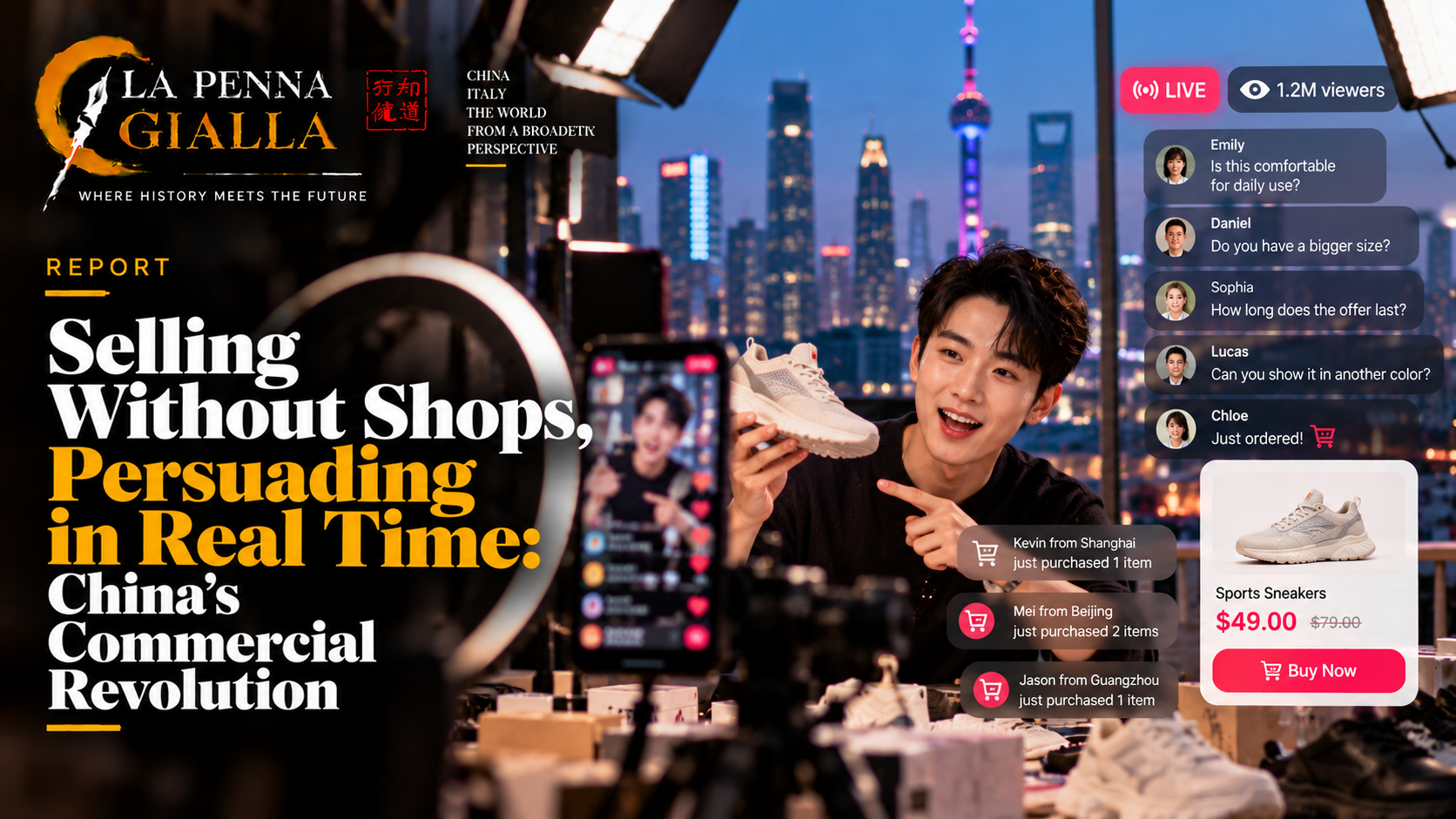
A presenter picks up a jar of face cream, opens it, shows its texture and applies it to the skin. Meanwhile, questions scroll across the screen: How much does it cost? What skin type is it suitable for? How long will the offer last? The presenter answers, compares products and demonstrates the results, urging viewers to take advantage of the promotion. The price appears in a corner of the screen. A single tap is enough to buy, without interrupting the broadcast.
There is no shop to visit, no checkout queue and no salesperson to find among the shelves. The live broadcast itself is the shop. And the seller does not have to wait for customers to walk through the door: the aim is to persuade them while they watch.
In China, this commercial model has reached enormous proportions. Live commerce — selling products through real-time video broadcasts — has transformed digital platforms into spaces where entertainment, product demonstrations, interaction and purchasing coexist. It is not simply a matter of listing a product for sale online. The innovation lies in creating a shopping experience that guides consumers from curiosity to a purchasing decision, sometimes within minutes.
The difference from traditional e-commerce is substantial. On a conventional online shop, customers search for an item, compare alternatives and decide when to buy. During a live broadcast, however, they may discover something they were not looking for, become engaged by the presenter's account and purchase it while the programme continues.
China did not invent distance selling or the art of commercial persuasion. It has, however, helped develop a model in which the seller becomes the star of the content, the audience participates in the presentation and the transaction takes place within the same digital environment. This integration, more than any individual technology, represents the real revolution.
The Shop Moves onto the Screen
To understand how this system emerged, it is necessary to look at a defining feature of China's digital ecosystem: its ability to integrate different services into a single experience.
Platforms do more than host videos. They can combine personalised recommendations, comments, payment tools, product links and order-management systems. The journey from watching to buying is short and does not necessarily require switching applications.
This reduces friction in the purchasing process. If a product attracts interest, consumers can buy it without interrupting the informational and emotional engagement created by the broadcast. The price is visible, the seller answers questions, and demonstrations help viewers understand how the product works.
Technology, however, is only part of the explanation. A platform that wants to sell must also attract viewers, keep them watching and give them reasons to return. That is why live commerce uses storytelling techniques associated with entertainment: rhythm, personality, suspense, demonstrations and interaction.
The product is not merely described. It is put on stage.
A kitchen knife can be presented through a practical demonstration; a garment can be modelled and shown from different angles; food can be tasted in front of the camera. Demonstrations make products more tangible, while conversation allows sellers to address doubts that a conventional product listing might not resolve.
The live broadcast becomes a commercial environment in which information, persuasion and entertainment reinforce one another.
The Seller Becomes a Celebrity
In this new model, the product is not necessarily the main attraction. Often, it is the person presenting it.
China's leading live-commerce hosts have built communities of viewers who return to watch them, recognise their style and trust their recommendations. Some specialise in cosmetics, others in fashion, food or household products. Their popularity can turn a straightforward product presentation into a major commercial event.
The best-known example is Li Jiaqi, nicknamed the “Lipstick King”. He rose to fame through broadcasts devoted to cosmetics, demonstrating products, comparing shades and engaging directly with viewers. Over time, he became much more than a salesperson: he developed a recognisable public persona capable of attracting huge audiences.
His success reveals an essential characteristic of live commerce. Audiences follow not only a product, but also the person presenting it. Personality, conversational rhythm, the ability to explain and even the expressions used all help establish a relationship.
For brands, working with a popular host offers access to an already engaged audience. For consumers, familiarity with the seller can make purchasing feel easier.
This relationship, however, is delicate. Trust built through an apparently spontaneous conversation can become a powerful tool of persuasion. Consumers must remember that behind a presentation there may be a commercial agreement with specific sales targets.
The new salesperson is therefore a combination of several skills: product knowledge, communication, entertainment and the ability to manage a digital community. Speaking well is not enough. The challenge is to turn attention into trust, and trust into purchases.
The Revolution That Changed the Scale of the Market
Live commerce began to integrate with China's e-commerce ecosystem in 2016, when platforms such as Taobao combined video broadcasting with the ability to purchase products directly from the presentation.
The idea itself was not entirely new: selling through images and demonstrations had existed for decades. The difference was the ability to make the process interactive and immediate, using a digital environment in which viewers could participate and buy without interrupting the experience.
In the years that followed, the model spread to other platforms and an increasing number of product categories. Live commerce was no longer confined to cosmetics or fashion. It became a way to promote food, electronics, household goods and even cars.
Growth has been significant. In 2025, according to Reuters, live-commerce sales accounted for more than 36% of China's online retail sales, compared with less than 18% in 2021.
The figures help explain the scale of the transformation. This is no longer a digital curiosity or a promotional technique used by a handful of businesses. It is a major channel within China's online economy.
Its success has attracted major brands, small businesses, independent producers and specialist operators. Around live commerce, an entire ecosystem has developed, including agencies, production studios, communications professionals, logistics services and sales analytics systems.
The new model has not eliminated physical shops or replaced every form of e-commerce. It has added a different approach, in which content becomes an integral part of the commercial process.
Small Producers Can Reach the Audience Too
One of the most interesting aspects of live commerce is its potential to reduce some of the barriers that traditionally separate producers from consumers.
A farm can showcase its products, explain how they are made and answer buyers' questions. A craft workshop can demonstrate its production process. A household-goods manufacturer can show how its products work without having to establish a network of physical shops.
In some rural areas of China, live broadcasts have also been used to promote local agricultural products, enabling producers to reach customers who might otherwise never have discovered their offerings.
The presentation becomes a story about a place. A product is described not only in terms of price or features, but also through the people who make it and the location from which it comes.
This can create a genuine opportunity, but it does not guarantee success. Attracting viewers requires time, communication skills and organisation. Businesses must prepare broadcasts, manage orders, ensure deliveries and respond to customers after the purchase.
Attention is also a limited resource. Live broadcasts compete with one another, and without an interested audience, even a good product can go unnoticed.
The model does not eliminate intermediaries altogether. It creates new ones: platforms, agencies, hosts and operators who can become essential to reaching consumers.
The possibility of selling directly exists, but visibility still depends on a digital ecosystem that individual producers do not fully control.
When Persuasion Becomes a Risk
The same immediacy that makes this system effective can also create problems.
During a live broadcast, a presenter may announce an expiring discount, emphasise that only a few items remain or urge viewers not to miss an opportunity. If consumers feel they must decide immediately, they may buy without checking all the relevant information.
The pressure is not necessarily illegitimate: limited-time offers and promotions exist in traditional retail as well. Problems arise when scarcity is fabricated, product features are exaggerated or commercial promises are misleading.
Unlike a static product page, a live broadcast can evolve rapidly. A statement made in front of thousands of people can influence purchases before its accuracy has been checked.
China has therefore strengthened its regulation of the sector. Specific rules governing live-streaming e-commerce came into force on 1 February 2026, clarifying the responsibilities of platforms, operators and presenters. The provisions address, among other issues, the transparency of commercial information, the verification of participants, consumer protection and the prevention of misleading claims.
The regulation shows that the sector has entered a more mature phase. When a commercial model reaches a significant scale, growth in sales is no longer the only measure that matters. Conditions must also be in place to allow consumers to trust the system.
Trust is not merely an ethical concern. It is an economic resource. If audiences begin to perceive every broadcast as a sequence of pressure tactics and questionable promises, commercial effectiveness may decline.
The Next Salesperson May Not Be Human
Just as live commerce is becoming an established part of the market, artificial intelligence is changing the work of selling.
Virtual presenters can now showcase products, read out information, answer certain questions and keep broadcasts running for long periods. They do not need the same breaks as human hosts and can be deployed during the night.
For a company that needs to present hundreds of products or keep a sales channel active, the potential cost advantage can be significant. In September 2026, JD.com said AI presenters could reduce certain operating costs associated with live commerce by 80–90%. This is an estimate relating to specific activities, not a guaranteed saving for every business.
The development raises an important question: how much does a human presence actually matter in a sale?
An AI presenter can describe a product, repeat an offer and provide standardised answers with remarkable consistency. It may be sufficient for simple items whose features are easy to explain and whose buyers tend to ask predictable questions.
But selling involves more than transmitting information. It also means interpreting hesitation, understanding which doubts matter most, adapting the tone of a conversation and building a credible relationship.
An artificial system can simulate some of these behaviours, but its effectiveness depends on the context and the quality of the interaction. Different products and consumers do not all respond in the same way.
The market may gradually divide. More repetitive and standardised broadcasts could increasingly be handled by AI, while human presenters focus on activities requiring creativity, reputation and relationship-building.
Work will change too. Speaking in front of a camera will no longer be enough. The ability to design content, use digital tools, interpret data and coordinate automated systems will become increasingly important.
China's commercial revolution, which began with the combination of video and purchasing, may therefore be entering a new phase in which the salesperson itself becomes a technological service.
The End of Easy Growth
After years of expansion, the sector is facing more intense competition. Consumers are exposed to a growing number of offers, and businesses must pay greater attention to profitability.
Selling a large volume of goods during a broadcast does not necessarily mean making a large profit. Discounts, presenter fees, platform commissions, logistics, returns and customer service all have to be taken into account.
Even major names must adapt. Popularity can attract viewers, but it does not guarantee that the business model will remain profitable. Brands increasingly need to understand which customers return, which products generate adequate margins and which forms of communication produce lasting results.
This shifts attention away from the spectacular success of a single broadcast towards building a sustainable commercial system.
AI may help reduce certain costs, but technology alone cannot solve every problem. If everyone can organise increasingly inexpensive broadcasts, the number of offers may grow further, making it even harder to attract attention.
The next challenge will be finding a balance between efficiency, quality and credibility. Being live will no longer be enough: businesses will need to offer people a reason to listen.
A New Idea of Selling
China's commercial revolution does not simply consist of moving the shop onto a smartphone. It lies in transforming selling into an experience that unfolds in front of consumers, involving them as a product is demonstrated, explained and offered for purchase.
Content is no longer just an advertising tool that precedes the transaction. It becomes part of the transaction itself. The presenter does not merely describe an item: they create a shared moment of attention. The platform does not simply host a catalogue: it organises the meeting between supply and demand, reducing the distance between interest and purchase.
This model has demonstrated the power of combining technology, communication and human behaviour. It has created opportunities for businesses, generated new professions and changed the habits of some Chinese consumers.
But it has also made the power of platforms more visible: their ability to determine what we see, which products attract our attention and when we are invited to buy.
Now artificial intelligence is challenging even the role of the salesperson, promising to make the system more efficient and constantly available.
The question, then, is not simply whether this form of selling will spread further around the world. It is what happens when commerce stops waiting for customers to search for a product and begins creating an experience designed to persuade them to buy it.
In China, this transformation is already a reality. And its lesson extends beyond shopping: in the digital economy, those who can bring attention, trust and purchasing together in the same moment can change not only the way things are sold, but also the way people decide what to buy.
Iscriviti e fai iscrivere al canale G-channel La Penna Gialla e non perderti le prossime novità
"Inserisci e fai inserire la tua Azienda o l'azienda di prossimità a costo zero".
"Siamo noi il tuo alleato digitale e con un semplice clic il tuo articolo puoi condividerlo su tutte le piattaforme"

I commenti degli utenti:
Non sono presenti commenti di altri utenti