




Mappa Interattiva - dove le persone incontrano le attività
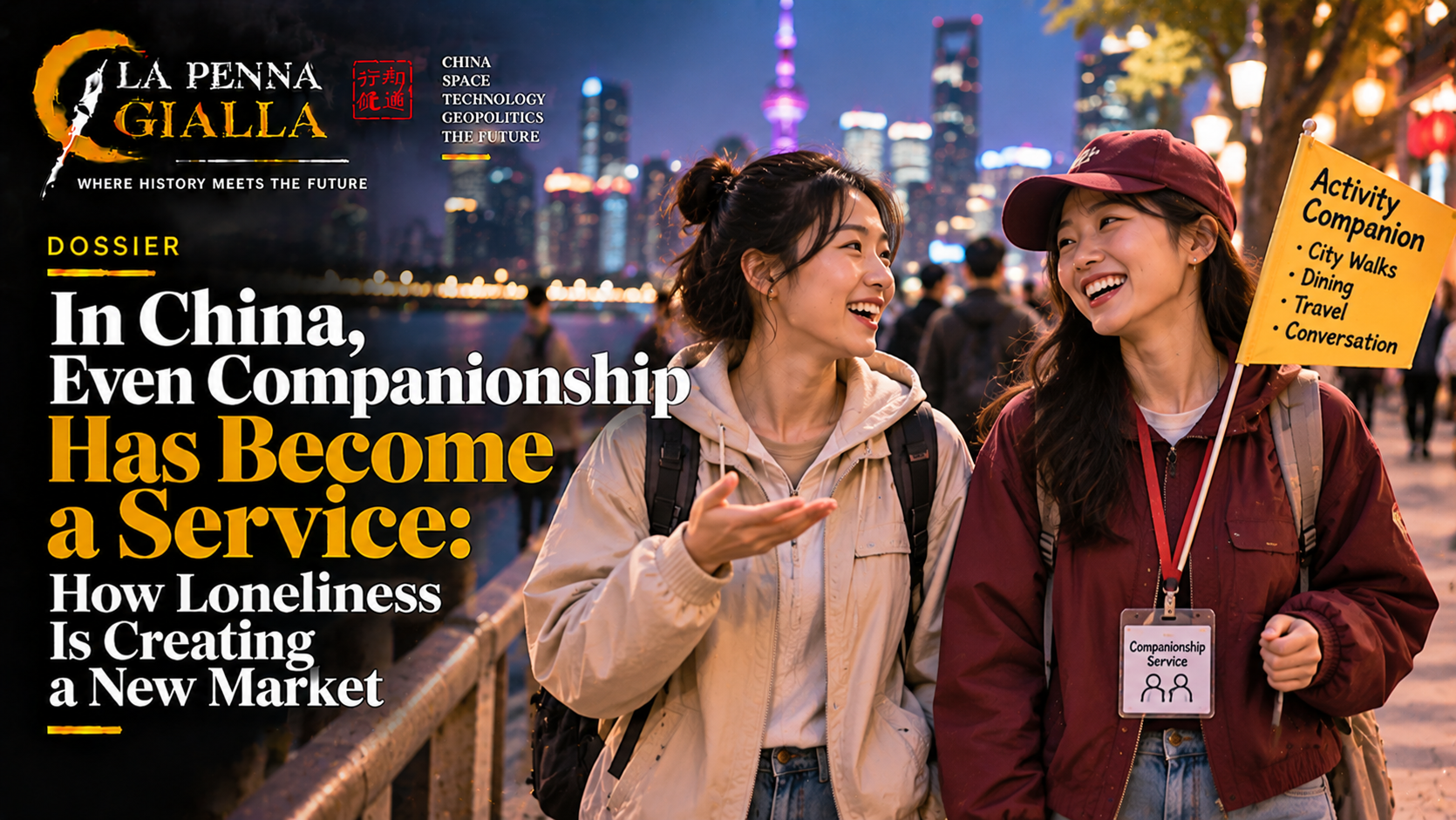
In China, you can pay someone to climb a mountain with you, go for a walk, explore a city, enjoy a hot pot dinner or simply spend a few hours in company. It is not necessarily a romantic date, nor is it always a traditional tourist service. It is something different: a person makes their time available to accompany someone else, share an experience, offer practical help and, sometimes, provide emotional support.
This is the so-called companionship economy: a growing market in which something traditionally associated with friendship, family and personal relationships is becoming a service that can be found online, booked and paid for.
Its expansion reveals a change that goes far beyond consumer habits. It speaks of young people living far from home, people experiencing loneliness in large cities, new forms of work and a society in which shared time is acquiring economic value. But it also raises a deeper question: what happens when even companionship becomes something we can buy?
A companion for climbing a mountain
One of the most striking examples of this phenomenon can be found on Mount Tai, in China's Shandong Province. One of the country's most famous mountains, it is a destination of cultural and spiritual significance, attracting visitors who climb thousands of steps to reach its summit.
Here, it is possible to hire a climbing buddy. This is not simply a mountain guide: the companion walks alongside the customer, helps them along the route, may carry their belongings, takes photographs and makes the experience more enjoyable.
The service can also include small gestures of attention: preparing water and snacks, waiting for someone who walks more slowly, encouraging tired climbers and sharing the journey all the way to the top.
Offers are advertised on Chinese social media, where potential customers can find profiles, photographs, descriptions of services and prices. Some companions are university students; others are young workers who have turned a personal passion into a paid activity.
Prices vary according to the duration, route and services requested. In some cases, a full day of companionship on Mount Tai can cost several hundred yuan.
The growth of these services has attracted international media attention. In June 2026, Reuters reported on an entrepreneur who had developed a business with hundreds of companions, starting from a small team. Initially focused on mountain excursions, the activity became a concrete example of how an apparently simple need can turn into an organised market.
But the mountain is only one of the places where this new form of consumption is taking shape.
From walks to dinner: you can book someone to share your time
Paid companionship is not limited to sports activities or excursions. Across China, services are emerging to accompany people through some of the most ordinary moments of everyday life.
You can find someone to explore a city with, go shopping, watch a film, play video games, run in a park or simply sit down for a meal.
Even eating out can become an experience to book. One example is hot pot, the traditional meal in which diners gather around a shared pot at the centre of the table, cooking ingredients in a simmering broth.
It is a meal with a strong social dimension. Eating it alone can feel like missing part of the experience, particularly in a culture where sharing food is an important part of social life. The solution, for some customers, is to pay someone to sit at the table, take part in the meal and make the occasion more enjoyable.
In other cases, the service is even simpler: someone is paid to talk, listen, accompany a person through a difficult day or provide company during an activity they would rather not do alone.
That is what makes this model different from a traditional service. Customers are not simply purchasing a practical task, but also a form of human interaction.
In China, the expression emotional value is often used to describe what customers are looking for: feeling listened to, receiving attention, enjoying a more pleasant experience and having someone available to share it.
It is not necessarily friendship, because the relationship begins with a commercial agreement. But neither is it a simple transaction, because the quality of the service depends largely on the relationship that develops during the time spent together.
A new economy worth billions
This phenomenon has moved beyond isolated individual initiatives. A market is taking shape around companionship, involving digital platforms, social networks, small businesses and independent workers.
Offers are published mainly through online channels, where companions present their profiles, characteristics and available activities. Users can search according to location, type of experience, availability and skills.
The model is flexible and often organised through direct contact and bookings. Some companions work occasionally, alongside their studies or another job. Others are turning it into a more structured occupation.
Estimates reported by Chinese media and picked up by international publications put the market at around 50 billion yuan in 2025, equivalent to approximately 7.4 billion US dollars. This is a significant figure, although it should be treated with caution: there is no single official measurement covering the entire sector. Estimates include different services, ranging from companionship during leisure activities to personal support.
What makes this market particularly interesting is not just its economic size. It is the kind of need it addresses.
For a long time, consumption was mainly associated with the purchase of goods: clothing, electronics, cars, travel and household products. Today, part of consumer demand is shifting towards experiences, relationships and services that can improve quality of life.
Companionship is entering a new category of consumption. People are not buying an object to own, but an experience to share with someone else.
Young people, big cities and new forms of loneliness
To understand why this market is growing in China, it is necessary to look at the country's social changes.
China's major cities offer professional opportunities, universities, services and career prospects, but they also demand an intense pace of life. Many young people move away from their families to study or work. Their days are often organised around professional commitments, commuting and the need to achieve financial stability.
Traditional social networks can become harder to maintain. Friends may live in different neighbourhoods, have incompatible schedules or move away for work. Building new friendships also takes time and availability, two resources that are not always easy to find.
There are other changes, too, in relationships and family life. A growing number of young people choose to postpone marriage or live alone, while social interactions increasingly take place in digital environments.
It would be misleading to attribute the growth of paid companionship to a single cause, or to describe an entire generation as unable to build relationships. Motivations vary: some people want practical help; others want to enjoy an experience without having to involve friends or relatives; some would like to explore a city with a local companion, while others simply do not want to spend a particular day alone.
But there is one common element: people are willing to pay to make shared experiences easier and more accessible.
Companionship thus becomes a response to a way of life in which free time is limited and opportunities to meet others do not always arise spontaneously.
Older people are looking for company, too
This phenomenon is not limited to young people.
In a rapidly ageing society, older citizens represent another potential market for services based on personal presence and everyday assistance.
In some Chinese cities, initiatives are emerging that make young people available to accompany older residents through daily activities. They may visit, talk, help them use a smartphone, accompany them to a medical appointment or assist with small household needs.
In the United States and Europe, home assistance and companionship services already exist. In China, however, some initiatives have attracted attention for a particular formula: the so-called rental adult children.
These services do not legally replace a son or daughter, nor do they necessarily provide medical care. The idea is to offer a presence that can, at least in part, resemble that of a family member: someone who spends time with an older person, listens and helps them manage everyday situations.
This takes on particular significance in a country undergoing a major demographic transformation. Falling birth rates, increasing life expectancy and the migration of younger generations are changing family structures.
Many adult children live and work far from their parents. Families are often smaller than in the past and cannot always provide daily support.
In this context, companionship becomes a service responding to a different need from that of young urban consumers, but one that is just as important: not feeling abandoned in everyday life.
It is a significant development because it shows that this market is not simply selling enjoyable experiences. It is also trying to respond to needs connected with vulnerability and the care of human relationships.
The paradox: you pay for a relationship, but not necessarily a bond
The growth of this economy raises a question that cannot be ignored.
If someone pays another person to spend time together, what kind of relationship is being created? And, above all, how genuine can companionship be when it begins with a commercial agreement?
On the one hand, the service offers clear advantages. Customers know in advance when a companion is available, can agree on the time and activities, and do not necessarily have to deal with the uncertainty of starting a new relationship. For people who find it difficult to organise their free time or feel uncomfortable doing things alone, this model can make experiences more accessible.
On the other hand, the relationship remains conditional on payment. Attention is guaranteed for the duration of the service, but that does not necessarily mean a lasting connection will develop.
This distinction matters. Paid companionship may temporarily ease loneliness, but it is not the same as friendship, an emotional relationship or a stable support network.
There are also questions surrounding safety, workers' rights and transparency. When services are arranged through advertisements and direct contacts on social media, it becomes important to verify people's identities, define clearly what is included in the agreement and protect both those offering and those purchasing companionship.
The boundaries between accompaniment, entertainment and other forms of personal service need to be clear. Without rules and safeguards, a market built on trust can become vulnerable to abuse.
Its growth, therefore, should not be viewed simply as a new business opportunity. It is also a sign of social change that deserves attention.
When shared time becomes a product
Paid companionship tells a story of China that is different from the one usually associated with major infrastructure projects, robots, technology platforms and industrial records. It is a story about people looking for new ways to organise their everyday lives.
Behind a companion climbing Mount Tai, someone paid to share a meal or a young person visiting an older resident for a few hours, there is a broader transformation: the economic value of services is expanding into areas that once belonged almost exclusively to private life.
Technology makes it possible to find these people, present offers, compare profiles and arrange meetings. But what is being sold is not digital. It is another human being's time, attention and willingness to share an experience.
Perhaps this is the most interesting paradox of China's new economy: in a society that is increasingly connected, where communication seems easier than ever, demand is growing for something no app can guarantee on its own.
The presence of another person.
And if, in China today, people can pay someone to avoid climbing a mountain alone, eating alone in a restaurant or spending an entire day without talking to anyone, the question that remains is not just about the future of this market.
It is about the value contemporary societies place on human relationships, and how much they are willing to spend to avoid going without them.
Iscriviti e fai iscrivere al canale G-channe La Penna Gialla e non perderti le prossime novità
"Inserisci e fai inserire la tua Azienda o l'azienda di prossimità a costo zero".
"Siamo noi il tuo alleato digitale e con un semplice clic il tuo articolo puoi condividerlo su tutte le piattaforme"

I commenti degli utenti:
Non sono presenti commenti di altri utenti