




Mappa Interattiva - dove le persone incontrano le attività
Some cities are remembered for their skylines.
Others for their monuments.
And then there is Hangzhou.
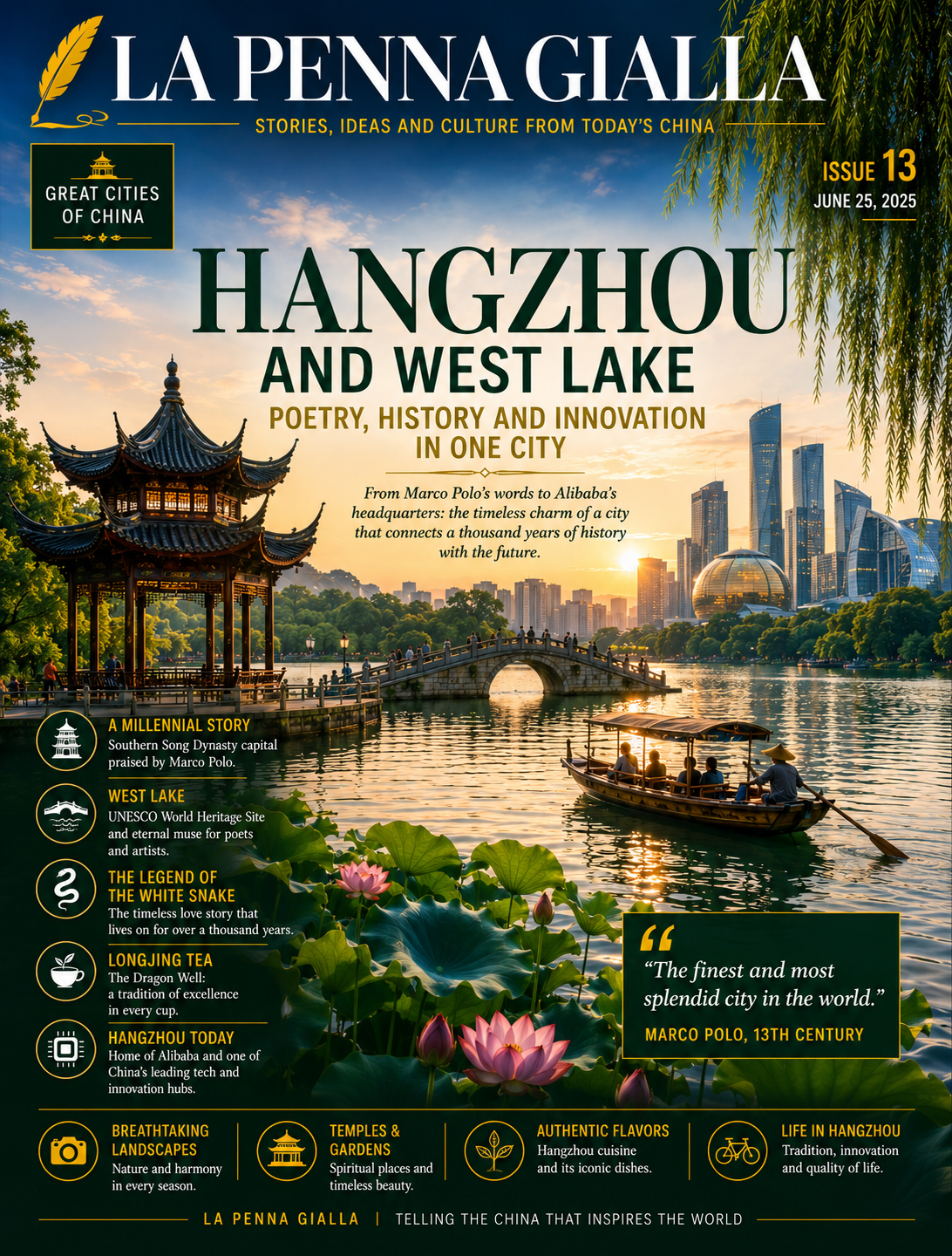
A place where a fisherman quietly crossing West Lake at sunrise can share the same skyline with the headquarters of one of the world's largest technology companies.
Here, history has not been replaced by progress.
It has grown alongside it.
Perhaps that is why Hangzhou has been considered one of China's most beautiful cities for more than a thousand years.
When the Venetian explorer Marco Polo visited during the late thirteenth century, he famously described it as "the finest and most splendid city in the world."
More than seven centuries later, those words still resonate with travelers who arrive on the shores of West Lake for the first time.
The Capital of the Southern Song Dynasty
Although Hangzhou's history stretches back more than two thousand years, its golden age began in 1127.
After the fall of Kaifeng, the Southern Song Dynasty established Hangzhou as its imperial capital.
The city quickly became one of the world's greatest centers of commerce, culture and learning.
Merchants arrived from across Asia.
Poets and painters found inspiration in its landscapes.
Scholars gathered in its academies.
Its canals, stone bridges, gardens and bustling markets impressed visitors from every corner of the known world.
Among them was Marco Polo, whose descriptions helped introduce Hangzhou to Europe centuries before global tourism existed.
West Lake: The Soul of Hangzhou
If Hangzhou has a heart, it beats beside West Lake.
Known in Chinese as Xi Hu, this UNESCO World Heritage Site is much more than a lake.
It is a cultural landscape where nature and human creativity have coexisted for over a thousand years.
Elegant stone bridges connect small islands.
Ancient pagodas rise above tree-lined hills.
Willow branches gently touch the water.
Lotus flowers bloom throughout the summer.
Morning mist softens the horizon, creating scenes that resemble traditional Chinese paintings.
For generations, poets, artists and philosophers have found inspiration here.
Today, visitors from around the world continue to do the same.
The Legend of the White Snake
Every iconic place in China carries its own legend.
Hangzhou's most famous story is the Legend of the White Snake, one of the country's greatest romantic tales.
According to tradition, Bai Suzhen, a powerful white snake spirit, transformed herself into a beautiful woman after centuries of spiritual cultivation.
She fell in love with a young scholar named Xu Xian.
Their happiness was challenged by the monk Fahai, who believed that humans and supernatural beings should never live together.
The story has inspired operas, novels, television series and films for generations.
Even today, visitors crossing the Broken Bridge often remember this timeless tale of love, sacrifice and destiny.
Longjing Tea: A Tradition in Every Cup
Just outside the city lies another of Hangzhou's treasures.
The hills of Longjing, or Dragon Well, produce one of the most celebrated green teas in the world.
Tea plants cover the rolling hills in carefully maintained terraces.
Many of the finest leaves are still picked by hand each spring.
For centuries, Longjing tea was reserved for emperors.
Today, it remains a symbol of Chinese hospitality and cultural identity.
To drink Longjing in Hangzhou is not simply to enjoy tea.
It is to participate in a tradition that has endured for hundreds of years.
The Birthplace of Alibaba
Yet Hangzhou is not trapped in its past.
In 1999, an English teacher named Jack Ma founded a small company in his apartment.
That company became Alibaba.
Today, Hangzhou stands among China's leading centers for technology, artificial intelligence, e-commerce and digital innovation.
Cashless payments, smart mobility and advanced digital services are part of everyday life.
Remarkably, all of this exists only minutes away from ancient temples, bamboo forests and tea plantations.
Hangzhou proves that tradition and innovation do not compete.
They complement one another.
A City Built on Balance
Perhaps this is what makes Hangzhou so distinctive.
It does not seek attention through dramatic skylines or futuristic architecture.
Instead, it quietly demonstrates that history and progress can exist in harmony.
An ancient stone bridge reflected in West Lake.
A centuries-old tea plantation.
A global technology company shaping the future of commerce.
All within the same city.
Few places illustrate modern China so completely.
La Penna Gialla Tells
Every journey through China reveals a different face of the country.
Beijing tells the story of power.
Xi'an preserves the origins of the Empire.
Shanghai looks confidently toward the future.
Hangzhou reminds us that progress is meaningful only when it respects beauty, culture and memory.
Perhaps that is why Marco Polo's words still feel so relevant today.
Some cities change with time.
Others teach us how time itself can become part of their identity.
Hangzhou is one of them.
Iscriviti e fai iscrivere al canale G-channel La Penna Gialla e non perderti le prossime novità
"Inserisci e fai inserire la tua Azienda o l'azienda di prossimità a costo zero".
"Siamo noi il tuo alleato digitale e con un semplice clic il tuo articolo puoi condividerlo su tutte le piattaforme"

I commenti degli utenti:
Non sono presenti commenti di altri utenti