




Mappa Interattiva - dove le persone incontrano le attività
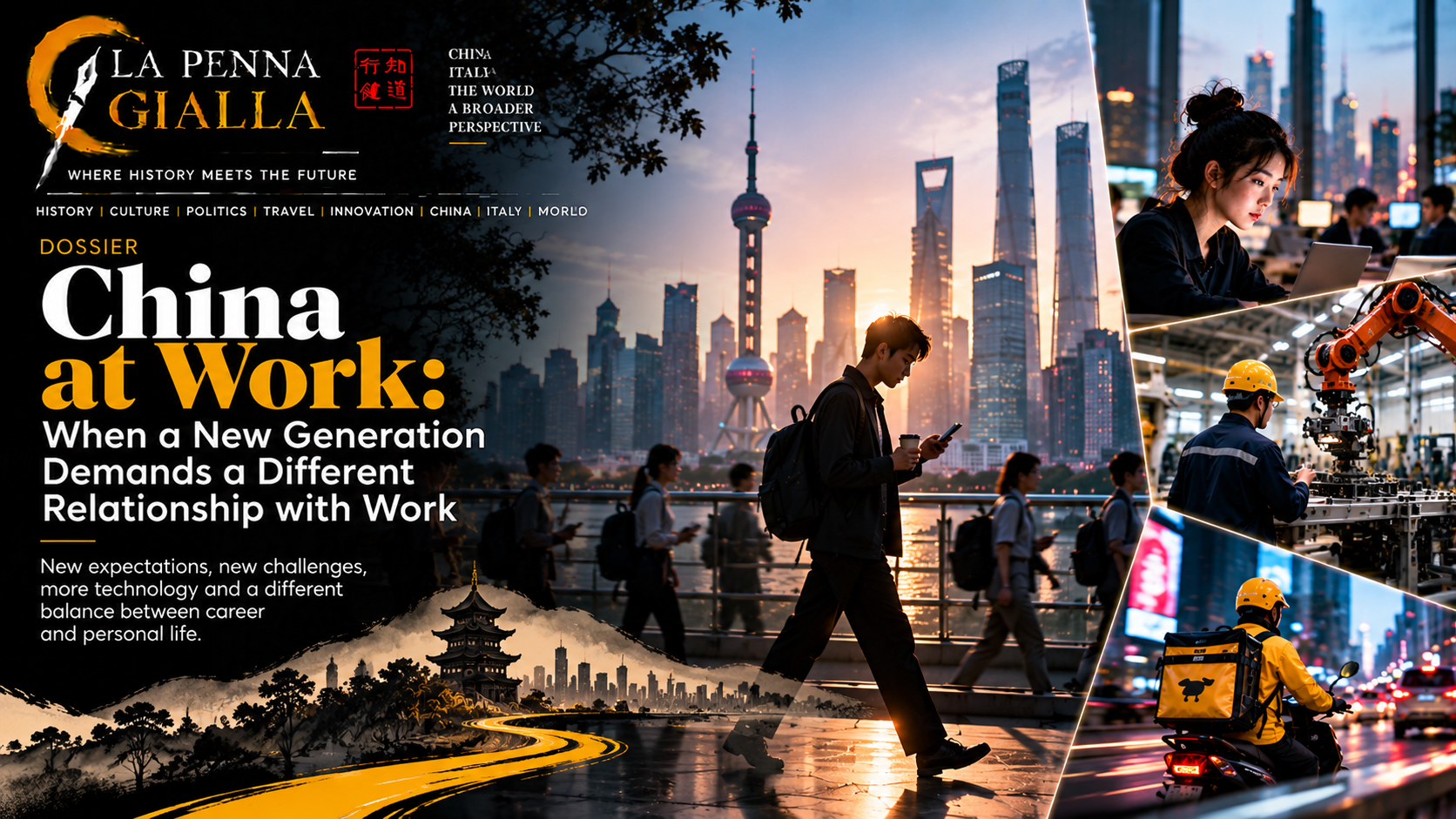
What happens when a generation that grew up during China’s economic boom begins to ask how much of its life should really be devoted to work?
For decades, work in China has been closely associated with progress. Economic growth, urbanisation and rising incomes created a powerful social promise: study hard, find a good job, build a career and improve your family’s future.
That promise has not disappeared. But something is changing.
A new generation of Chinese workers is entering a labour market that is more competitive, more technological and more fragmented than the one their parents knew. At the same time, expectations are changing. Career advancement is still important, but so are time, personal freedom, stability and the possibility of having a life outside the workplace.
The debate over working hours has become increasingly visible. As national holidays approach, discussions about weekend work, overtime and the right to proper rest have once again highlighted a broader question: what should work mean in contemporary China?
China no longer has the same labour market
The scale of China’s workforce remains extraordinary. In 2025, around 725 million people were employed, including more than 475 million in urban areas. The country created approximately 12.7 million new urban jobs, while the average surveyed urban unemployment rate stood at around 5.2%.
But behind these numbers lies a labour market undergoing a profound transformation.
China is moving away from an economy in which manufacturing and construction absorbed enormous numbers of workers and towards one in which services, technology, digital platforms and emerging industries are playing an increasingly important role.
The government’s employment strategy for 2026–2030 reflects this transition. Creating jobs is no longer simply a matter of generating economic growth. The focus is increasingly on the quality of employment, skills, new industries and better matching between workers and the jobs available.
For younger Chinese workers, this means that the question is not simply whether there will be jobs. It is increasingly about what kind of jobs will exist — and what kind of life those jobs will allow.
The young Chinese worker at a crossroads
For a generation raised in a rapidly modernising China, the traditional idea of success remains powerful.
A prestigious university, a stable position, a career in technology, finance or the public sector can still represent an important achievement. Competition, however, has become intense, particularly for younger people entering the labour market.
This is why education and professional training have become central to China’s employment policies.
The country is investing in skills designed for emerging industries while also encouraging the development of services and new professional sectors. The objective is to reduce the gap between what workers know and what companies increasingly need.
Artificial intelligence, electric vehicles, advanced manufacturing, digital services and other emerging industries are creating new opportunities. But they are also raising the threshold for entering the labour market.
The young Chinese worker therefore faces a paradox: there may be more technologically advanced opportunities than ever, but accessing them requires a different set of skills.
From the race for a career to the search for balance
For years, the idea of professional success in China was closely linked to sacrifice.
Long working hours could be interpreted as evidence of ambition. The famous “996” model — working from 9 a.m. to 9 p.m., six days a week — became a symbol of the extreme end of this culture, particularly in parts of the technology sector.
Today, however, the relationship between work and personal life is being questioned more openly.
Younger workers are increasingly attentive to working hours, commuting time, holidays and the possibility of maintaining relationships, interests and personal space outside the office.
This does not mean that ambition has disappeared. Rather, the definition of a successful career is becoming more complicated.
A job can be attractive because of its salary. But salary is no longer necessarily the only measure.
How much time does it take? How stable is it? How much autonomy does it offer? What happens after working hours?
These questions are becoming part of the calculation.
When work moves onto the smartphone
The transformation of the Chinese labour market can also be seen on the screen of a smartphone.
Delivery couriers, ride-hailing drivers, online sellers and other platform workers have become an integral part of urban life. In 2026, Chinese authorities estimated that around 84 million people were involved in new forms of employment, including several categories of platform-based work.
This is one of the most visible changes in the relationship between technology and employment.
The smartphone is no longer simply a tool for communication. For millions of workers, it is also an office, a navigation system, a payment terminal and, in some cases, the mechanism through which work itself is assigned.
The result is greater flexibility, but also new forms of uncertainty.
A worker can potentially choose when and where to work. At the same time, income may depend on demand, customer ratings, platform rules and algorithmic decisions.
The old factory manager has not necessarily disappeared.
Sometimes, the manager has simply become an algorithm.
When the algorithm becomes the boss
This is one of the most important questions in China’s new labour market.
For a delivery driver, for example, an algorithm can determine routes, assign orders and calculate delivery times. For a ride-hailing driver, the platform can influence where the next passenger comes from and how much can be earned.
Technology can make work more efficient. But it can also make the relationship between worker and employer less transparent.
In April 2026, Chinese authorities introduced new guidelines concerning emerging forms of employment, addressing issues such as algorithmic management, reasonable remuneration, transparency and worker participation.
It is an important sign of how quickly the nature of work is changing.
The challenge is no longer simply protecting workers inside a factory or office.
It is also understanding who is responsible when the workplace is an app.
A new generation, a new set of skills
The transformation of employment is also transforming education.
China needs workers capable of operating increasingly sophisticated technologies, but it also needs people able to work in expanding service sectors. This is creating growing demand for vocational education, technical training and continuous professional development.
The traditional distinction between “university graduate” and “manual worker” is becoming less useful.
A modern factory can require advanced technical knowledge. A logistics company can depend on sophisticated digital systems. A service professional may need technological skills that would have been considered unnecessary only a few years ago.
The future of work therefore depends not only on creating jobs, but on preparing people for jobs that are changing faster than educational systems traditionally have.
The factory is no longer the only future
China remains one of the world's great manufacturing powers. Factories, logistics centres and construction sites continue to employ millions of people.
But the Chinese economy is increasingly diverse.
Services, healthcare, elderly care, childcare, digital commerce, technology and emerging industries are becoming more important sources of employment. At the same time, the country's enormous migrant workforce — more than 300 million people — continues to connect rural areas with the urban economy.
For many of these workers, the question is not only where they can find employment, but whether they can build a sustainable life around it.
Housing, commuting, family responsibilities and access to public services all influence the real value of a job.
Employment is therefore becoming less about a workplace alone and more about the entire ecosystem surrounding it.
When the right to rest becomes an economic issue
The debate over working hours may appear, at first, to be a question of labour rights.
But it is also an economic question.
A population that works constantly has less time to consume, travel, meet friends, participate in cultural activities or simply rest. In an economy increasingly dependent on domestic consumption and services, free time has an economic value of its own.
This helps explain why discussions about holidays, weekends and working hours are becoming increasingly significant.
Rest is not necessarily the opposite of productivity.
It can also be part of the infrastructure that makes a modern economy function.
The new question is no longer simply “How much do you earn?”
For a younger generation, the calculation surrounding employment is becoming more complex.
A good salary remains important. But so are stability, career prospects, working hours, commuting time, housing costs and the possibility of maintaining a personal life.
The workplace is therefore becoming a reflection of a much broader transformation in Chinese society.
The same generation that grew up surrounded by smartphones, high-speed trains, global brands and extraordinary technological change is now asking what it wants from the next stage of its life.
It is not necessarily rejecting work.
It is asking for a different relationship with it.
A China redefining the value of work
China’s labour market is entering a new phase.
The country still needs growth, innovation and highly productive workers. But it is also confronting a society in which expectations are changing, technology is rewriting professional roles and younger generations are less willing to accept that professional success must automatically mean sacrificing personal time.
The transformation will not happen overnight.
Factories will remain. Offices will remain. Platforms will remain. And the pressure to succeed will certainly remain part of Chinese society.
But the definition of success may be changing.
For decades, the question was how much a person was willing to work in order to build a better future.
Now another question is emerging:
How much should a society work — and how should it work — to build the future it actually wants?
Iscriviti e fai iscrivere al canale G-channel La Penna Gialla e non perderti le prossime novità
"Inserisci e fai inserire la tua Azienda o l'azienda di prossimità a costo zero".
"Siamo noi il tuo alleato digitale e con un semplice clic il tuo articolo puoi condividerlo su tutte le piattaforme"

I commenti degli utenti:
Non sono presenti commenti di altri utenti