




Mappa Interattiva - dove le persone incontrano le attività
At 7:58 in the morning, the departure board at Beijing West Railway Station lights up.
A train number.
A destination.
Thousands of passengers move quietly through security checks, boarding gates and platforms with remarkable efficiency.
A few minutes later, the train glides out of the station.
Within moments, it reaches 350 kilometers per hour.
Inside, however, nothing seems to move. A cup of tea remains perfectly still on the table, a student studies on a laptop, a businessman joins an online meeting, and a family enjoys breakfast while crossing hundreds of kilometers.
For first-time visitors, China's high-speed rail network is more than transportation.
It is an experience that changes the way they understand the country.
From Vision to the World's Largest Network
Only two decades ago, China's railway system was vast but increasingly unable to keep pace with the country's rapid economic growth.
Everything changed in 2008, when the Beijing–Tianjin high-speed railway opened to the public.
It was the beginning of one of the most ambitious infrastructure projects ever undertaken.
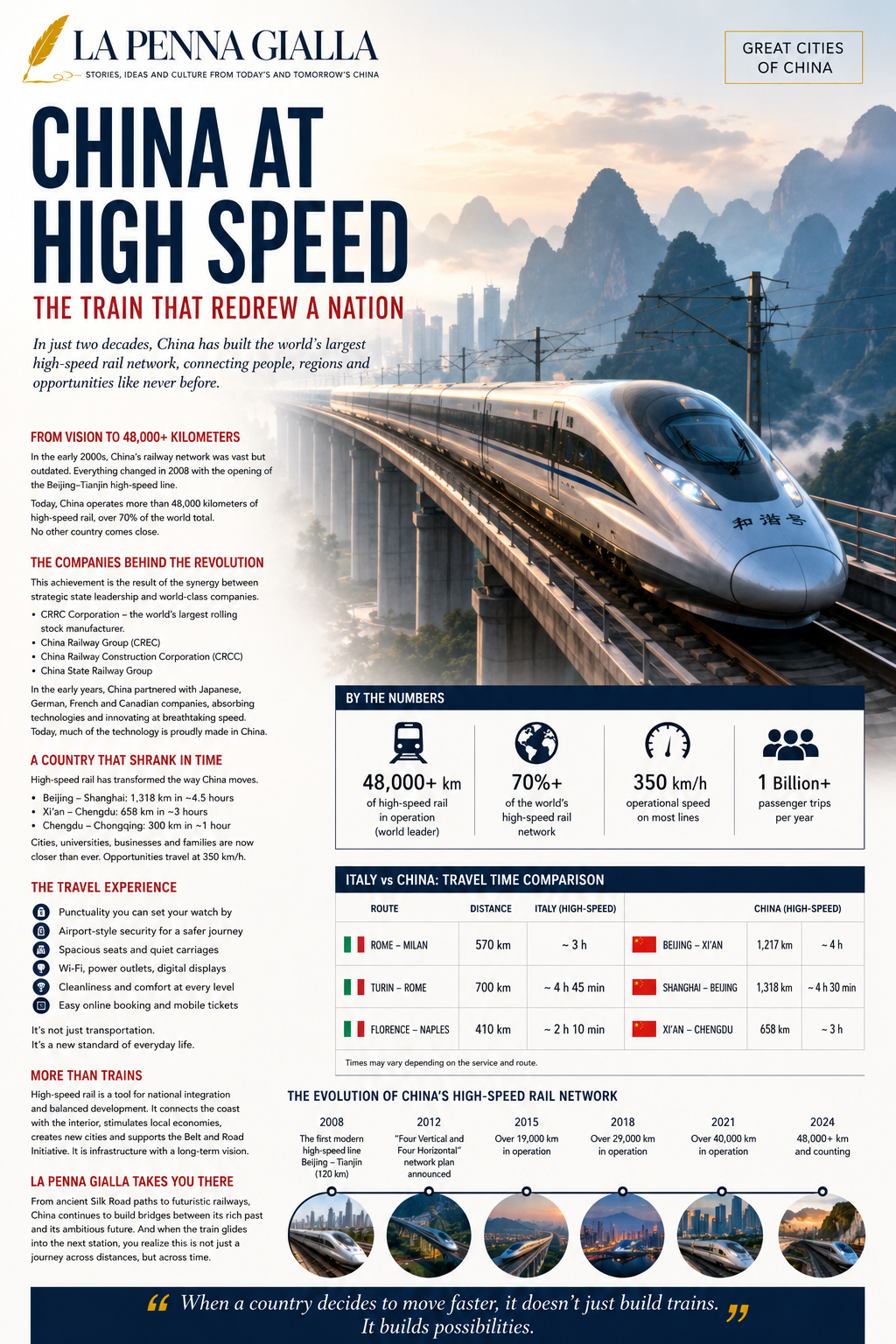
Today, China operates more than 48,000 kilometers of high-speed rail, accounting for over 70% of the world's total high-speed railway network.
No other country comes close.
What was once considered an enormous national investment has become an essential part of everyday life for hundreds of millions of people.
The Companies Behind the Revolution
This transformation was made possible by a combination of long-term planning and industrial development.
Companies such as CRRC Corporation, now the world's largest rolling stock manufacturer, design and build some of the fastest trains on the planet.
Construction giants including China Railway Group (CREC) and China Railway Construction Corporation (CRCC) developed thousands of bridges, tunnels and stations across a country larger than Europe.
During the early stages, China partnered with Japanese, German, French and Canadian companies, absorbing international expertise before developing its own technologies.
Today, much of that innovation is proudly designed and manufactured in China.
A Country That Became Smaller
High-speed rail has done something extraordinary.
It has changed China's geography.
Distances that once required an entire day can now be covered in just a few hours.
Beijing to Shanghai:
More than 1,300 kilometers in approximately four and a half hours.
Xi'an to Chengdu:
Over 650 kilometers in around three hours.
Chengdu to Chongqing:
Just over one hour.
For businesses, universities, tourists and families, the country suddenly feels much closer.
China and Italy: Two Different Models
Italy is widely recognized as one of Europe's high-speed rail success stories.
Its network efficiently connects Turin, Milan, Bologna, Florence, Rome and Naples, providing an excellent alternative to domestic flights.
Yet the Chinese approach operates on an entirely different scale.
| Route | Distance | High-Speed Travel Time |
|---|---|---|
| Rome – Milan | 570 km | ~3 hours |
| Turin – Rome | 700 km | ~4 h 45 min |
| Florence – Naples | 410 km | ~2 h 10 min |
| Beijing – Xi'an | 1,200+ km | ~4 hours |
| Shanghai – Beijing | 1,300+ km | ~4 h 30 min |
| Xi'an – Chengdu | 650+ km | ~3 hours |
The comparison is not about declaring a winner.
The two countries differ enormously in size, geography and population.
Instead, it illustrates how China has chosen to invest heavily in rail transportation as a tool for economic integration and national development.
Traveling at 350 Kilometers per Hour
What surprises visitors is not only the speed.
It is the experience.
Quiet cabins.
Spacious seats.
Wi-Fi.
Power outlets.
Digital information systems.
Exceptional punctuality.
Outside the window, mountains, rivers, megacities, rice fields and endless bridges flow together into a constantly changing landscape.
The journey itself becomes part of the destination.
More Than Transportation
China's high-speed railway tells a much larger story.
It connects remote provinces.
Supports regional development.
Creates new economic corridors.
Strengthens tourism.
Links major cities with emerging industrial centers.
It is not simply a transportation network.
It is one of the most visible symbols of modern China's transformation.
La Penna Gialla Tells
Many travelers remember the Great Wall or the Terracotta Warriors.
Those who cross China by high-speed train remember something different.
A nation that decided to invest in movement, connectivity and opportunity.
As the train silently enters the next station, it becomes clear that the journey has been about much more than distance.
It has been a journey through the idea of a country that chose to build its future one railway line at a time.
Iscriviti e fai iscrivere al canale G-channel La Penna Gialla e non perderti le prossime novità
"Inserisci e fai inserire la tua Azienda o l'azienda di prossimità a costo zero".
"Siamo noi il tuo alleato digitale e con un semplice clic il tuo articolo puoi condividerlo su tutte le piattaforme"

I commenti degli utenti:
Non sono presenti commenti di altri utenti