




Mappa Interattiva - dove le persone incontrano le attività
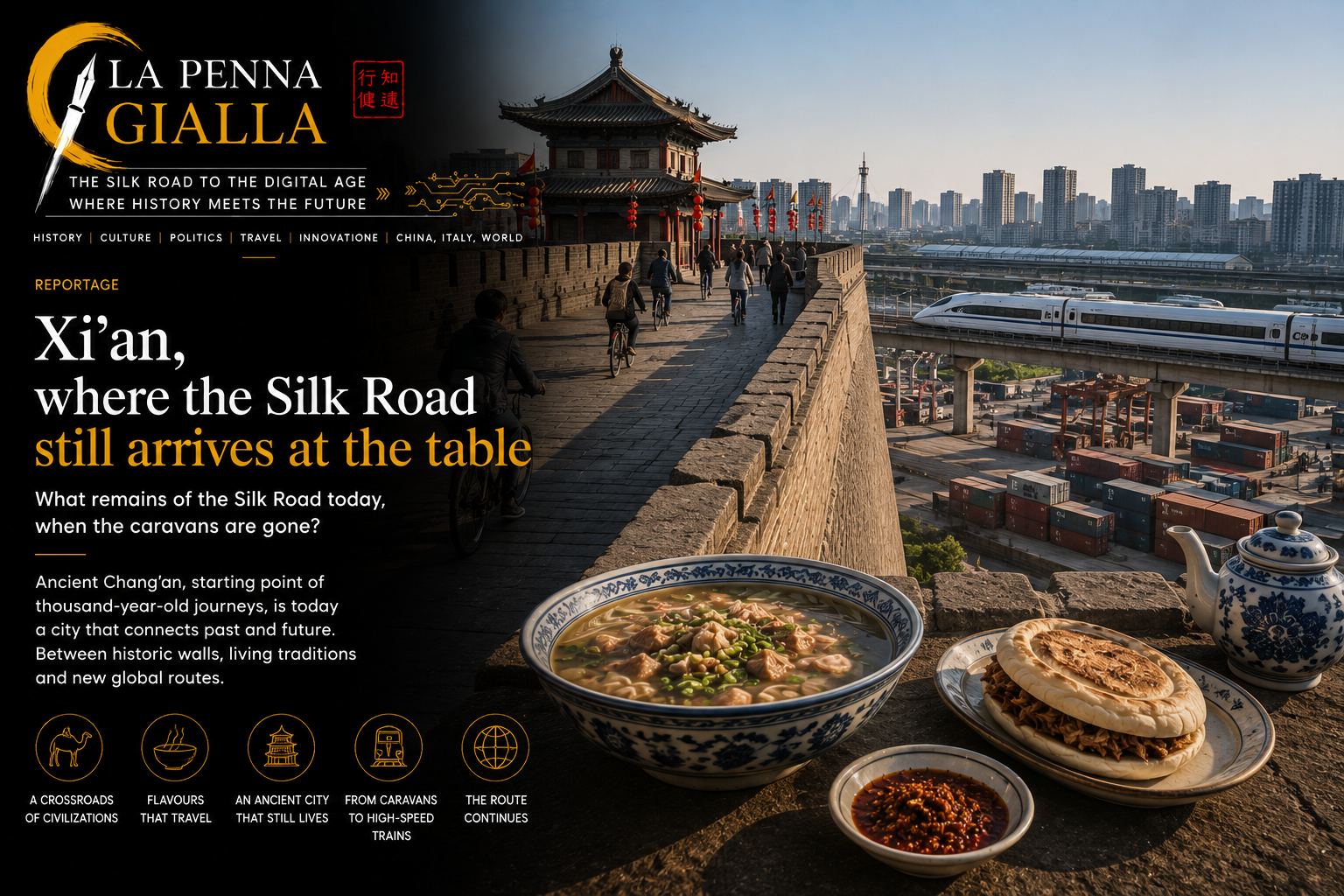
What remains of the Silk Road today, when the caravans are gone?
There are cities that preserve history in museums. And there are cities where history continues to move through everyday life.
Xi’an belongs to the second category.
Once known as Chang’an, the ancient capital of several Chinese dynasties, the city stood at the eastern end of the routes that connected China with Central Asia, the Middle East and, eventually, Europe. For centuries, merchants, travellers, diplomats, monks and soldiers passed through its gates. They carried silk, horses, spices, precious stones, religious ideas and technologies.
The caravans are gone. The routes have changed. But in Xi’an, the Silk Road has never completely disappeared.
Sometimes, it is still possible to taste it.
A city built at the crossroads
Xi’an’s importance was never simply geographical.
As Chang’an, it was one of the great capitals of the ancient world and a starting point for the overland routes later known collectively as the Silk Roads. From here, commercial and cultural connections extended westward across the vast landscapes of present-day China and Central Asia.
The city was therefore more than a destination. It was a meeting point.
Different languages could be heard in its streets. Different religions found a place within the city. Foreign merchants settled here, bringing not only goods but also habits, flavours and techniques.
That history left traces that are still visible today.
The most famous are monumental: the ancient city walls, the Big Wild Goose Pagoda, the Bell Tower and the Drum Tower. But some of the most revealing traces are much smaller.
They are found in kitchens, food stalls and crowded streets.
The Silk Road you can eat
In the heart of modern Xi’an, the Muslim Quarter is one of the places where this history becomes particularly tangible.
The district is not a reconstruction of an ancient caravanserai. It is a living urban neighbourhood, busy with residents, visitors, restaurants and food vendors.
Its streets fill with aromas: grilled meat, cumin, fresh herbs, bread, broth and spices.
The atmosphere is unmistakably contemporary, but some of the ingredients tell a much older story.
Cumin, for example, has a long history of movement between Central Asia and China. Lamb became an important ingredient in the cuisines of regions connected to the old trade routes. Flatbreads and techniques for preparing meat developed across cultural boundaries rather than inside them.
Food, in this sense, becomes a kind of historical map.
You do not need to reconstruct the exact menu of a Tang-dynasty traveller to understand the principle. The important point is that the Silk Road was never only about silk.
It was also about exchange.
Yangrou paomo: a dish made of journeys
Among Xi’an’s best-known dishes is yangrou paomo, a lamb and bread soup.
Its preparation is deceptively simple. Pieces of flatbread are broken into a bowl and combined with a rich lamb broth, meat and other ingredients. Traditionally, part of the experience is breaking the bread yourself before it is taken to the kitchen.
The dish is deeply associated with Xi’an.
Yet its meaning goes beyond local cuisine.
Bread, lamb and aromatic spices all belong to a wider culinary geography stretching across northern China and into Central Asia and the Middle East. Over centuries, ingredients and techniques travelled, were adapted and became local.
That is one of the great paradoxes of cultural history: something can arrive from elsewhere and, after enough time, become completely at home.
Today, a bowl of yangrou paomo does not announce itself as an international dish.
It is simply Xi’an food.
And that is precisely what makes it interesting.
Roujiamo and the language of the street
Then there is roujiamo, often described as a Chinese-style meat sandwich.
A crisp, flat bread is filled with finely chopped braised meat, creating one of the city's most recognisable street foods.
It is fast, practical and deeply rooted in everyday life.
There is nothing ceremonial about eating it in a crowded street. People stop, order, eat and continue on their way.
Yet this simplicity is part of Xi’an’s appeal.
The Silk Road was not only a story of emperors and merchants carrying precious cargo across continents. It was also made by ordinary people who travelled, settled, traded and cooked.
Over time, those movements became traditions.
From caravans to containers
Standing in Xi’an today, it is tempting to imagine the ancient city as a place permanently suspended in the past.
It is not.
The same geographical position that once made the city a crucial point on the overland Silk Road has helped give it a new role in contemporary logistics.
Modern Xi’an is connected to national and international transport networks by rail, road and air. The old idea of a route linking China with the West has acquired a completely different physical form.
The caravan has become the container.
The camel has been replaced by freight trains.
The handwritten record has become a digital tracking system.
And the journey that once took months can now be measured in days.
The historical continuity should not be exaggerated: the ancient Silk Road and today's global logistics networks are not the same thing. They belong to different economic and political worlds.
But the geographical logic has an echo.
Xi’an remains a place where routes converge.
A city between memory and innovation
This tension between old and new is one of the most fascinating aspects of Xi’an.
Ancient walls surround a city that is increasingly modern. Traditional restaurants coexist with shopping centres and technology companies. Historic landmarks stand alongside a rapidly developing urban landscape.
The contrast is not necessarily a contradiction.
In Xi’an, modernity does not always mean erasing the past. Sometimes it means finding new ways to live alongside it.
A visitor can walk along the ancient city walls in the morning, explore a historic temple or pagoda, eat a bowl of lamb soup in the afternoon and, later, move through a contemporary city where payments are made digitally and services are increasingly connected to smartphones.
The old route survives not as a road, but as a habit of connection.
The Silk Road is not a museum
Perhaps this is what makes Xi’an different from a city that simply commemorates its past.
Here, the Silk Road is not locked behind glass.
It is in the spices.
In the bread.
In the lamb.
In the neighbourhoods shaped by centuries of exchange.
It is also in the city's contemporary ambition to remain connected to the wider world.
The history of the Silk Road is often told through spectacular objects: silk, ceramics, manuscripts, coins and monuments.
But cultural exchange rarely survives only through monuments.
It survives through things people continue to do.
A recipe repeated for generations.
A flavour that becomes local.
A technique adapted to a new kitchen.
A word borrowed from another language.
A neighbourhood where different histories meet.
And, sometimes, a simple meal.
The route continues
At night, Xi’an changes character.
The streets become brighter, food stalls fill with people and the city’s historic architecture becomes a backdrop to a very modern urban life.
There is something almost symbolic about eating here.
The Silk Road once carried people towards the unknown. Today, trains, planes, digital networks and global supply chains perform the same basic function in a radically different world: they connect places that would otherwise remain distant.
The road has changed.
The travellers have changed.
The speed has changed.
But the idea of connection remains.
And in Xi’an, you can still encounter that idea not only in a museum or on an ancient map, but at a table, over a steaming bowl of soup, surrounded by the sounds and aromas of a city that has spent more than two thousand years at the crossroads of worlds.
Iscriviti e fai iscrivere al canale G-channel La Penna Gialla e non perderti le prossime novità
"Inserisci e fai inserire la tua Azienda o l'azienda di prossimità a costo zero".
"Siamo noi il tuo alleato digitale e con un semplice clic il tuo articolo puoi condividerlo su tutte le piattaforme"
I commenti degli utenti:
Non sono presenti commenti di altri utenti