



Mappa Interattiva - dove le persone incontrano le attività
When we think about China today, we often picture a distant superpower. Futuristic skylines, magnetic trains, artificial intelligence, microchips, vast industrial hubs, and cities that seem to belong to the future.
And yet, the connection between Italy and China did not begin with globalization, the internet, or the cargo ships crossing oceans filled with technology.
It began centuries ago.
It began with a journey.
A Venetian Traveler Heading East
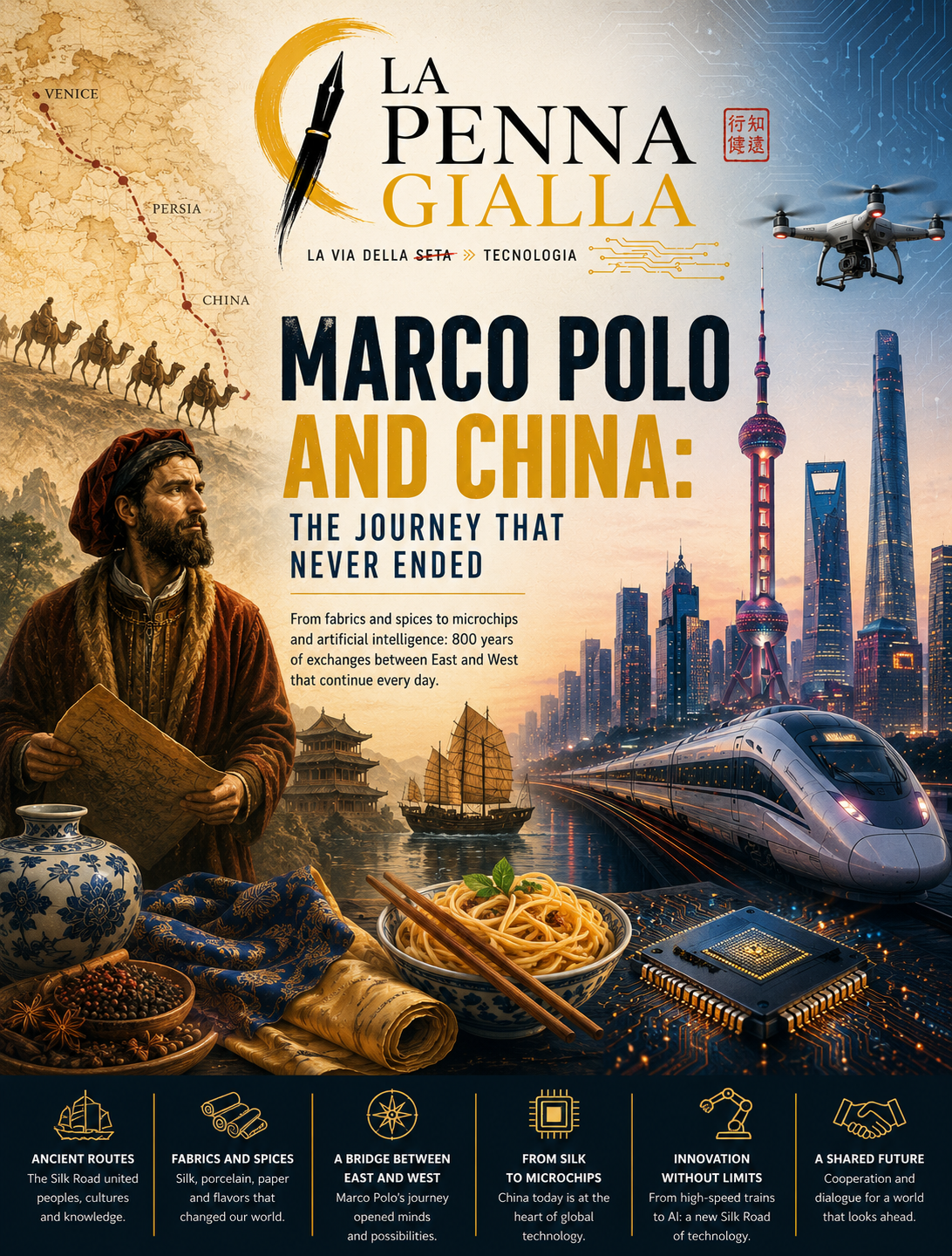
In the 13th century, Marco Polo left Venice with his father and uncle, following the trade routes that would later become known as the Silk Road.
That journey was far more than a geographical adventure.
It became one of the first great cultural bridges between East and West.
For Europeans at the time, China was almost mythical — a land shaped more by legend than by real knowledge. Marco Polo was among the first to describe it in detail: its immense cities, sophisticated administration, wealth, paper currency, commercial networks, spices, textiles, and technologies.
In his book, The Travels of Marco Polo, the East appeared astonishingly advanced compared to medieval Europe.
And perhaps that is the most fascinating detail of all:
even then, China was perceived as a civilization capable of looking beyond its own time.
What Did Marco Polo Really Bring Back?
One of the most famous legends claims that Marco Polo brought pasta from China to Italy.
Historically, the story is far more complex, since forms of pasta already existed throughout the Mediterranean. But the real point is not whether spaghetti were “invented” in China or Italy.
The point is what that trade represented.
Through the eastern routes came:
- fine silk,
- spices,
- porcelain,
- new artisanal techniques,
- paper,
- ideas,
- and different ways of understanding commerce and society.
The Silk Road did not transport goods alone.
It transported knowledge.
And in many ways, it still does today.
From Silk to Microchips
For many years, especially in the West, China was often described through a single stereotype:
the factory of the world, a producer of cheap goods and imitations.
Today, that vision feels increasingly outdated.
Over the last two decades, China has radically transformed its economy. It is no longer simply a place of low-cost manufacturing; it has become one of the world’s leading centers of technological innovation.
Today, the global economy depends on China for:
- electronic components,
- batteries,
- rare earth materials,
- solar panels,
- digital infrastructure,
- advanced manufacturing,
- industrial supply chains,
- and technological research.
Most importantly, it plays a central role in the production ecosystem surrounding microchips — the invisible heart of modern life.
Every smartphone, modern car, computer, high-speed train, or artificial intelligence system relies on a global network in which China occupies a crucial position.
The new Silk Road is no longer made only of caravans and textiles.
It is made of data, semiconductors, energy, logistics, and technology.
The China the West Still Struggles to Understand
In Europe, there is still a tendency to describe China through extremes:
- either with exotic fascination,
- or with economic and political suspicion.
Reality, however, is far more complex.
Modern China is simultaneously:
- an ancient civilization,
- an industrial superpower,
- a technological laboratory,
- and a society in constant transformation.
Perhaps this complexity is exactly what makes China so difficult for the West to fully understand.
While Europe experienced modernity gradually over centuries, entire Chinese cities transformed within a single generation.
A Journey That Continues
Perhaps the true legacy of Marco Polo is not a specific object, a plate of pasta, or a piece of silk.
Perhaps he left us something even more important:
the curiosity to explore a world that once seemed distant, yet has always been deeply connected to our own.
Today, those connections no longer cross deserts and mountains by caravan.
They travel through ports, underwater cables, satellites, and digital networks.
But the principle remains exactly the same.
China continues to enter our homes — through what we buy, use, wear, and even through the technology with which we are reading these words.
The Road of Technology is already here.
And perhaps the journey that began centuries ago never truly ended.
Iscriviti e fai iscrivere al canale G-channel La Penna Gialla e non perderti le prossime novità
"Inserisci e fai inserire la tua Azienda o l'azienda di prossimità a costo zero".
"Siamo noi il tuo alleato digitale e con un semplice clic il tuo articolo puoi condividerlo su tutte le piattaforme"
I commenti degli utenti:
Non sono presenti commenti di altri utenti