




Mappa Interattiva - dove le persone incontrano le attività
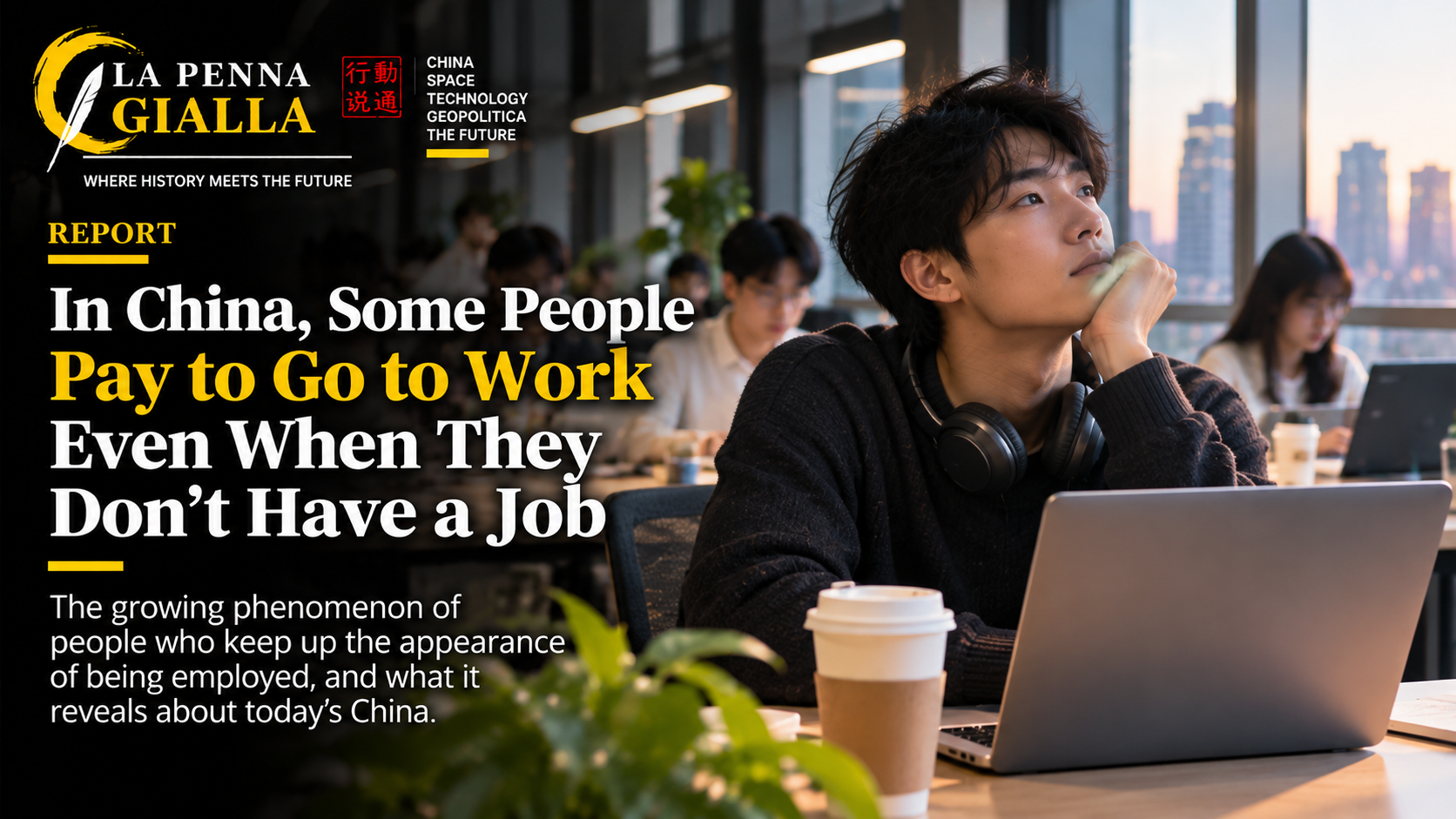
Every morning, they get dressed, leave home and head for the office. They sit at a desk, switch on a computer and spend the day surrounded by people who seem to be working. There is just one difference: they have no job to go to. In China, a growing number of unemployed people are paying to keep up the appearance of being employed. Not because they have something to do, but because facing the world without a job has become harder than pretending.
At nine in the morning, the city is already moving. Trains are crowded, office towers are filling up, coffee cups are carried through revolving doors. Across China, millions of people are beginning another working day.
Among them are people who have nowhere to report to.
They still get up early. They still choose what to wear. They still leave the house at the usual time, sometimes with a laptop bag over their shoulder. They know the route by heart: the station, the familiar streets, the morning rush. Their families may believe they are going to work. Their neighbours may think nothing has changed.
But they have been laid off. Their contracts have ended. They are looking for a new opportunity, or perhaps they have stopped knowing where to look.
And instead of staying at home, they go somewhere else to spend the day.
Some find a place in a library or a café. Others walk through shopping centres, sit in parks or move from one public space to another, waiting for the hours to pass. A growing number have found a more unusual solution: they pay to enter an office where everyone is pretending to work.
It is a strange kind of workplace. And for those who go there, it can feel like the only way to keep life from falling apart.
An office where nobody has a job
In several Chinese cities, businesses have begun offering spaces designed for people who want to experience an ordinary working day, even when they are unemployed.
The idea is simple. For around 30 to 50 yuan a day, visitors can rent a desk, use a computer and connect to Wi-Fi. Coffee and lunch may be included. Some places provide badges, assign small tasks or organise mock management rounds, recreating the familiar rituals of office life.
There are desks, chairs, screens and the quiet hum of people typing. Someone is looking at a spreadsheet. Someone else is drinking coffee. A person walks past, checking what everyone is doing.
From the outside, it looks like an ordinary company.
But there is no real business behind the activity. No clients are waiting for the work to be completed. No salary will arrive at the end of the month. The people in the room have come for something less tangible than a job: the feeling of still having one.
For some, the attraction is the structure. They can get up, get dressed, leave home and follow a routine. They have somewhere to go and a reason to get out of bed. They are no longer spending every weekday alone, watching the hours disappear.
Others are drawn by the company. Around them are people who understand what it means to be between jobs, even if nobody says it aloud.
The office becomes a place where unemployment is not immediately visible.
The daily journey to nowhere
Not everyone is willing, or able, to pay for a desk.
Some create their own version of the working day. They leave home at the usual hour and spend the day outside, moving between libraries, cafés, parks and shopping centres. They return in the evening, just as they would if they had spent eight hours at an office.
The journey itself becomes part of the performance.
One woman described how difficult it was to hide her situation from her mother. She had lost her job but continued to behave as though she were still employed. Even a small detail, such as a photograph of a home-cooked lunch, risked revealing that she was not where her family believed her to be.
For people in this situation, the hardest part is not always finding another job. It is answering the questions that come before it.
Where are you going every morning? How is work? Have you found something better? When will you start again?
Questions that may come from affection can become painful when there is no reassuring answer.
So they keep walking. They maintain the routine. They return home at the end of the day with nothing to report, but at least they have avoided explaining why.
When losing a job means losing more than an income
Work is never just about money.
It gives shape to the day. It provides a place in the world, a reason to wake up, a circle of colleagues and a familiar answer to the question: what do you do?
In China, as in many other societies, employment is also closely tied to family expectations and social standing. Having a job can mean independence, stability and the ability to meet the hopes that parents have invested in their children.
Losing it can feel like losing a part of one's identity.
For someone who has spent years studying, competing and working towards a professional future, unemployment can be particularly difficult to explain. It is not simply a gap in a CV. It can feel like a public failure, even when the circumstances have little to do with personal ability.
The pressure is especially heavy when families have made sacrifices to support education and career ambitions. Telling them that a job has disappeared may mean facing disappointment, worry or a long conversation about what went wrong.
Some would rather postpone that moment.
The daily performance becomes a way of protecting the people around them, but also of protecting themselves. As long as they leave home in the morning, as long as they sit at a desk and return in the evening, the word unemployed can remain unspoken for a little longer.
A generation facing a different working world
Behind these individual stories lies a much larger change.
China's labour market has been under pressure from several directions: the prolonged property crisis, financial difficulties affecting local governments, fierce competition in manufacturing and growing uncertainty across many industries. At the same time, automation and artificial intelligence are reshaping jobs that once seemed secure.
For some workers, a career can end abruptly. A company restructures, a project disappears, or a position is no longer considered necessary. Experience does not always guarantee another opportunity, and finding a new role can take far longer than expected.
The people who pay to pretend they are working do not all share the same story. Some have been laid off after years in established professions. Others are younger and trying to find their first stable position. Some are actively applying for jobs; others need time to recover from the shock of losing one.
Their circumstances are different, but they share an uncomfortable question: how do you live with the feeling that everyone else is moving forward while you are standing still?
The mock office offers no answer. It cannot create a career or guarantee a new beginning. But it can provide a temporary shelter from that question.
The strange comfort of pretending
The phenomenon has attracted enormous attention on Chinese social media. Posts about how to spend the day while hiding unemployment have been widely shared, and the subject has become familiar to people who may never have considered paying to sit in an office without a job.
Some see the idea as absurd. Why pay to do something that has no purpose? Why spend money to imitate a routine that employed people often complain about?
But perhaps the point is precisely that the routine has a purpose of its own.
A working day gives time a structure. It creates small obligations: arriving on time, taking a break, eating lunch, leaving at the end of the afternoon. These details may seem insignificant when life is going well. When a job disappears, they can become surprisingly important.
Unemployment can be isolating. Days lose their boundaries. Weekends become indistinguishable from weekdays. Friends are busy, former colleagues move on, and every conversation seems to circle back to the same question: what next?
In a room full of strangers, the silence can feel less heavy.
Nobody needs to explain why they are there. Nobody has to pretend that everything is fine in quite the same way. For a few hours, they can simply sit at a desk and belong to a place.
Paying to keep an ordinary life
There is something deeply revealing about this new kind of office.
People are not paying for the work. They are paying for the appearance of work, for the rhythm of a day that still resembles the life they had before. They are buying a desk, a coffee, a little company and, perhaps most importantly, a few hours without questions.
It is easy to laugh at the idea of paying to pretend to have a job. Yet the people who do it are not necessarily trying to deceive the world. Many are trying to hold on to something familiar while they work out how to begin again.
The most striking part is not that an office can exist without a real business. It is that, for some people, being seen going to work has become almost as important as having work itself.
Every morning, they leave home. They take the train, cross the city and sit down at a desk. They open a laptop, look at a screen and let the hours pass.
At the end of the day, they switch everything off and go home.
They have not earned a salary. They have not advanced a project. They may not even have taken a single step towards finding a new job.
But for one more day, they have avoided the question that hurts most.
And tomorrow morning, they will put on their clothes, pick up their bag and leave home again.
Iscriviti e fai iscrivere al canale G-channel La Penna Gialla e non perderti le prossime novità
"Inserisci e fai inserire la tua Azienda o l'azienda di prossimità a costo zero".
"Siamo noi il tuo alleato digitale e con un semplice clic il tuo articolo puoi condividerlo su tutte le piattaforme"

I commenti degli utenti:
Non sono presenti commenti di altri utenti