




Mappa Interattiva - dove le persone incontrano le attività
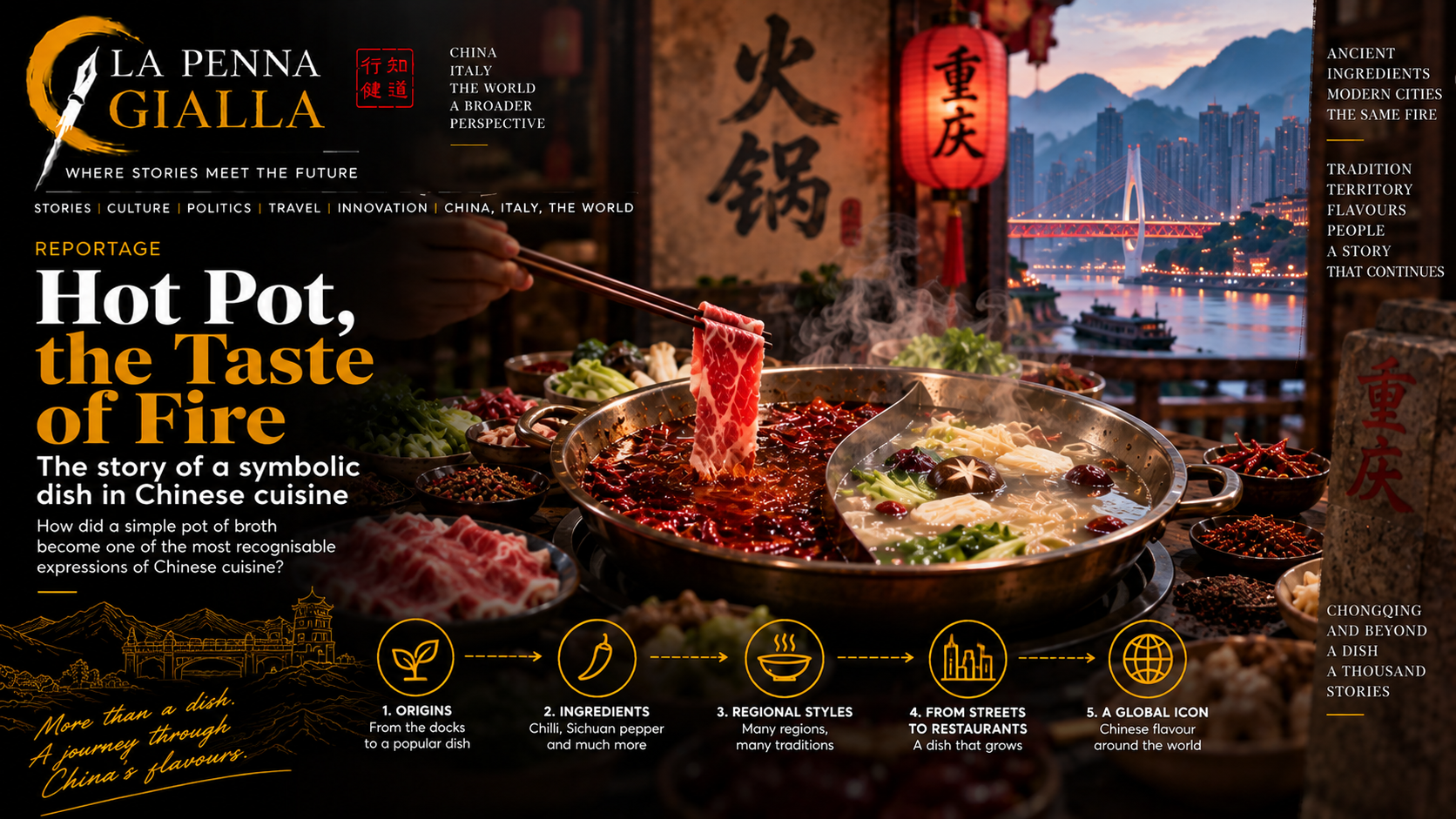
How did a simple pot of broth become one of the most recognisable expressions of Chinese cuisine?
A pot at the centre of the table. A broth at a rolling boil. Chilli, Sichuan pepper, meat, vegetables, tofu, noodles. Ingredients enter the liquid one at a time and are taken out when they reach the right point of cooking.
It is huǒguō, literally “fire pot”.
In the West, it is often described as a particular way of eating together. But stopping at conviviality means missing the most interesting part of its story.
Because hot pot is not a single recipe.
It is a family of regional traditions, techniques and flavours that have transformed a pot of broth into one of the most recognisable expressions of Chinese cuisine. The national professional standard for hot pot chefs, introduced in 2024, explicitly takes into account the variety of regional techniques and flavours. Among the main types are spicy hot pots, those based on fermented vegetables, tomato-based versions and mushroom varieties.
And if there is one city where this story has taken on a particularly distinctive form, it is Chongqing.
Before hot pot, there was a pot
The origins of Chinese hot pot cannot be traced with certainty to a single date or place.
Cooking different ingredients in a shared pot belongs to a much broader culinary history that developed across different regions of China. Contemporary hot pot varieties are numerous and deeply connected to the territories in which they emerged.
The history of Chongqing hot pot, however, has a more clearly defined local tradition.
According to a reconstruction published by the Chongqing government, its development is connected to the city's dock culture, particularly the Chaotianmen area and the banks of the Jialing River. Local tradition traces it back to the late Ming and Qing dynasties, when it was reportedly a simple meal for boatmen and workers who hauled boats along the rivers.
It did not begin as elaborate cuisine.
It emerged from a practical need: to create a hot, inexpensive and filling meal using readily available ingredients.
The dish of the docks
To understand the identity of Chongqing hot pot, you have to look at the city itself.
Chongqing lies at the confluence of the Yangtze and Jialing rivers and has long been an important river and commercial centre. Its docks were places of intense activity, crossed every day by goods, boats and people.
Local accounts connect hot pot in particular with the cuisine of dock workers and with the use of inexpensive ingredients, including offal. The preparation made it possible to cook different foods quickly in a highly aromatic base.
It is an interesting culinary story precisely because it overturns the traditional idea of a dish being “born in a kitchen”.
Chongqing hot pot was born on the streets, around the docks and through work.
Only later would it enter restaurants and become a recognisable speciality far beyond the city.
The real revolution is in the broth
If there is one element that defines Chongqing hot pot, it is not simply the pot.
It is the guōdǐ, the base of the pot.
The traditional version is characterised by a deep red, intense and aromatic base in which chilli, Sichuan pepper, ginger, garlic, spices and beef fat play central roles. Preparing the base is a fundamental part of the technique and has a decisive influence on the final character of the dish.
This is where one of the key expressions of Sichuan and Chongqing cuisine appears:
má là.
Má describes the distinctive tingling and numbing sensation associated with Sichuan pepper.
Là refers to the heat of chilli.
Together they create a sensation very different from simple “spiciness”.
Sichuan pepper acts on the mouth almost electrically, while chilli brings the heat.
It is a combination that has become one of the defining characteristics of the region's cuisine.
Beef fat and the red base
In traditional Chongqing hot pot, beef fat is not a secondary ingredient.
The base is prepared by working fat, chilli and aromatics together until they form a concentrated mixture that gives the broth its colour, aroma and much of its structure.
It is a technique that requires balance.
Too much chilli can overwhelm the other aromas. Too much Sichuan pepper can make the numbing sensation dominant. Poorly cooked spices can compromise the result.
That is why the hot pot base is much more than a simple broth.
It is the recipe within the recipe.
Its importance is such that in 2025 a new Chinese national standard for the quality of hot pot bases was published, coming into force on 1 June 2026.
Máodù, the ingredient that tells the story of its origins
Among the most characteristic ingredients in Chongqing hot pot is máodù, beef tripe.
Its presence says a great deal about the dish's history.
Offal was inexpensive and readily available, and it remained closely associated with the hot pot tradition of Chongqing.
Today the range is enormously broader: beef and lamb, fish, seafood, tofu, mushrooms, vegetables, noodles and countless other ingredients can be immersed in the broth.
But máodù retains a particular significance.
It is one of the ingredients that helps preserve the connection between the popular cuisine of the past and contemporary hot pot.
The nine-section pot
Then there is an object that has become almost an icon of Chongqing: the jiǔgōnggé, the nine-section hot pot.
At first glance, it may seem like a curiosity.
In reality, it is one of the most recognisable forms of local hot pot.
Its structure creates separate compartments within the same pot, making it possible to manage different ingredients and cooking times. The nine-section pot has become so characteristic that it is immediately associated with Chongqing cuisine.
It is a solution that captures the spirit of hot pot particularly well:
one pot, many ingredients, different cooking times and a single flavour base.
There is no single Chinese hot pot
And this is where we have to abandon the idea of hot pot as a single recipe.
China has developed numerous regional variations.
In Chongqing, the red, intense and spicy broth dominates.
In Chengdu, also within the wider cultural area of Sichuan cuisine, hot pot has developed its own characteristics.
In northern China, shuan yangrou is widespread, with very thin slices of lamb quickly swished through a more delicate broth.
Elsewhere, there are mushroom-based broths, tomato versions, fermented-vegetable bases and preparations built around local ingredients.
The principle remains similar.
It is the territory that changes the personality of the pot.
The same diversity is recognised by the national system: the professional model developed in 2024 was created after consultations with operators in numerous Chinese cities precisely to take regional differences into account.
When the dish enters the city
During the twentieth century, Chongqing hot pot changed scale.
From a popular preparation associated with the docks, it moved to street stalls and later into restaurants.
The transformation was important because it changed the meaning of the dish itself.
What began as accessible food for workers gradually became an urban speciality.
And the hot pot restaurant developed its own aesthetic: steaming pots, trays of ingredients, condiments, open kitchens and, above all, the intense aroma of chilli filling the room.
Hot pot stopped being simply something people ate.
It became an image of the city.
From popular cuisine to an industry
Today, hot pot has become a huge sector of China's restaurant industry.
In Chongqing, around 18,900 hot-pot-related businesses and 39,600 venues were registered in 2024, with hot pot consumption revenue reaching approximately 82.4 billion yuan, according to figures reported by the municipality. The wider industry chain was valued at around 341.2 billion yuan.
Behind these figures lies a profound transformation.
Hot pot is no longer simply a culinary preparation.
It is a supply chain encompassing ingredients, bases and seasonings, equipment, restaurants, professional training, research, brands and food tourism.
In 2024, a national professional standard for hot pot chefs was also introduced, with five professional levels. Training covers the preparation of bases, broths, sauces and ingredients, as well as food safety and banquet management.
A cuisine born at the margins of society has become a regulated profession.
In 2026, Chongqing moves to protect its identity
There is a recent development that shows just how important hot pot has become to the city.
In March 2026, the Chongqing Municipal People's Congress approved the Chongqing Hot Pot Industry Development Promotion Regulation, which came into force on 1 May 2026.
It is China's first local regulation specifically dedicated to a hot pot industry.
The regulation formally defines Chongqing hot pot as a style originating in Chongqing, characterised by a particular preparation of its base and the má là xiān xiāng profile: spicy, aromatic and intense, reflecting the culinary culture of Bashu.
The regulation covers not only restaurants but the entire industry chain: ingredients, bases, seasonings, equipment, restaurant services, research, training, cultural transmission and brand development.
It is a significant step.
Chongqing no longer treats hot pot simply as a local speciality.
It considers it an element of the city's gastronomic heritage and economy.
Why hot pot?
Perhaps because few preparations manage to tell so many stories about China at the same time.
There is geography: Chongqing, Sichuan, the rivers and the docks.
There is history: dock workers and popular cuisine.
There is technique: preparing the base, toasting the spices and managing cooking times.
There is flavour: má and là, the tingling of Sichuan pepper and the heat of chilli.
There is economics: from simple ingredients to a vast restaurant industry.
And above all, there is territory.
Hot pot demonstrates that the same culinary idea can develop completely different identities depending on where it is prepared.
A pot that tells the story of Chongqing
In Chongqing, hot pot has become part of the urban landscape.
It can be found in modern restaurants and popular local venues, in tourist districts and on side streets. The city has even begun transforming unexpected urban spaces into new food destinations: in 2026, Xinhua reported on the conversion of former air-raid shelters into restaurants and culinary spaces, bringing together urban memory and gastronomy.
It may be the best way to close the story of hot pot.
Because hot pot has followed the evolution of the city.
From the docks to the restaurants.
From workers' cuisine to a vast gastronomic industry.
From offal to the extraordinary variety of contemporary ingredients.
From a local preparation to a symbol of Chinese cuisine around the world.
And yet, when the broth begins to boil and Sichuan pepper meets chilli, its identity remains immediately recognisable.
The fire is still at the centre.
The pot is still the heart of the dish.
And Chongqing still recognises itself in its most intense flavour: the taste of a cuisine born on the docks and transformed into the gastronomic symbol of a city.
Iscriviti e fai iscrivere al canale G-channel La Penna Gialla e non perderti le prossime novità
"Inserisci e fai inserire la tua Azienda o l'azienda di prossimità a costo zero".
"Siamo noi il tuo alleato digitale e con un semplice clic il tuo articolo puoi condividerlo su tutte le piattaforme"

I commenti degli utenti:
Non sono presenti commenti di altri utenti