



Mappa Interattiva - dove le persone incontrano le attività
Some cities become symbols of a nation.
Paris represents France.
New York reflects the energy of the United States.
Tokyo embodies modern Japan.
China, however, has chosen a different path.
Rather than concentrating its future in a single metropolis, it is building something far more ambitious: an interconnected urban region where eleven cities work together as one of the world's most dynamic economic and technological ecosystems.
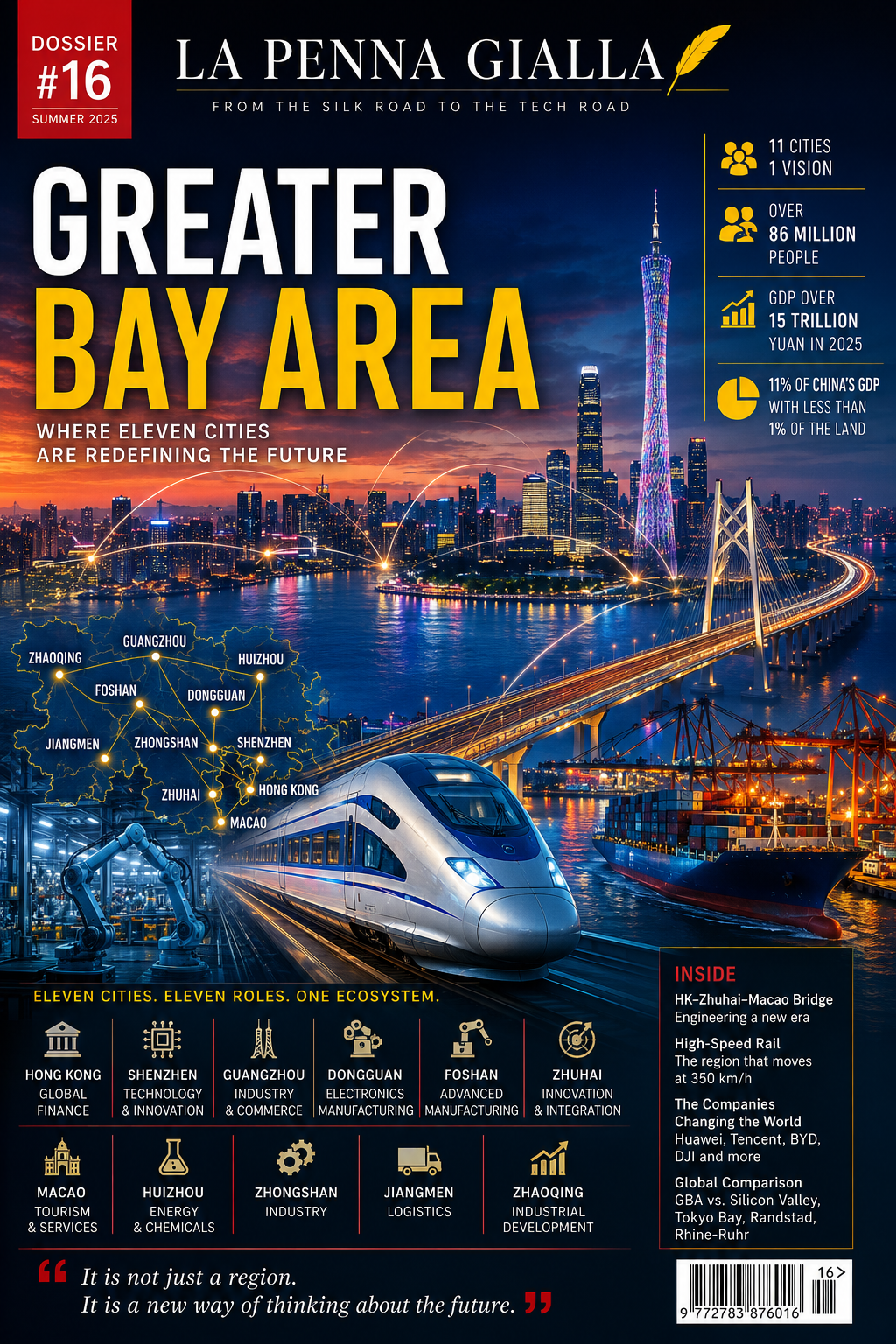
Its official name is the Guangdong–Hong Kong–Macao Greater Bay Area, though it is commonly known simply as the Greater Bay Area (GBA).
Here, some of the busiest ports on Earth operate alongside world-class universities, research centers, advanced manufacturing hubs, global financial institutions and technology companies that are shaping the future.
This is more than a geographical region.
It is one of the most ambitious urban development projects of the 21st century.
📌 Why It Matters
When people think about China's technological rise, cities such as Shenzhen or Hong Kong usually come to mind. Yet the real strength of southern China lies in the way eleven different cities complement one another. The Greater Bay Area combines finance, innovation, manufacturing, logistics and international trade into a single interconnected ecosystem that is becoming increasingly influential on the global stage.
A Vision Larger Than a City
The story begins in the late 20th century.
China had just launched its economic reforms.
Shenzhen was designated as the country's first Special Economic Zone.
Hong Kong had already established itself as one of Asia's leading financial centers.
Guangzhou remained the commercial gateway to southern China.
For many years these cities developed independently.
Then came a bold new vision.
What if they could grow together instead of competing?
The answer became the Greater Bay Area—a long-term strategy designed to integrate infrastructure, innovation, finance, industry and talent across an entire region.
Rather than creating a new city, China decided to connect existing ones, allowing each to specialize while contributing to a common economic ecosystem.
Eleven Cities, Eleven Different Roles
The Greater Bay Area consists of:
- Hong Kong – an international financial center and gateway between China and the global economy.
- Macao – a world-renowned tourism and entertainment hub.
- Shenzhen – China's capital of technological innovation.
- Guangzhou – the region's commercial and manufacturing powerhouse.
- Dongguan – one of the world's leading electronics manufacturing centers.
- Foshan – a major hub for advanced manufacturing and industrial robotics.
- Zhuhai – an emerging center for innovation and high-quality urban development.
- Huizhou – a growing base for energy, petrochemicals and advanced industries.
- Zhongshan – an important manufacturing city.
- Jiangmen – an expanding logistics and industrial platform.
- Zhaoqing – one of the region's fastest-growing industrial areas.
Individually, each city has its own identity.
Together, they form a metropolitan region of more than 86 million people and one of the world's most dynamic economic areas.
Infrastructure That Connects the Future
A regional ecosystem can only succeed if its connections are efficient.
That is why the Greater Bay Area has invested heavily in transportation and infrastructure.
Its most iconic landmark is undoubtedly the Hong Kong–Zhuhai–Macao Bridge, one of the world's longest sea-crossing bridge-and-tunnel systems.
Stretching more than fifty kilometers, it dramatically reduces travel times across the Pearl River Estuary.
Yet the bridge is only one part of a much larger network.
High-speed rail lines connect the region's major cities.
International airports handle millions of passengers every year.
Ports in Shenzhen, Guangzhou and Hong Kong rank among the busiest container terminals in the world.
Every project shares the same objective:
bringing cities closer together and making collaboration faster, easier and more efficient.
Where Innovation Takes Shape
The Greater Bay Area is home to some of China's most influential companies.
In Shenzhen alone are headquartered:
- Huawei, a global leader in telecommunications.
- Tencent, creator of WeChat and one of the world's largest technology companies.
- DJI, the world's leading manufacturer of civilian drones.
- BYD, one of the fastest-growing electric vehicle companies on the planet.
Guangzhou has become a center for automotive manufacturing and biomedical research.
Foshan continues to expand its leadership in industrial robotics.
Dongguan remains one of the world's most important electronics manufacturing hubs.
The strength of the Greater Bay Area is not that everything happens in one place.
Its strength lies in allowing each city to excel at what it does best while remaining connected to the others.
More Than China's Silicon Valley
The comparison with Silicon Valley is inevitable.
Both regions are recognized as global centers of innovation.
Yet their development models are fundamentally different.
Silicon Valley grew around universities, venture capital and private entrepreneurship.
The Greater Bay Area has evolved through long-term planning, strategic infrastructure, industrial integration and cooperation between multiple metropolitan centers.
It is not a copy of Silicon Valley.
It represents a distinctly Chinese model of regional development.
Numbers That Tell the Story
Although the Greater Bay Area occupies less than one percent of China's land area, it generates a remarkable share of the country's economic output.
Today it is home to more than 86 million residents.
The region contributes roughly 11% of China's GDP, making it one of the world's largest metropolitan economies.
Every year thousands of patents are filed across sectors such as artificial intelligence, telecommunications, robotics, advanced manufacturing and biotechnology.
These figures explain why economists, investors and policymakers around the world are watching the Greater Bay Area so closely.
🇮🇹 Italy–China
Italian cities have traditionally developed as independent urban centers, each with its own economic identity and local governance.
The Greater Bay Area follows a different philosophy.
Rather than replacing local identities, it connects them through infrastructure, technology and long-term planning, demonstrating how cooperation between cities can create opportunities that no single metropolis could achieve alone.
La Penna Gialla Tells
Most travelers visit Hong Kong or Shenzhen as separate destinations.
Few realize they are experiencing only two pieces of a much larger puzzle.
The Greater Bay Area is not simply a place on the map.
It is an idea.
An idea that the future may belong not to individual cities competing against one another, but to interconnected regions capable of sharing knowledge, talent, infrastructure and innovation.
In a century increasingly shaped by collaboration, the Greater Bay Area offers a glimpse of what tomorrow's metropolitan world may look like.
And perhaps that is why this remarkable region deserves far more attention than it usually receives.
It is not only helping to transform China.
It is quietly reshaping the future of the global economy.
Iscriviti e fai iscrivere al canale G-channel La Penna Gialla e non perderti le prossime novità
"Inserisci e fai inserire la tua Azienda o l'azienda di prossimità a costo zero".
"Siamo noi il tuo alleato digitale e con un semplice clic il tuo articolo puoi condividerlo su tutte le piattaforme"

I commenti degli utenti:
Non sono presenti commenti di altri utenti