




Mappa Interattiva - dove le persone incontrano le attività
What remains of a community when the people who should inherit its future leave?
There is a China racing towards the future, building megacities and connecting distant places with high-speed trains. And then there is a quieter China, made up of villages, old houses and streets where time seems to follow a different rhythm. This is a China less frequently seen in international travel imagery, yet essential to understanding the country's transformation.
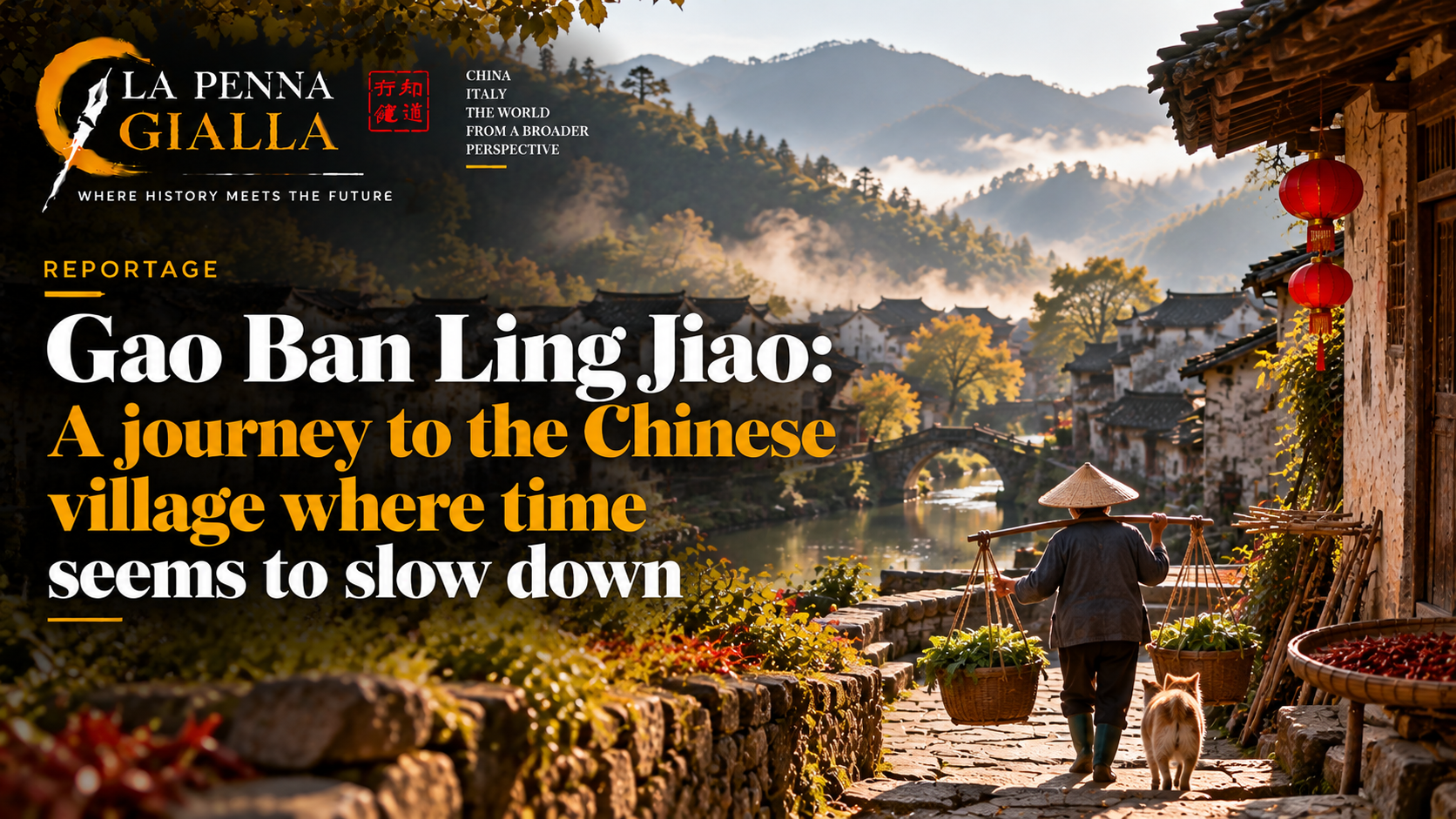
Gao Ban Ling Jiao, located in Zhuji, in the eastern Chinese province of Zhejiang, belongs to this less familiar world. It is not one of China's best-known destinations for international visitors. Its story, however, reflects a change affecting many rural communities across the country: young people leave in search of jobs and opportunities in the cities, while older generations remain in the places where they grew up.
The village has been documented by photographer Zifan Zhang in The Last Watch, a project exploring rural communities shaped by the departure of younger generations. His photographs do not portray a China frozen in time, but a world changing in ways that are not always immediately visible.
Houses That Hold Generations of Memories
In Gao Ban Ling Jiao, houses are more than buildings. They preserve the memory of families, relationships and habits that have shaped the community over time.
Some homes are still inhabited; others bear the marks of a presence that has become sporadic or disappeared altogether. Doors, rooms and everyday objects tell stories that rarely feature in the grand narratives of China's economic development. A house may have sheltered several generations, watched children grow up and welcomed relatives during family celebrations. When descendants move elsewhere, the buildings remain, but their meaning changes.
Shared spaces tell a similar story. The community centre, once a place for gatherings and collective celebrations, illustrates how village life depends on the people who live there. A community is not made of buildings alone. It is also made of opportunities to meet, rituals shared over time and everyday encounters that gradually become part of a place's identity.
When the population declines, not everything disappears at once. The transformation is often quieter: a celebration attracts fewer people, a house stands empty, an activity comes to an end. A village can retain its physical appearance while its social life changes profoundly.
Work Has Not Disappeared. It Has Changed
An ageing village might suggest a world left behind by modernisation. The reality is more complex.
Documentation of Gao Ban Ling Jiao shows an elderly couple assembling badminton rackets inside their home. The frames come from a factory in the Fuyang area and are finished locally. It is a small but revealing example of how production can reach rural communities, offering work to people who may no longer be able to cope with the pace and commuting demands of urban employment.
This detail gives the village a tangible, contemporary dimension. Life has not stopped; it has adapted to the circumstances of those who remain.
Working from home, however, does not solve every difficulty. Economic opportunities may be limited, while ageing makes activities that once formed part of an ordinary day increasingly demanding. Distance from services and family members can be as challenging as distance in kilometres.
Rural China is not separate from contemporary China. It is part of the same economic network, yet remains exposed to inequalities that development alone has not erased.
The Children Leave, but the Ties Remain
To understand Gao Ban Ling Jiao, we must look beyond the village itself.
Over recent decades, China's economic growth has concentrated many opportunities in its cities. Jobs, universities, services and professional prospects have encouraged people to leave their places of origin. For younger generations, moving away can mean building a different life from that of their parents, gaining access to new opportunities and imagining a broader future.
Leaving does not necessarily mean breaking ties. A village can remain the place of one's origins, somewhere to return to during holidays or family celebrations. Yet emotional attachment does not always translate into a daily presence.
This raises some of the most delicate questions facing rural communities. Who cares for older parents when their children live far away? How are traditions passed on when opportunities to share them become less frequent? And what does it mean to grow up knowing that greater opportunities may require leaving the place where one was born?
Gao Ban Ling Jiao does not offer a single answer for all of China. Instead, it shows how major economic changes translate into family decisions, distance and new balances between generations. Every departure represents an opportunity pursued; every person who stays represents a life that remains connected to the land.
A Village Between Memory and the Future
Gao Ban Ling Jiao's future is not necessarily that of a place destined to disappear. Available documentation also describes efforts to revitalise the village through rural tourism and hospitality initiatives, with the aim of creating economic opportunities and giving new value to local heritage.
Tourism can help sustain local activities, restore buildings and bring new resources into a community. Its impact, however, depends on how it is developed. A village is not simply a collection of old houses to be turned into a picturesque setting. It is a living place, with everyday needs and people who must be able to continue living there.
The challenge is to find a balance between revitalisation and authenticity. Traditions can become an economic opportunity, but they should not be reduced to a performance designed exclusively for visitors. Local life must remain at the centre of change, rather than becoming a decorative backdrop.
This is why Gao Ban Ling Jiao matters beyond its modest size. It raises a question shared by rural communities around the world: how can a place build a future without giving up its identity?
The China You Cannot See from the Big Cities
Discovering China through its metropolises means encountering a country of innovation, speed and spectacular transformation. Looking at a village such as Gao Ban Ling Jiao reveals another side of the same development: the distance between generations, the uneven distribution of opportunities and the importance of places that rarely make international headlines.
There is no need to romanticise rural life to recognise its value. Villages can offer deep relationships and a strong sense of belonging, but they can also face isolation and a lack of services. Their story is not a nostalgic tale about the past. It is part of China's present.
The houses, objects and people of Gao Ban Ling Jiao tell a story that is still unfolding. Some young people have chosen other cities. Older residents preserve a continuity that is becoming more fragile. New initiatives are trying to imagine different possibilities.
One question remains, perhaps more important than any statistic: what makes a place feel like home, even when much of life takes place somewhere else?
It is a question that invites us to look at China from a different perspective. Not only through what it builds, but also through what it is trying to preserve. And through the lesser-known places that, far from the most famous routes, can reveal much more than we might expect.
Sometimes, to understand a country's future, we must stop and listen to the places that seem to have been left behind.
Iscriviti e fai iscrivere al canale G-channel La Penna Gialla e non perderti le prossime novità
"Inserisci e fai inserire la tua Azienda o l'azienda di prossimità a costo zero".
"Siamo noi il tuo alleato digitale e con un semplice clic il tuo articolo puoi condividerlo su tutte le piattaforme"

I commenti degli utenti:
Non sono presenti commenti di altri utenti