




Mappa Interattiva - dove le persone incontrano le attività
What changes when robots are no longer confined to factories, but begin to enter the spaces of everyday life?
For decades, the image of a robot was inseparable from the factory floor: a mechanical arm repeating the same movement thousands of times, welding car frames or assembling components with speed and precision. These machines transformed industrial production, but they operated in environments designed around their capabilities. The next challenge is different. What happens when a robot has to move through a world built for human beings, where objects are not always in the same place, tasks rarely follow a perfect sequence, and every day brings unexpected situations?
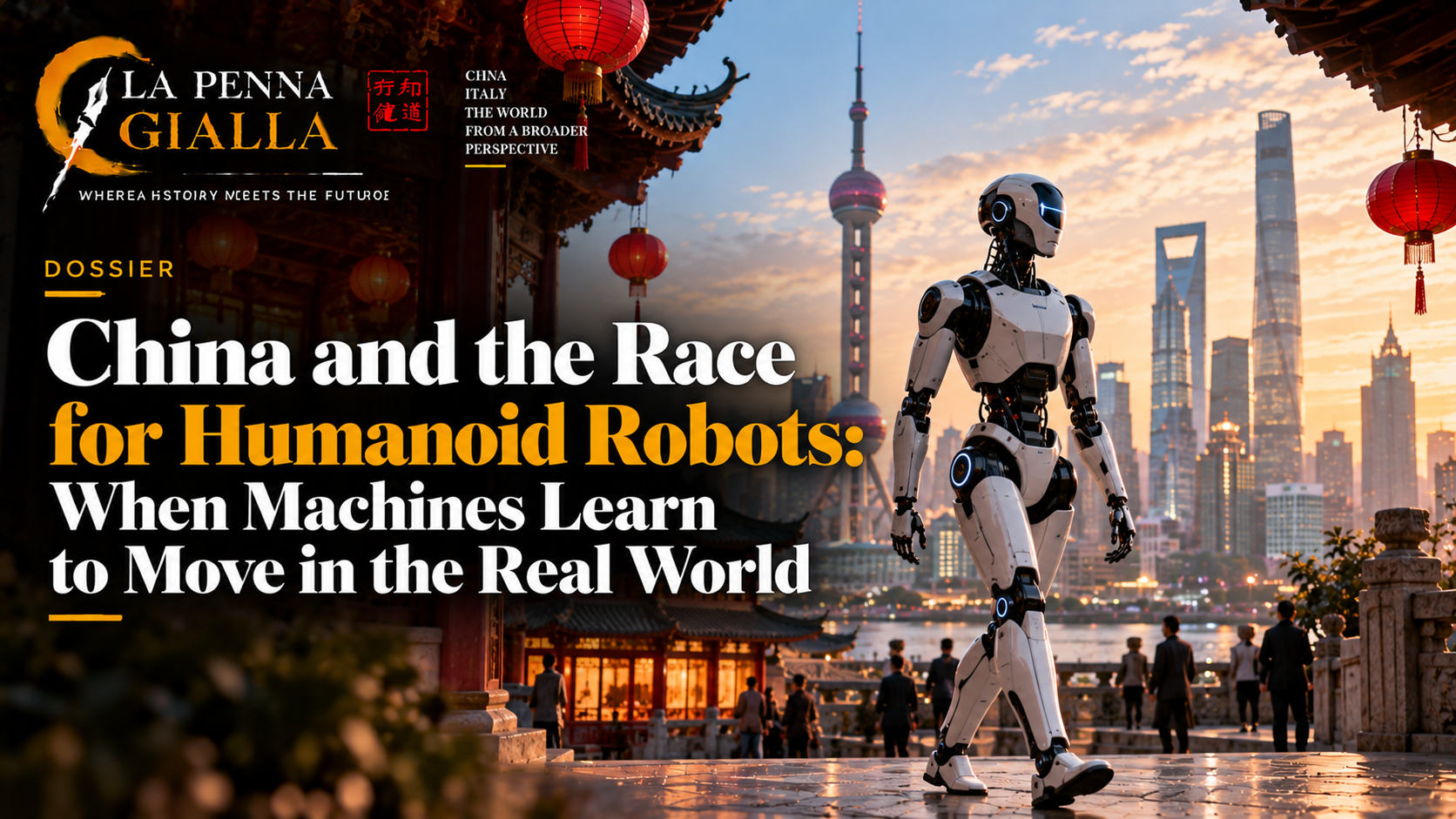
This is the ambition behind humanoid robotics, one of the most closely watched frontiers of China's technological development. The goal is not simply to build machines that resemble people. It is to create systems capable of walking, handling objects, interpreting their surroundings and performing useful tasks in environments that were never designed for robots.
The distinction matters. A machine that can walk across a stage or imitate a human gesture may capture attention, but a robot that can reliably carry a box, identify the correct component on a crowded workbench or assist with a repetitive task presents a much more significant technological and economic challenge.
Why build a robot with a human shape?
The human body is, in many ways, an extraordinarily versatile tool. We walk up stairs, open doors, carry objects, use tools and adapt our movements to spaces that change constantly. Our homes, workplaces, hospitals and public buildings have all been designed around this physical model.
A humanoid robot could, in principle, take advantage of the same infrastructure. Rather than redesigning an entire workplace around a specialised machine, a company might deploy a robot capable of using existing workstations, moving through corridors and handling objects intended for human hands.
This is the promise, but also the difficulty. Two legs do not automatically make a robot good at walking, just as two mechanical hands do not guarantee the dexterity needed to handle fragile or irregular objects. Balance, coordination, perception and decision-making must work together, often in fractions of a second.
There is also a practical question: does a machine really need to look human to perform a particular job? In many industrial applications, a specialised robotic arm remains faster, cheaper and more reliable. Humanoid robots make the most sense where versatility is valuable, especially when the same machine must carry out several different tasks without major changes to its surroundings.
The challenge, therefore, is not to reproduce the human body for its own sake. It is to understand which human capabilities can be translated into useful, dependable technology.
From the factory floor to the wider world
China already has extensive experience in industrial automation, electronics manufacturing and the development of intelligent machines. Humanoid robotics builds on this industrial foundation while introducing a more demanding combination of hardware and software.
A robot must be able to perceive its surroundings, recognise objects, plan movements and respond when something unexpected happens. It needs motors and mechanical joints that can reproduce complex movements, sensors that provide information about the environment, and computing systems capable of interpreting that information.
These elements must operate as a coherent whole. A robot may have sophisticated artificial intelligence and still fail if its movements are too imprecise. Equally, a mechanically impressive machine will have limited usefulness if it cannot understand what it is supposed to do.
Manufacturing environments offer a logical starting point. They can be organised around relatively predictable tasks, and the benefits of automation can be measured in terms of productivity, consistency and operating costs. Repetitive handling, material movement and selected assembly operations are among the activities that researchers and companies are exploring.
Moving beyond these controlled environments is another matter. A warehouse contains obstacles, people and objects that change position. A hospital has narrow passages, delicate equipment and strict safety requirements. A private home is even less predictable: furniture, lighting and objects vary from one room to another, and tasks often require judgement rather than simple repetition.
For humanoid robots to become genuinely useful, they will have to bridge the gap between performing a demonstration and completing a task reliably, day after day.
China wants to turn prototypes into an industry
One reason China is attracting attention in this field is the scale of its manufacturing ecosystem. The country has extensive supply chains for electronics, batteries, sensors and mechanical components, alongside a large industrial base that can potentially become both a customer and a testing ground for new robots.
This combination could help manufacturers move from experimental prototypes to repeatable production. It may also make it easier to refine components, reduce manufacturing costs and adapt machines to different industrial applications.
The ambition extends beyond building individual robots. It involves developing an entire industrial chain: from motors and precision components to control systems, artificial intelligence, testing facilities and the software that allows machines to learn new tasks.
Competition is therefore taking place on several levels at once. Companies are trying to improve the capabilities of their robots, but they are also working to lower costs, establish technical standards and identify applications for which customers are willing to pay.
A striking prototype can attract investment and publicity. A commercially successful robot must meet a more demanding set of conditions: it must be safe, maintainable, productive and economically justified.
The decisive test will come when businesses can demonstrate that humanoid robots offer an advantage over existing equipment, rather than simply providing a more spectacular form of automation.
The virtual factory where robots learn
One of the less visible aspects of humanoid robotics is the role of simulation. Before a machine can operate safely in the physical world, researchers need ways to train and test its behaviour across a wide range of situations.
A virtual environment can reproduce factory floors, obstacles, objects and possible movements. Within this digital space, a robot can practise tasks repeatedly, encounter simulated failures and improve its responses without damaging equipment or putting people at risk.
This approach is particularly valuable for activities that require coordination between movement and perception. A robot must learn not only how to reach for an object, but also how to adjust its grip, compensate for changes in position and react when the object behaves differently from what it expected.
Simulation does not eliminate the need for real-world testing. The physical world contains friction, wear, uneven surfaces and countless small variations that are difficult to reproduce perfectly in a digital model. A movement that works in a simulation may still fail when performed by a real machine.
The most promising approach combines virtual training with physical experimentation. Simulation can accelerate learning and reduce the number of costly trials, while real-world feedback helps correct the differences between the model and reality.
This creates another field of competition: not just who can build the most advanced robot, but who can teach it to perform useful actions more efficiently.
Artificial intelligence must learn to act
The rapid development of generative artificial intelligence has changed expectations about what machines might eventually be able to do. Systems that interpret language, images and complex instructions have opened new possibilities for robots that need to understand their environment before acting.
Yet a robot cannot rely on language alone. Knowing how to describe a cup is not the same as knowing how to pick it up without crushing it. Recognising a staircase does not automatically provide the balance and coordination required to climb it.
Physical intelligence demands a continuous exchange between perception and action. The robot must observe, make a decision, move and evaluate the result. If the situation changes, it must adapt.
This is one of the hardest problems in the field. Real environments are full of uncertainty, and even a seemingly simple task may involve many small decisions. Picking up an object, for example, requires estimating its position, identifying a suitable grip, controlling the force applied and adjusting the movement if the object slips.
Artificial intelligence can help connect these stages, but reliable physical performance depends on the quality of the robot's sensors, mechanics, training and control systems as well.
The objective is not simply to give a machine a more sophisticated interface. It is to make intelligence useful through movement.
The economic promise — and the cost
Humanoid robots are often presented as a possible response to labour shortages and rising production costs. In ageing societies, they could eventually help with certain physically demanding or repetitive activities. In industry, they might allow companies to automate tasks that have resisted conventional robotics because they require flexibility or human-like movement.
However, economic value cannot be measured by technical capability alone. The purchase price is only one part of the calculation. Companies must also consider energy consumption, maintenance, downtime, supervision, software updates and the cost of adapting existing workflows.
A robot that performs a task successfully in a demonstration may not yet be ready to operate an entire shift. If it needs constant assistance or frequently stops when conditions change, the expected productivity gains can quickly disappear.
Safety is equally important. A humanoid robot working near people must be able to detect hazards, control its movements and respond appropriately when someone enters its path. The more powerful and versatile the machine becomes, the more important these safeguards will be.
For manufacturers, the real breakthrough will not necessarily be the robot that can perform the greatest number of impressive movements. It may be the one that can carry out a modest task consistently, safely and at a cost that makes sense.
What happens to work?
The introduction of humanoid robots raises a familiar question: which jobs will disappear, and which new forms of work will emerge?
The answer is unlikely to be uniform across sectors. Tasks that are repetitive, physically demanding or performed in predictable environments may be easier to automate than activities requiring complex judgement, negotiation or continuous adaptation to other people.
Even within the same occupation, some tasks may be automated while others remain dependent on human skills. A robot might move materials or perform a standardised handling operation, while a person remains responsible for quality control, troubleshooting, coordination and decisions that require context.
New roles could also develop around programming, training, maintenance, safety and the integration of robots into existing production systems. But the creation of new jobs does not automatically compensate for every job transformed or eliminated, nor does it guarantee that workers will have the skills needed to move into those positions.
The transition will depend on how businesses introduce the technology, how training is organised and whether productivity gains are accompanied by opportunities for workers.
For China, the issue has particular significance because technological upgrading is taking place alongside demographic change and a reorganisation of the labour market. Humanoid robots may become part of the response to some industrial challenges, but they will not provide a universal solution to the economic and social consequences of an ageing population.
From factories to homes
The prospect of humanoid robots entering private homes is perhaps the most captivating — and the most difficult to realise.
A machine capable of moving objects around a laboratory may struggle in a real kitchen, where surfaces are wet, utensils have different shapes and the same cupboard may be arranged differently in every household. Domestic environments demand flexibility, but they also impose high expectations of safety, affordability and ease of use.
Tasks such as carrying objects, moving supplies or assisting with certain household routines may become feasible before more complex activities such as cooking an entire meal or providing independent care for a vulnerable person.
The distinction between assistance and autonomy will be crucial. A robot that can perform a task under supervision is not necessarily capable of making safe decisions on its own. In homes, where people may be children, older adults or individuals with limited mobility, the consequences of failure can be particularly serious.
There is also a question of acceptance. People may welcome a machine that reduces physical effort, but feel uncomfortable sharing intimate spaces with a powerful device that records its surroundings or makes decisions they cannot easily understand.
For humanoid robots to become part of everyday life, technical performance will have to be accompanied by transparent data practices, clear safety standards and a convincing reason for households to pay for them.
A new frontier in China's technological competition
China's humanoid robotics ambitions sit at the intersection of several strategic priorities: advanced manufacturing, artificial intelligence, industrial automation and the development of new technology markets.
The sector also illustrates a broader change in the nature of technological competition. It is no longer enough to develop a powerful algorithm or manufacture a sophisticated component. Success increasingly depends on combining hardware, software, data, supply chains and practical applications into a product that can be deployed at scale.
This is a demanding objective. Technical progress can be rapid in some areas and frustratingly slow in others. A robot may improve dramatically in its ability to walk while making much more modest progress in handling delicate objects or completing complex tasks. Commercial adoption may lag behind public demonstrations, especially when costs and reliability remain unresolved.
The race will therefore be decided less by spectacular presentations than by sustained progress in the less glamorous details: the precision of a hand, the durability of a joint, the quality of a sensor, the efficiency of a battery and the ability to recover from a mistake.
These are the details that determine whether a humanoid robot remains a technological curiosity or becomes a useful industrial tool.
When will we stop being amazed?
The first time we see a robot walk, run or manipulate an object with human-like movements, it is difficult not to be impressed. Yet the significance of humanoid robotics will ultimately depend on what happens after that first reaction.
Can the machine repeat the task tomorrow? Can it do so in a different environment? Can it recognise when something has gone wrong? Can it work safely alongside people, and can the organisation using it justify the cost?
These questions are less spectacular than a robot dancing or performing an acrobatic movement. They are also much more important.
China's race to develop humanoid robots is not simply a contest to build machines that resemble human beings. It is an attempt to extend automation into environments where traditional industrial robots have limitations, while creating a new market around the combination of physical machines and artificial intelligence.
The future of humanoid robotics will not be decided when machines look human. It will be decided when they can reliably perform work that still requires a person today.
Iscriviti e fai iscrivere al canale G-channel La Penna Gialla e non perderti le prossime novità
"Inserisci e fai inserire la tua Azienda o l'azienda di prossimità a costo zero".
"Siamo noi il tuo alleato digitale e con un semplice clic il tuo articolo puoi condividerlo su tutte le piattaforme"

I commenti degli utenti:
Non sono presenti commenti di altri utenti