




Mappa Interattiva - dove le persone incontrano le attività
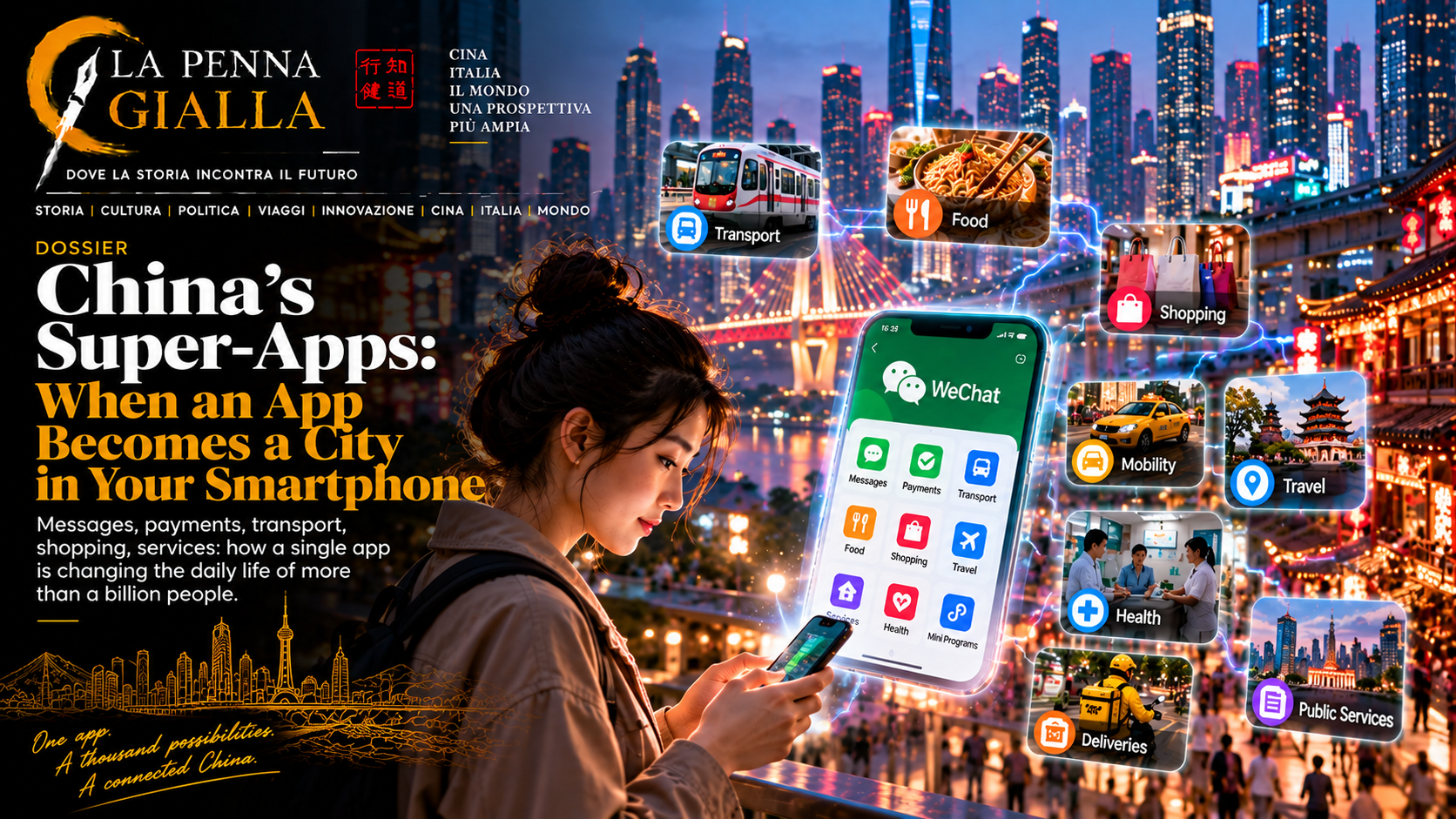
What happens when messages, payments, transport, shopping and services all come together inside the same smartphone?
Imagine arriving in a city you have never visited before.
You need to pay for a coffee, call a taxi, buy a train ticket, book a table, rent a bicycle or order something to eat.
In Italy, you would probably open a different app for each task.
In China, many of these actions can begin in the same place: your smartphone.
Not because there is a single application that has replaced all the others, but because platforms such as Weixin, known outside China as WeChat, and Alipay have built digital ecosystems where different services coexist.
This is the logic of the super-app.
And to understand contemporary China, it is one of the most interesting transformations to observe.
It is no longer just a messaging app
When WeChat was launched in 2011, it was primarily a communication tool.
Today, Weixin offers messaging, social networking, payments, search, content, business services and, above all, Mini Programs: lightweight applications that work directly inside the platform.
The transformation is significant.
It is not simply about adding more functions to an app.
The real change is creating an environment in which one action can naturally lead to the next.
A message can lead to a shop.
A QR code can open a service.
A Mini Program can allow you to book, purchase and pay without downloading another application.
The phone becomes something more than a communication device.
It becomes the interface through which people access everyday life.
The small program that changes everything
At the heart of this system are Mini Programs.
They are applications that do not necessarily require a separate download and can operate within the Weixin or Alipay ecosystem.
For users, that means fewer apps to search for, install and update.
For companies, it means entering directly into the digital environment where their customers already spend much of their time.
The scale of the phenomenon is enormous.
Tencent reported that Weixin Mini Programs generated 8 trillion yuan in transaction volume in 2024.
Behind a figure like that are not only major purchases.
There are also the small actions that, taken together, define everyday life: ordering, booking, paying, buying a ticket or accessing a service.
That continuity is what makes the model so interesting.
Payment is only the beginning
For years, when talking about Chinese technology, one of the first images that came to mind was payment through a QR code.
But the QR code is only the most visible part of a much broader transformation.
Mobile payments through platforms such as Weixin Pay and Alipay have become part of everyday life in China.
The crucial change is this:
people do not simply pay through their phones.
Increasingly, payment is built into the service itself.
You choose a product, make a reservation, receive a code, pay and complete the transaction without constantly switching between different digital environments.
The transaction almost disappears.
A city inside your smartphone
This is where the definition of “super-app” becomes particularly interesting.
Think about a physical city.
It has streets, shops, public transport, restaurants, offices, banks, cinemas and public services.
A digital city can connect many of these services through a single entry point.
It does not mean that everything literally exists inside one application. Weixin and Alipay, for example, are separate ecosystems and competitors.
But for the user, the result can feel similar: many everyday activities become accessible from the same smartphone.
It is a different way of organising digital life.
Not a collection of isolated islands.
Instead, a system in which different functions are connected.
Travelling changes too
The transformation is particularly visible for international visitors.
Foreign travellers can now link some international bank cards to Weixin Pay and Alipay and use mobile payments in many everyday situations, from transport and restaurants to hotels and supermarkets.
But for a traveller, the interesting point is not only being able to pay.
Mini Programs can also provide access to transport services, shared bicycles, deliveries, tickets and other local services.
The consequence is fascinating.
A technology originally developed to simplify everyday life for people living in China is also becoming one of the first tools through which international visitors enter the country’s digital everyday life.
The Chinese model is different from what we are used to
In Europe, we are accustomed to a fragmented digital ecosystem.
One app for messaging.
Another for transport.
Another for payments.
Another for food delivery.
Another for bookings.
Another for shopping.
Another for public services.
The super-app model attempts to reduce this fragmentation.
Its strength does not necessarily lie in having more functions than other applications.
It lies in connecting them.
A search can become a booking.
A booking can become a payment.
A payment can generate another service.
The platform becomes an environment in which the user stays longer and different activities reinforce one another.
The integration of payments and Mini Programs has been one of the central elements in the development of Chinese super-apps.
And what about Alipay?
If Weixin built its ecosystem starting from communication, Alipay followed a different path.
Its origins are connected to digital payments and Alibaba’s commercial ecosystem.
Over time, however, Alipay also developed into a much broader platform, combining payments, shopping, transport, travel and numerous Mini Programs.
This is one of the most interesting characteristics of the Chinese model:
a super-app is not necessarily a single product. It is an ecosystem.
And ecosystems can compete.
Weixin and Alipay represent two major parallel digital infrastructures, each seeking to become a gateway to everyday life.
What have we lost along the way?
The most interesting question may not actually concern technology.
It concerns habits.
What happens when you no longer have to ask yourself which app to open?
When the phone is no longer simply a collection of separate applications, but a single gateway to different services?
The change may seem small.
In reality, it changes the way we interact with technology.
The distinction between application, service and payment becomes increasingly blurred.
And the phone stops being merely something we use.
It becomes the environment through which we organise an increasing part of our daily lives.
The real innovation is not the app
Perhaps this is the most interesting aspect of China’s super-app revolution.
The real innovation is not creating an application with hundreds of functions.
It is imagining a different relationship between people and technology.
A relationship in which we are no longer forced to jump constantly from one service to another.
Technology instead becomes invisible, embedded in everyday actions.
And when technology becomes invisible, it means it has stopped being a novelty.
It has become a habit.
From the Silk Road to the Technology Road
For La Penna Gialla, perhaps this is where the journey of our first season finds one of its strongest images.
The Silk Road connected cities, markets, people and goods through an immense physical network.
Contemporary China is building different kinds of networks: digital, mobile and immediate.
They do not transport silk, spices or porcelain.
They transport information, payments, services and access.
And today, for millions of people, part of that network passes through a screen held in the palm of the hand.
It is no longer simply a phone.
It is a gateway.
And behind that gateway, increasingly, there is an entire city.
Iscriviti e fai iscrivere al canale G-channel La Penna Gialla e non perderti le prossime novità
"Inserisci e fai inserire la tua Azienda o l'azienda di prossimità a costo zero".
"Siamo noi il tuo alleato digitale e con un semplice clic il tuo articolo puoi condividerlo su tutte le piattaforme"
I commenti degli utenti:
Non sono presenti commenti di altri utenti