




Mappa Interattiva - dove le persone incontrano le attività
Long before photography captured the beauty of landscapes, China had already learned how to preserve them.
Not with cameras.
But with ink.
For centuries, painters created delicate scrolls depicting towering granite peaks rising through seas of clouds, ancient pine trees clinging to impossible cliffs, and mist drifting silently through deep valleys.
To many Western observers, these scenes looked like works of imagination.
Then they discovered Huangshan.
The Yellow Mountains.
A place where nature seems to have stepped directly out of a painting.
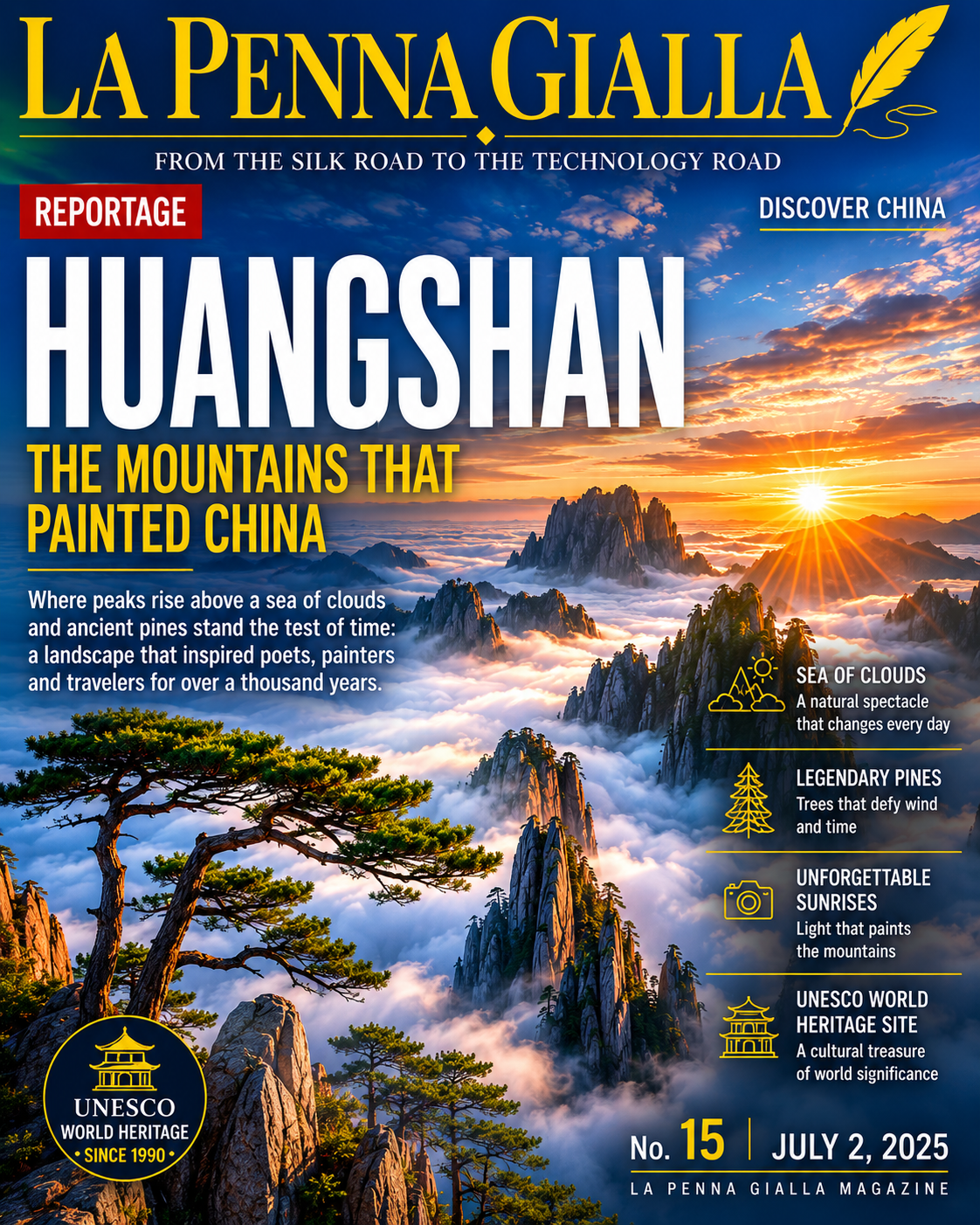
Here, jagged peaks emerge above an endless ocean of clouds.
Centuries-old pines grow from cracks in solid granite.
Silence is broken only by the sound of the wind and distant birdsong.
Huangshan is not simply a destination.
It is an experience of contemplation.
📌 Why It Matters
Huangshan is far more than one of China's most spectacular natural landscapes. For over a thousand years it has inspired painters, poets, philosophers and calligraphers, shaping the visual identity of traditional Chinese art. Understanding Huangshan means understanding how the Chinese have long viewed nature—not as something to conquer, but as something to respect, admire and live in harmony with.
Why Are They Called the Yellow Mountains?
The name Huangshan literally means "Yellow Mountain."
According to Chinese tradition, these peaks were renamed in honor of the legendary Yellow Emperor, Huangdi, one of the mythical founders of Chinese civilization.
Ancient legends tell of the emperor coming here in search of immortality.
Whether history or mythology, the story reflects the spiritual significance these mountains have held for centuries.
In Huangshan, legends and landscapes are inseparable.
A Landscape Shaped by Time
The dramatic granite formations of Huangshan began taking shape millions of years ago.
Wind, rain and geological forces sculpted sheer cliffs, isolated peaks and extraordinary rock formations that seem almost surreal.
Many have poetic names inspired by their appearance.
Some resemble animals.
Others resemble human figures.
Walking along the mountain trails often feels like wandering through an immense open-air sculpture gallery created by nature itself.
The Sea of Clouds
If one image defines Huangshan, it is undoubtedly the famous Sea of Clouds.
During the early morning hours, or after rainfall, dense clouds fill the valleys below while the highest peaks remain visible above them.
The result is breathtaking.
Mountains appear to float in the sky like islands suspended in an endless white ocean.
No two mornings are ever the same.
The constantly changing light, mist and weather have fascinated artists for centuries and continue to inspire photographers from around the world.
The Legendary Pines
Equally iconic are Huangshan's ancient pine trees.
Growing directly from narrow cracks in the granite, they have adapted to extreme conditions over hundreds of years.
Twisted by powerful winds and harsh winters, each tree seems to possess its own unique personality.
The most famous is the Greeting Pine, whose graceful branches appear to welcome every visitor arriving along the mountain path.
Today it has become one of the most recognizable natural symbols of China.
Sunrise Above the Clouds
Modern cable cars and carefully maintained stone pathways make Huangshan accessible to visitors from around the world.
Yet many travelers choose to spend the night on the mountain.
The reason is simple.
Watching the sunrise above the Sea of Clouds is considered one of China's most unforgettable experiences.
As the first rays of sunlight illuminate the granite peaks, the landscape transforms minute by minute.
Colors shift.
Clouds drift.
Shadows disappear.
For a few moments, time seems to stand still.
A UNESCO World Heritage Site
In 1990, Huangshan was inscribed on the UNESCO World Heritage List, recognized for both its extraordinary natural beauty and its profound cultural significance.
Few places in the world have influenced artistic expression as deeply as these mountains.
Generations of painters, writers and philosophers found inspiration here, helping shape the aesthetic traditions that continue to define Chinese culture today.
La Penna Gialla Tells
Some places are photographed.
Others are described.
Huangshan belongs to a rarer category.
It invites silence.
It encourages reflection.
It reminds us that beauty does not need to be loud to leave a lasting impression.
Perhaps that is why these mountains have inspired travelers, artists and dreamers for more than a thousand years.
They teach us that nature's greatest masterpiece is not something we create.
It is something we simply learn to admire.
Iscriviti e fai iscrivere al canale G-channel La Penna Gialla e non perderti le prossime novità
"Inserisci e fai inserire la tua Azienda o l'azienda di prossimità a costo zero".
"Siamo noi il tuo alleato digitale e con un semplice clic il tuo articolo puoi condividerlo su tutte le piattaforme"

I commenti degli utenti:
Non sono presenti commenti di altri utenti